
Vandaag of morgen in huis

Kwaliteit gegarandeerd

Welkomstaanbiedingen ontgrendelen: GRATIS bezorging | Tot 80% korting | Gratis 30 dagen JoyPlus-proefperiode
Download de app
A screwdriver set may seem simple to choose: select a few handles, bits and sizes, and you are ready to get started. In practice, sets vary considerably in their contents, fit, materials and safety features. As a result, a cheap set can become useless as soon as you encounter an unusual Torx screw, a small electronic component or a seized bolt.
For DIY enthusiasts, hobbyists, mechanics and electricians, three pitfalls are particularly important:
For furniture, household appliances and general assembly, Phillips, Pozidriv, slotted and Torx are common types. Bicycle repairs, automotive work and appliances also often use hex and security Torx bits.
A Torx bit set is particularly practical if you regularly work on bicycles, car parts, electronics or appliances. Do not just check the number of bits; check the sizes too. For example, a WORKPRO set contains 16 Torx and hex bits with a universal 1/4-inch hex shank and a length of 25 mm. According to the product description, the bits are made from S2 steel and CNC-machined. These are verifiable material and size specifications; terms such as ‘professional quality’ should not be treated as a guarantee of performance without further details.
For an electronics screwdriver set, small sizes are just as important. Look for PH000, PH00, PH0, T5, T6 and T8, as well as specialist shapes such as Y, tri-wing or security Torx. A large standard bit will not fit into a small screw head and may slip.
Many screwdrivers use chrome vanadium steel. Bits for heavier-duty applications are also available in S2 steel. Check whether the information refers to the shaft, the bit or just one component of the set.
According to the product description, a black oxide finish may help protect against corrosion. This does not mean the tool is rust-proof. Store the set somewhere dry and remove dirt or moisture after use.
The handle determines how much control you have. A soft grip is comfortable during longer jobs, while a T-handle or pistol grip can transfer more force. Do not use a precision screwdriver set for heavy-duty assembly, and do not use an ordinary screwdriver as a chisel or pry bar.
A magnetic screwdriver is useful when working with screws in hard-to-reach places. However, check that the tip is actually magnetic and that magnetism is suitable for your application. Extra care may be needed when working with sensitive electronics.
A ratcheting screwdriver saves time when carrying out repeated movements. Look for the switch controlling clockwise, anti-clockwise and neutral settings. A fine ratchet allows for small movements, but it still has a maximum torque.
An electric screwdriver is useful for assembly and minor repairs, but check the adjustable torque, battery, charging time and included bits. An electric model with plenty of power is not automatically suitable for small electronics.
For work on electrical installations, a VDE insulated screwdriver is a separate category. Check that the tool is insulated in accordance with IEC 60900 and the voltage for which it is rated. The product description for the Wera 410 i VDE A RA states an allowable voltage of 1000 V and an individual test in accordance with IEC 60900 at 10,000 V. Only use tools suitable for the specific task and follow the safety regulations in the workplace.

Why it suits this profile: This set combines fixed screwdrivers, precision types and bits for common jobs around the home, furniture assembly and hobby projects.
The contents specify the types and sizes, including Torx, Phillips, slotted and hex. This means you can see in advance which sizes you will receive.
37 pieces, magnetic tips and a wall mount for tidy storage.
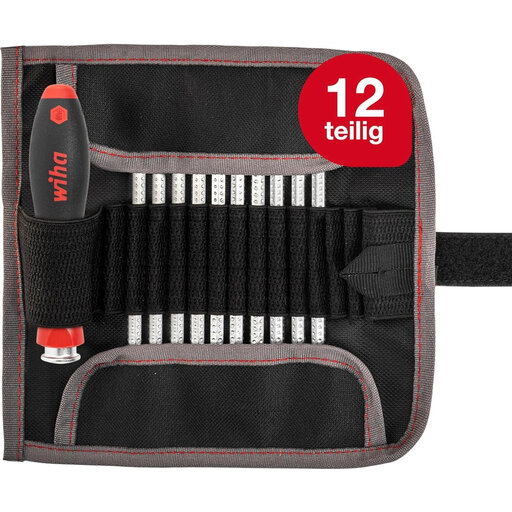
Why it suits this profile: The interchangeable blades save space and offer a practical solution for regular maintenance and assembly.
The set specifies hardened chrome vanadium steel, a locking button and an adjustable shaft length from 18 to 90 mm.
Compact 11-piece set with Phillips, slotted and Torx bits in a storage pouch.
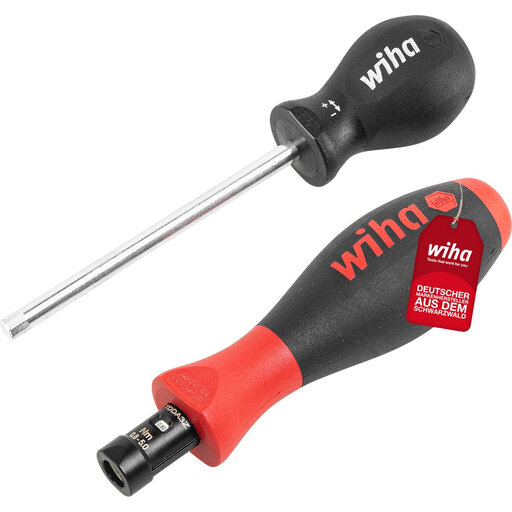
Why it suits this profile: A torque screwdriver is suitable when a fixed torque is important, for example during assembly, maintenance or installation.
The adjustment range of 0.8 to 5.0 Nm is specified. According to the manufacturer, the stated accuracy is ±6%; always check that this range is suitable for your application.
Adjustable torque, a click signal when the setting is reached and a factory inspection report.
We have compiled a complete, up-to-date list of products that fully meet these strict selection criteria and the applicable European safety regulations.
Choose a precision screwdriver set with small Phillips, slotted and Torx sizes. For laptops, phones, glasses and watches, PH000 to PH0 and T5 to T8 are often relevant. Always check the device’s exact screw type first.
Its lifespan depends on the material, frequency of use, force applied and storage. Do not use a precision set for heavy-duty bolts, and do not use bits as levers. Wipe the tools dry after cleaning and replace components as soon as the tip becomes deformed or damaged.
No. A ratcheting screwdriver is practical for repeated screwdriving and confined spaces, but a fixed screwdriver can provide more direct control. For precise tightening, choose a torque screwdriver; for electrical work, you need a suitable VDE version.
