
Parents working to a tight drying deadline
If you wash uniform items at the weekend, consider how many garments can hang freely at once and whether there’s enough time for your chosen drying method. Check the care labels and ventilation options too.


Choose an airer based on how many uniform items need to hang at once, the floor and storage space available, and the care instructions on the garments. A heated airer may be an option when time is short, but it uses electricity and cannot guarantee that a load will be dry before the working week; Milieu Centraal recommends ventilating when drying clothes indoors. If you’re considering an electric model, check its instructions, the mains voltage for that specific product and its CE marking before choosing.
If you wash uniform items at the weekend, consider how many garments can hang freely at once and whether there’s enough time for your chosen drying method. Check the care labels and ventilation options too.
Compare the space an airer takes up when opened with the room you have to store it after use. Also check that longer garments can hang freely.
If you want to follow the care label or don’t need built-in heat, an unheated airer may be suitable if you have enough time to dry your clothes. Milieu Centraal recommends drying clothes outdoors or in an unheated room where possible.
Suitable if: you want to spread out individual uniform items and have enough floor width.
Bear in mind: according to the manufacturer, the Silvergear winged airer reviewed has 20 heated bars and a power rating of 230 W. These specifications don’t predict how long your load will take to dry.
Suitable if: floor space is limited and you can spread your uniform items across several levels.
Bear in mind: according to the manufacturer, the Silvergear model reviewed has a power rating of 300 W. That figure alone doesn’t prove it will dry clothes faster or cost less per load.
Suitable if: you have enough time and can put the airer somewhere with good ventilation.
Bear in mind: there’s no built-in heat, and the actual drying time depends on the conditions and the space between garments.
First choose the airer style and how much hanging space you need. Then consider whether you need heat and the care instructions for each garment. Milieu Centraal points out that moist air needs to be removed when drying clothes indoors.
| What to consider | What to look for | Who should pay particular attention? |
|---|---|---|
| Getting clothes dry in time | Compare the usable hanging space and check whether the items you need can hang freely without overlapping. | If I need uniform items dry before the working week, I want plenty of space to hang them rather than relying on a promise about drying times. Around 39% of consumers put meeting a drying deadline first when choosing what to buy. |
| Space at home | Measure the available floor and storage space, and check that longer garments will fit. | If I have limited floor space, I want to know whether the airer is practical when opened and can be put away after use. Around 23% of consumers put the space an airer takes up first. |
| Electricity use | For heated airers, check the stated power rating and expected running time, then compare these with how long an unheated airer will be in use. | If I want to factor in electricity use, I need to weigh up heating against the time available for drying. Around 23% of consumers name running costs as their top priority when buying. |
| Care for your clothes | Check the drying label on each garment and follow the instructions for the specific appliance before using direct heat. | If I want to dry uniform items in line with their care labels, I check which drying methods are allowed for each garment. Around 15% of consumers make garment care their top priority when buying. |
The stated power rating alone doesn’t tell you how much electricity a drying session uses; how long the airer is switched on also matters.
Compare the power rating and running time for the way you intend to use the airer. Don’t treat a calculated running time as proof of a particular drying time.
Clothes dried indoors release moisture. Milieu Centraal warns that poor ventilation can lead to damp and mould.
Before you buy, decide where the airer can go and how moist air will be removed from that space.
Drying symbols distinguish between different drying methods. An instruction about tumble drying doesn’t automatically tell you whether direct contact with heated bars is suitable.
Check the full care label for each garment and the instructions for your chosen appliance before using heat.
The models reviewed include a heated winged airer and a heated tower airer.
The Classic 250 Flex reviewed is an unheated airer with adjustable drying space.
The white HangOn Too airer reviewed is a foldable, unheated option for natural drying.
These Joybuy picks are airers for hanging or spreading out clothes; the range also includes an electrically heated model. When choosing, consider where you’ll put it, the hanging space and the drying instructions for your uniform items.
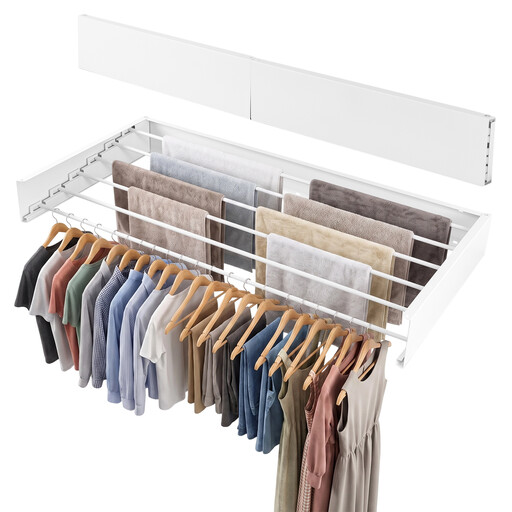 No image available
A good fit if you want to dry clothes on the wall and keep the floor clear.
The product description lists six bars, a 15 kg load capacity and dimensions of 100 × 50 cm when extended. Wall mounting requires drilling.
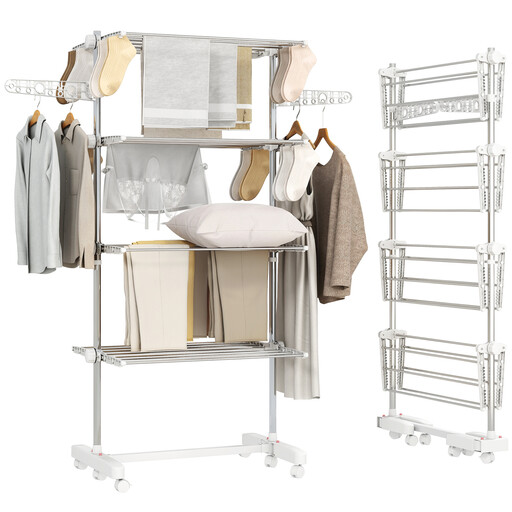 No image available
A good fit if you want to spread clothes across several levels and fold the airer away after use.
The product description lists four main shelves, two rotating side wings and six wheels. The stated maximum load is 30 kg, with up to 6 kg per shelf.
 No image available
A good fit if you’re looking for an electrically heated airer with side wings that folds away after use.
The product information gives dimensions of 144 × 53 × 91 cm and a recommended maximum load of 10 kg. The instructions specify a stable, level indoor setup and a distance of at least 31 cm from walls. Check the mains voltage and CE marking for this exact model before buying.
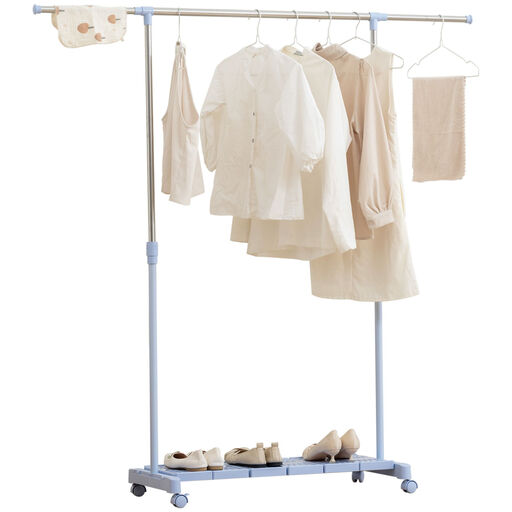 No image available
A good fit if you want to adjust the width and height to suit the space available.
The product description lists an adjustable width of 94–159 cm, an adjustable height of 93–168 cm and a maximum load capacity of 15 kg. The airer has wheels; don’t place it near a heat source.
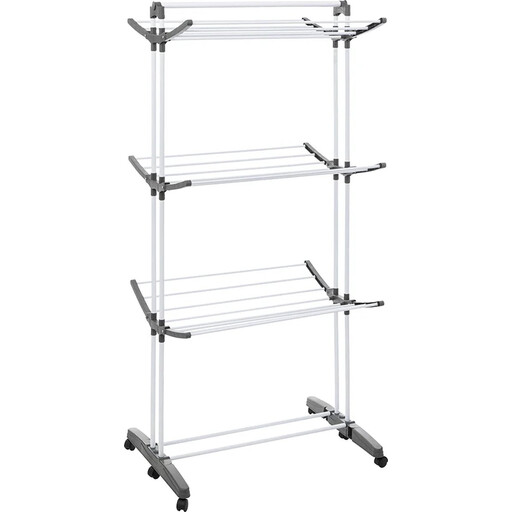 No image available
A good fit if you want to hang several garments and fold the airer away after use.
The product title lists 24 m of drying line and dimensions of 125 × 62 × 172 cm. The product description mentions a metal, foldable design with wheels.
Not based on that symbol alone. GINETEX distinguishes between tumble drying and natural drying methods, such as hanging or drying flat. Check the full garment care label and the heated airer’s instructions before putting the garment in direct contact with warm bars.
Make sure moist air is removed. Milieu Centraal warns that poor ventilation can lead to damp and mould; heating or an airer cover doesn’t replace ventilation.
Follow the instructions for the exact model. The product instructions for one heated winged airer include setting it up on a stable surface indoors, checking the mains voltage and unplugging it before cleaning. The stated clearances and other model-specific instructions don’t automatically apply to every airer. The Fire Service also provides general advice on safe connections and allowing heat from appliances to escape.
In the Netherlands, the seller is responsible for the statutory guarantee if a product is faulty. For online purchases, there is generally a statutory 14-day cooling-off period after delivery, subject to legal exceptions. A commercial guarantee doesn’t replace these rights. The Netherlands Authority for Consumers and Markets explains these consumer rights.
CE marking is required for electrical products covered by the Dutch low-voltage rules. The Netherlands Food and Consumer Product Safety Authority gives a nominal AC voltage range of 50 V to 1000 V for the Low Voltage Directive. Check the applicable mains voltage and product details for the specific model: the rule alone doesn’t prove that a particular airer complies with it.