
If a sharp crease is your priority
You want to press a neat crease into your school trousers, so look for temperature and steam settings that suit the care label. The Consumentenbond recommends checking the care instructions before ironing.


If you only need to iron one pair of school trousers and have little storage space, a standard steam iron is a more practical choice than a steam generator. You’ll also need a suitable ironing surface to create a neat crease. The Consumentenbond cites limited storage space and smaller loads as reasons to choose a standard iron. First, check the care label: GINETEX and the Consumentenbond point out that the permitted temperature and use of steam depend on it. If you regularly have a lot of ironing to do for several housemates, a steam generator’s larger tank may still come in handy, provided you have room for it.
You want to press a neat crease into your school trousers, so look for temperature and steam settings that suit the care label. The Consumentenbond recommends checking the care instructions before ironing.
You share a small home and want an appliance you can put away after a quick ironing session. The Consumentenbond cites limited storage space as a reason to consider a standard steam iron instead of a steam generator.
You regularly iron several garments and are weighing up a larger tank and fewer refills against the space the appliance takes up. A steam generator may suit larger loads, provided you have room for the base unit and a suitable ironing board.
Best for: ironing a pair of school trousers now and then when storage space is limited.
The trade-off: a smaller tank may mean you need to refill it sooner during a longer ironing session.
Best for: ironing larger loads frequently, with enough room for a base unit and suitable ironing board.
The trade-off: the base unit takes up extra storage space and may be more than you need for one pair of trousers.
Best for: steaming creases out of hanging clothes and avoiding an ironing board.
The trade-off: a handheld steamer works vertically and doesn’t provide the horizontal pressure you need to press a crease into trousers.
Start with the finish you want and the care label. Then choose an appliance you can use safely and store away easily.
| What to consider | What to look for | Who should consider this? |
|---|---|---|
| Creases and wrinkles | Check whether you can adjust the temperature and steam, and whether you can iron without steam. The Consumentenbond recommends following the care instructions. | If you mainly want to press a neat crease into one pair of school trousers, control over temperature and steam is important. Around 26% of consumers prioritise a sharp crease. |
| Storage space | Check the dimensions and think about where you can safely store the appliance and a suitable ironing surface. The Consumentenbond cites limited space as a reason to consider a standard iron. | If you live in a small shared home, you’ll want to be able to put the appliance away easily after a quick ironing session. Storage space is the main concern for around 21% of consumers. |
| Protecting the fabric | Read the trousers’ care label and check that you can set the recommended temperature and steam level. GINETEX states that a maximum of 110 °C means ironing without steam. | If your trousers may have different care instructions, you’ll want to adjust how you iron them accordingly. Around 21% of consumers prioritise protecting the fabric. |
| Safe use by housemates | Check whether the exact model variant has an automatic shut-off function and follow the instructions for use. Never leave an iron plugged in and unattended. | In a shared space, you’ll want to avoid leaving a hot appliance plugged in if someone gets distracted. Safe use is the main concern for around 16% of consumers. |
| Buying and maintenance | Consider whether you’ll also need a suitable ironing surface, and check how to descale your chosen model. Philips says limescale can build up more quickly in hard water. | If you mainly iron one pair of trousers, you won’t want to buy a larger appliance or take on more maintenance than you need. Around 16% of consumers prioritise buying and maintenance. |
A handheld steamer works vertically and doesn’t provide the horizontal pressure of an iron. It removes creases in a different way from pressing trousers flat.
Choose based on the result you need: steaming creases out of hanging clothes or pressing trousers on a suitable surface.
If a handheld steamer doesn’t create the crease you want, you may still need an iron and a suitable ironing surface.
Too high a temperature can damage the fabric or make it shiny. The GINETEX symbol for a maximum of 110 °C means ironing without steam.
Check the trousers’ care label and adjust the temperature and steam accordingly.
Fabric damage can be permanent.
Even if a model has automatic shut-off, Tefal’s product information warns you not to leave the iron plugged in and unattended.
Check the function on the exact variant, unplug the iron after use and leave it to cool down safely.
The 3000 Series includes standard steam irons for smaller loads; features vary by model.
Easygliss Plus is a range to consider if you’re looking at a standard steam iron with adjustable steam.
TexStyle 3 models have different features; the SI 3055 black is one example.
The 322890 is a standard steam iron to consider if you’re looking at a smaller tank.
This selection features irons for everyday ironing, including models for those looking for adjustable temperature and steam or a tank suited to shorter ironing sessions.
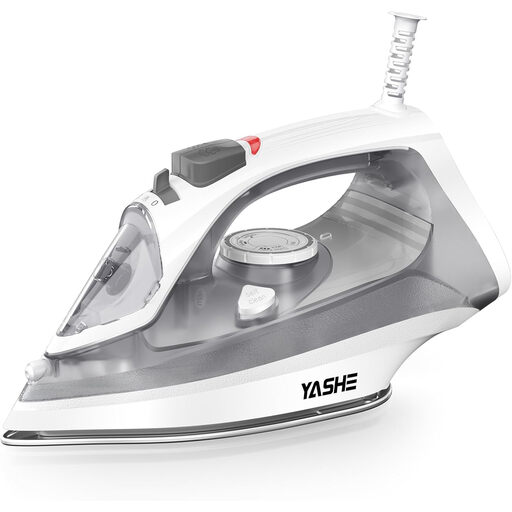 No image available
For everyday steam ironing, with temperature and steam settings you can adjust to suit the care label.
The product name lists 2300 W, a 300 ml tank, a non-stick soleplate, continuous steam of 25 g/min and a steam boost of 150 g/min.
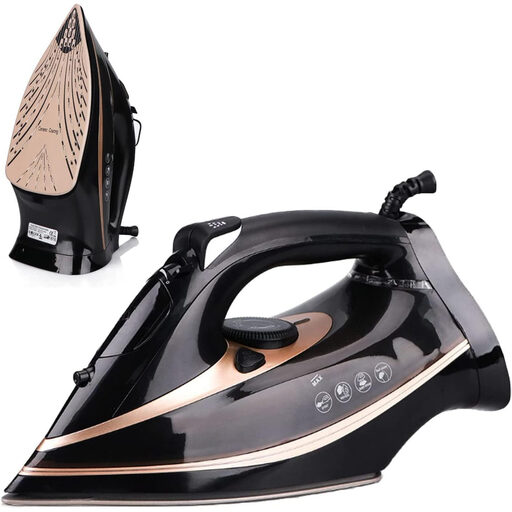 No image available
A standard iron to consider if you’re looking for a ceramic soleplate and a water tank.
The product name lists steam output of 70 g/min, a steam boost of 120 g/min and a 300 ml tank. Self-cleaning is also listed.
 No image available
A model to consider if you’re weighing up a non-stick soleplate and maintenance features for everyday ironing.
The product name lists 2400 W, automatic cleaning and an anti-drip system.
 No image available
Suitable if you want to adjust the temperature and steam to suit the care label; the product information says both can be set manually.
For the FV5736E0, Tefal lists continuous steam of 45 g/min, a steam boost of 220 g/min and automatic shut-off. Check the exact variant and never leave the appliance plugged in and unattended.
 No image available
An option to consider if you’re looking for a compact, lightweight handheld iron. Check that its shape and controls suit the crease you want to create.
The product name lists dual voltage. The product information mentions manual temperature and steam controls, as well as dry and steam ironing.
No. Check the trousers’ care label before using steam. According to GINETEX, the symbol for a maximum of 110 °C means ironing without steam; don’t iron the garment if the label says not to.
Only use steam once the iron is hot enough, and follow the instructions for your chosen model. Follow the model-specific descaling instructions too; Philips says limescale can build up more quickly in hard water.
For a consumer purchase, the seller is your point of contact for your statutory guarantee. The Dutch Government says there is no fixed statutory guarantee period in the Netherlands: what you can expect from a product depends, among other things, on the product, its price and whether it is new or second-hand. For a standard online consumer purchase, you’ll usually also have a 14-day cooling-off period after delivery, subject to legal exceptions; ACM ConsuWijzer explains how this works.
Yes. Electrical equipment covered by the applicable European low-voltage rules must have a CE mark before it is placed on the market. The Dutch Government and EUR-Lex explain manufacturers’ obligations; when buying, check the marking and documentation for the exact product variant.