
The cautious tie ironer
You want to remove creases, but the shape of the school tie and its care instructions come first. GINETEX and the Consumentenbond stress the importance of checking the care label.


For a few ties whose care label allows ironing, a compact steam iron with temperature control is usually a practical choice. A garment steamer may suit light creases when you don’t need pressing pressure, while a steam generator makes most sense if you also iron larger loads of laundry. GINETEX stresses that the maximum ironing temperature depends on the care label, not just the type of fibre.
You want to remove creases, but the shape of the school tie and its care instructions come first. GINETEX and the Consumentenbond stress the importance of checking the care label.
You iron a few ties after school, and perhaps some clothes too. A compact appliance and minimal set-up may matter more than a large water tank; the Consumentenbond describes compact steam irons as an option for shorter ironing sessions.
As well as ties, you regularly iron larger piles of cotton clothing. The amount of laundry, tank capacity and space to store the appliance all come into play.
Best for: a few ties whose care labels allow ironing, and possibly other cotton school clothes.
Bear in mind: the hot soleplate and pressure require care around seams, lining and the tie’s shape.
Best for: light creases if the care label allows steaming and you don’t need a crisp pressed finish.
Bear in mind: Brabantia says a handheld steamer is less effective than ironing at smoothing stubborn creases.
Best for: longer ironing sessions when you have plenty of other laundry to tackle too.
Bear in mind: a larger appliance needs more storage space; you may not need that capacity for just a few ties.
GINETEX advises following the maximum temperature shown on the care label. Also check that the label allows steaming before you use steam.
| What to consider | What should you check? | Who is this important for? |
|---|---|---|
| Fabric, lining and shape | Read the care label and only use a permitted temperature; check whether you can reduce or switch off the steam. | I want to make sure the whole tie can withstand the heat setting I choose; protecting the fabric and shape comes first. Around 33% of consumers prioritise protecting the fabric, lining and shape. |
| Quick ironing session | Compare the appliance size, stated heat-up time, ease of filling and whether you need an ironing board. | I want to tackle a few ties after school without much preparation or storage space. Around 27% of consumers mainly prioritise a quick, short ironing session. |
| Creases in cotton | Compare continuous steam output in g/min separately from the steam boost; also consider how much other laundry you iron. | I also iron cotton school clothes and want them smooth, not just the tie. Around 20% of consumers prioritise results on cotton. |
| Pauses while ironing | Check whether the exact model has an automatic shut-off function and follow the instructions for use. | I want to allow for interruptions in a busy household and choose an appliance that’s safe to handle. Around 13% of consumers prioritise safe use. |
| Maintenance | Check the descaling method, the type of water allowed and whether any replaceable parts are needed. | I want to know what maintenance the appliance needs and whether I’ll have to replace any parts. Around 7% of consumers mainly prioritise easy maintenance. |
The outer fabric doesn’t tell you what temperature the whole tie can withstand. According to GINETEX, the care label determines the maximum ironing temperature.
Read the label before you start and set the temperature and steam according to the care instructions.
They’re different product specifications. A high steam boost alone doesn’t prove that an appliance is better for ironing a tie with care.
Compare the continuous steam output in g/min separately from the steam boost, and bear in mind what the care label allows.
An anti-scale system can slow the build-up of limescale, but maintenance is still needed. Some systems use replaceable cartridges.
Check how to descale the exact model and whether any parts need replacing.
The TexStyle 3 range includes compact steam irons, such as the SI 3041 GR.
The Easygliss Plus FV5736 is a steam iron for anyone who also irons everyday laundry.
The PerfectCare PSG7200/20 represents the steam generator option for households that also iron plenty of other laundry.
The Autosteam DW4020D1 is a steam iron with automatic steam and temperature control.
The products below are steam generators for longer ironing sessions, for example if you iron larger loads of laundry as well as ties.
 No image available
This steam generator is suited to longer ironing sessions alongside ironing ties; always follow the care label for the tie.
The product name lists a 1.4 L tank, a 350 g steam boost and 2400 W power.
 No image available
This model is a steam generator for anyone tackling larger loads of laundry as well as ties; check the care label before ironing a tie.
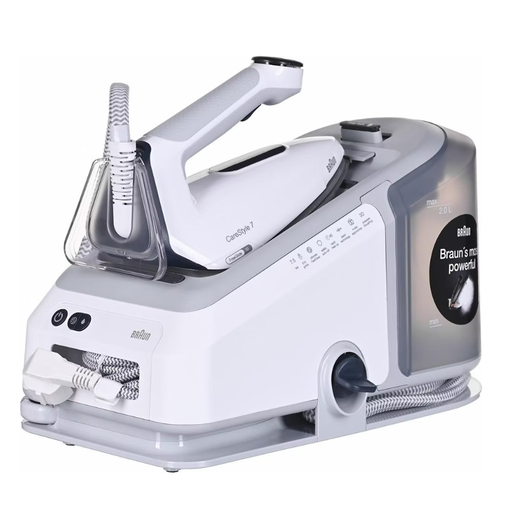 No image available
This ironing system is suited to longer sessions with other laundry as well as ties; always follow the tie’s care instructions.
The product name identifies it as a steam ironing system.
 No image available
This steam generator is designed for longer ironing sessions; the care label must allow ironing or steaming before you use it on a tie.
The product name lists a 1.8 L tank, a 120 g steam boost, a steam output of 70 g and a pressure of 6 bar.
Not based on the outer fabric alone. Follow the maximum ironing temperature and any steam restrictions on the care label for the whole tie; if ironing isn’t allowed, don’t use a hot iron setting.
Only use steam if the care label allows it, apply it sparingly and let the fabric dry. The Consumentenbond warns that repeated use of the steam boost can make textiles too wet; if ironing is allowed, it advises ironing without steam after steaming.
Check the manual for the exact model. According to the Consumentenbond, steam irons are generally designed for tap water and still need descaling; additives in ironing water can cause problems or stains.
For a standard online consumer purchase in the Netherlands, there is generally a statutory 14-day cooling-off period from delivery. Check before buying whether any relevant exception applies.