What should you consider when choosing?
For headshots, your choice depends on more than the camera body alone. The Consumers’ Association highlights the combined effect of the lens and sensor, while Canon Netherlands identifies lighting and composition as separate factors to consider.
| Factor to consider |
What to check before buying |
Who is this most important to? |
| Lighting and portrait style |
Check the maximum aperture of the included lens and take some test shots at your intended location. |
If I’m shooting indoors, I want to assess how the light and background affect my portraits. Around 33% of consumers prioritise lighting and portrait style. |
| Sharp eyes and ease of use |
Check whether the exact model has eye or face detection for photos, and whether the screen and controls suit your set-up. |
When shooting a series of headshots, I want to check that the eyes are in focus and operate the camera easily. Around 27% of consumers prioritise focusing and ease of use. |
| Complete kit |
Compare the camera body with the lens actually included in the kit. Check separately whether you’ll need a memory card or additional lighting. |
If I’m buying a camera for one school project, I want to know what complete kit I need. Around 20% of consumers prioritise the cost of their complete equipment set-up. |
| Carrying and setting up |
Check the weight and screen of the exact model, and assess the camera-and-lens combination as a whole. |
When I’m shooting in different places around school, I want to be able to carry and set up my equipment easily. Around 20% of consumers put portability first. |
Mirrorless camera with standard zoom lens
Best for: taking both headshots and wider portraits with one lens. Canon Netherlands explains how focal length affects composition.
Trade-off: the maximum aperture depends on the specific lens and zoom setting. A standard zoom won’t automatically give you the background blur of a fast portrait lens.
Mirrorless camera with a faster portrait lens
Best for: shooting indoors often or deliberately aiming for more background blur, and having room in your budget for a suitable lens.
Trade-off: with a prime lens, you may need to change your shooting distance. A separate lens can also add to the cost of your complete kit.
Camera you already own or a compact camera
Best for: a one-off project where you first want to find out whether equipment you already own can give you the framing and sharpness you’re after.
Trade-off: lenses, sensors and maximum apertures vary by model. Without knowing the exact model, it isn’t possible to compare it with a specific mirrorless camera kit.
Cameras at Joybuy
The selection includes compact cameras and mirrorless cameras with zoom lenses. Before choosing a kit, compare how you plan to use it, its controls and the included lens.
 No image available
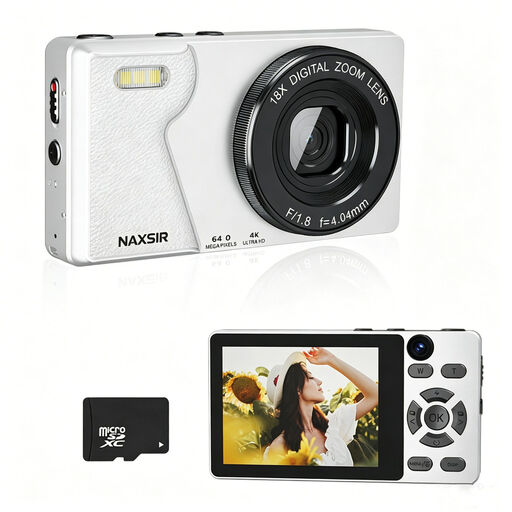
NAXSIR digital camera, 4K Ultra HD, 64 MP, 18× digital zoom, autofocus and 32 GB card
A compact camera with autofocus and an included memory card. Before buying, check that its controls and framing suit your headshots.
The product name lists 4K Ultra HD, 64 MP, 18× digital zoom, autofocus and a 32 GB memory card.
Joybuy
 No image available
DJI Osmo Pocket 3 Creator Combo
The product description mentions photography and fast focusing. Check whether the rotating screen suits the camera position you’ll use for your project.
The description lists a 1-inch CMOS sensor and a 2-inch rotating touchscreen.
Joybuy
 No image available
DJI Osmo Pocket 3
The product description mentions photography and fast focusing for stills. Check whether the controls suit the way you want to take headshots.
The description lists a 1-inch CMOS sensor, 4K/120fps video, 3-axis stabilisation and a 2-inch rotating touchscreen.
Joybuy
 No image available
Sony ZV-E10 with 16–50mm zoom lens
The included zoom lens lets you try different portrait framings. The product description also mentions Real-time Eye AF.
The lens is listed as a 16–50mm f/3.5–5.6 OSS. The description also mentions a vari-angle screen.
Joybuy
 No image available
Sony Alpha A6100 with 16–50mm f/3.5–5.6 OSS II lens
The kit includes a zoom lens for different portrait framings. The product description mentions Real-time Eye AF for people.
The title lists a 16–50mm f/3.5–5.6 OSS II lens. The description also mentions a touchscreen and electronic viewfinder.
Joybuy
Frequently asked questions
Do you always need a fast lens for a headshot?
No, not always. Start by considering the available light, shooting distance and framing you want. A suitable faster lens may be useful if you often shoot in low light or want more background blur, but it won’t replace good lighting on the face.
How can you create a simple, repeatable portrait set-up?
Choose a simple background, take some test shots and check the lighting on the face and focus on the eyes. Canon Netherlands explains how the position of the key, fill and background lights can change the look. Using several flash units is one possible set-up, not a requirement for every school project.
What should you check when buying, and what should you do if something is faulty?
Before buying, check exactly what’s included in the kit and keep your proof of purchase. If a product is faulty, the seller must provide a solution. According to the Dutch government, there is no fixed statutory two-year guarantee period for all products in the Netherlands.
Can a school publish identifiable portraits of pupils?
Not automatically. According to the Dutch Data Protection Authority, a school must ask for permission to take and publish identifiable images from pupils aged 16 or over, and from parents if the pupil is under 16. This applies to the processing described by a school. The term ‘school project’ alone doesn’t mean that every private photo or use involves the same activity.


