
Families who plan lunch in advance
If you’d rather not buy rolls every day, consider part-baked or frozen rolls and plan when to prepare them. Fresh rolls from a shop are a good choice when you want to serve them straight away.


For a school-holiday lunch for children, wholemeal or brown rolls are a sensible first choice: the Netherlands Nutrition Centre recommends wholemeal and brown bread for primary school children’s lunches. Then choose between fresh, part-baked and frozen rolls depending on when you want to serve them, and check the ingredients, allergens and preparation instructions for each product. If you need sliced rolls, don’t assume they’re pre-sliced—check first.
If you’d rather not buy rolls every day, consider part-baked or frozen rolls and plan when to prepare them. Fresh rolls from a shop are a good choice when you want to serve them straight away.
When choosing between white, brown, wholemeal and multigrain rolls, check the ingredients list and fibre per 100 g. The Netherlands Nutrition Centre recommends wholemeal or brown bread for primary school children’s lunches.
If you need a gluten-free product, choose a roll that is clearly labelled gluten-free. Also check the current allergen information: gluten-free doesn’t mean free from other allergens.
First decide which ingredients and nutritional information matter for your lunch. Then choose a product type to suit when you’ll serve it, and check for allergens before you buy.
| What to consider | What to check before buying | Who is this important for? |
|---|---|---|
| Ingredients and fibre | Check whether wholemeal flour is a main ingredient and compare the fibre per 100 g. Check the ingredients list for baker’s salt if that matters to your choice. | For my child’s lunch, I want to know which flour has been used and how much fibre the roll contains. For around 46% of consumers, this nutritional information would be the top priority when buying. |
| Preparation and storage | Check whether the rolls are fresh, part-baked or frozen, and read the preparation and storage instructions. | If lunchtime varies, I want to be able to plan the rolls without forgetting the baking or defrosting time. For around 36% of consumers, preparation and storage would come first. |
| Gluten and allergens | Read the current label or ask about allergen information for loose rolls, including any ‘may contain’ statements. | If someone at the table needs to avoid an ingredient, I want to be able to check the allergen information before buying. This would be the main requirement for around 18% of consumers. |
Rolls don’t automatically come sliced. If you need them sliced for fillings or smaller portions, it can make a difference when preparing lunch.
Ask whether the shop can slice fresh rolls for you. For packaged rolls, check the product information or allow time to slice them yourself.
Fibre content varies from product to product. Albert Heijn lists 7.1 g of fibre per 100 g for the wholemeal roll reviewed; PLUS lists 7 g for its multigrain part-baked rolls and 2.7 g for its white part-baked rolls.
Compare the ingredients and fibre per 100 g on the current packaging rather than relying on the product name alone.
According to the product information, Albert Heijn’s gluten-free white rolls may contain egg, milk, soya, almond and hazelnut, among other things.
Check the current allergen statement and any ‘may contain’ notices for ingredients the person eating them needs to avoid.
Jumbo says its brown frozen rolls must not be refrozen after defrosting.
Defrost the amount you expect to use for lunch and follow the storage instructions on the packaging.
Offers, among other products, fresh rolls sold individually and a separate gluten-free part-baked option.
Offers a brown, pre-baked frozen option in a pack of four.
Offers part-baked rolls, including white and multigrain options.
Lists 1 de Beste white rolls as part-baked rolls in a pack of four, weighing 300 g in total.
Lists an individual white roll as a white wheat roll, available in store only.
This pack of four white rolls is a handy choice if you want to stock up for lunch. Before buying, check that the slicing and preparation requirements fit your plans.
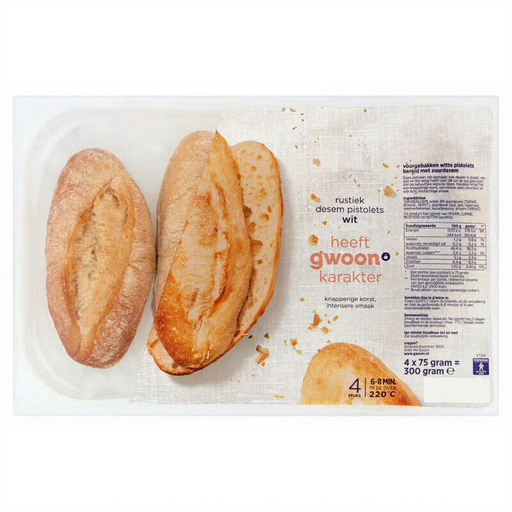 Image unavailable
A pack to help you plan rolls for lunch at home. Check whether they’re sliced, how they need to be prepared and which allergens are listed on the current packaging.
Wholemeal or brown rolls are a good place to start: the Netherlands Nutrition Centre recommends wholemeal and brown bread for primary school children’s lunches. Then compare the ingredients and fibre per 100 g, and choose a product type that suits your lunchtime.
Not all of them; it depends on the product. Albert Heijn lists a fresh roll available in store, while PLUS gives baking instructions of 8 to 10 minutes in the oven or 4 minutes in an air fryer for the multigrain part-baked rolls reviewed. Read the current instructions before planning lunch.
If allergen information isn’t clearly available for loose rolls, ask for it before buying. The Netherlands Food and Consumer Product Safety Authority says allergen information must be available for unpackaged foods. For packaged rolls, read the current label, including any ‘may contain’ statements.
Don’t assume so. The Netherlands Nutrition Centre recommends choosing bread made with baker’s salt if iodine is a concern. Check the current ingredients list for each roll for baker’s salt or iodised salt.