
Students with bound journals
If your book doesn’t lie flat easily, focus on how the scanner handles the spine. CZUR, Ricoh, IRIS and Plustek describe models or features for scanning books.


For a bound travel journal that won’t lie flat easily, an overhead scanner designed for books is a better fit: you don’t have to place each page on a glass platen. A flatbed may suit you if you can position individual pages flat on the platen. With either type, check the scan size, software and how text and images are captured near the book’s spine.
If your book doesn’t lie flat easily, focus on how the scanner handles the spine. CZUR, Ricoh, IRIS and Plustek describe models or features for scanning books.
If you mainly need text for your project, check whether the software can create a searchable file, then compare recognised quotations with the scan. IRIS describes OCR output; the KB, the national library of the Netherlands, explains that the quality of the source page affects text recognition.
If you also want to capture images and pages in different sizes, measure your largest original and check the scanning area. IRIS and Canon describe scanning options for different sizes, but a larger scanning area doesn’t in itself say anything about image quality.
Choose this if: your journal is bound or doesn’t lie flat easily.
Bear in mind: book correction doesn’t remove the need to check that text and images remain legible near the spine.
Choose this if: you can position individual pages on a glass platen.
Bear in mind: you’ll need to place the book on the platen for every scan. Check that the software supports the specific model too.
Choose this if: you mainly scan loose pages or pages that lie sufficiently flat.
Bear in mind: an A3 scanning area doesn’t automatically mean curved book pages will be corrected.
For travel journals used in a school project, your choice mainly depends on the binding, the text recognition you need and the size of the pages or pasted-in items.
| What to consider | What should you look for? | Who is this important for? |
|---|---|---|
| Bound pages | Check for book correction and look at a test scan close to the spine. | If I don’t want to press my journal flat, I look at how pages near the binding are captured. Around 37% of consumers prioritise preserving a bound journal. |
| Searchable text | Check whether the software creates a searchable PDF and test it with your pages. | If I want to find quotations in my project, I check the recognised text against the page image. Around 27% of consumers prioritise searchable text. |
| Images and size | Measure the original and compare its size with the stated scanning area. | If I want to preserve photos or pasted-in items, I look at both the detail and the space available on the scanning bed. Around 18% of consumers prioritise images and size. |
| Small-scale project use | Work out how many pages you’ll scan and whether a standard flatbed will be suitable for your flat pages. | If I’m only scanning a few pages that lie flat, I want to choose features that suit the way I’ll use the scanner. Around 18% of consumers prioritise occasional project use. |
An A3 scanning area doesn’t prove that a model can correct curved pages in a bound journal.
Check the features of the exact model and look at a test scan of a page near the spine.
The KB, the national library of the Netherlands, explains that the quality of the source material affects OCR. Recognised text may therefore differ from what’s on the page.
Keep the page images and check every quotation you submit against the original.
Plustek’s specifications for different regions vary in their stated operating system support. You should also distinguish between the manufacturer’s warranty and your rights with the retailer.
Check the software for the exact model and consult information that applies to your purchase in the Netherlands.
CZUR describes its ET series as designed for books, with curved-page correction. The Shine 800 A3 Pro is intended mainly for flat originals.
Ricoh describes the SV600 as a contactless overhead scanner for books and other materials up to A3 size.
According to IRIS, the Desk 6 Pro combines overhead scanning of books up to A3 with OCR output.
The OpticBook 4800 with eBookScan is a book-oriented flatbed for anyone who can position pages on a glass platen.
Canon describes the CanoScan LiDE 400 as an A4 flatbed for loose pages or pages that lie sufficiently flat.
These product recommendations are for pages that lie flat and loose sheets. Check that the scanning area is large enough, and bear in mind that a flatbed or sheet-fed scanner works differently from a book-oriented overhead scanner.
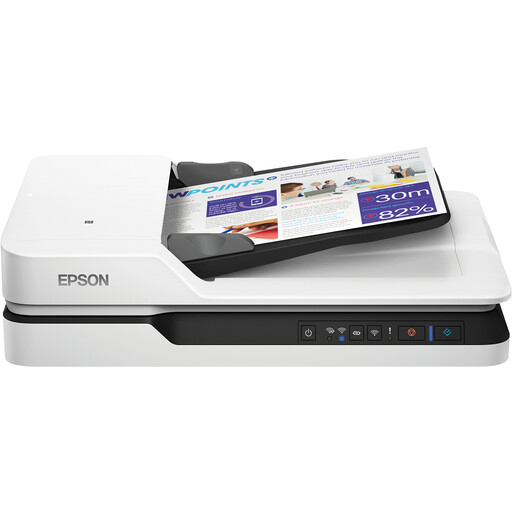 No image available
Could suit you if you can place your journal pages individually on the glass platen.
A4 size; the product information lists duplex scanning and 1200 × 1200 dpi. Check that your page fits on the scanning bed.
 No image available
Suitable for scanning flat sheets when you need A3 coverage and OCR output.
The product information lists support for flat sheets up to A3, OCR output as editable text, and compatibility with Windows and macOS. The description advises against scanning highly reflective materials, such as glossy photos. There’s no evidence that this model has book-spine correction.
Not necessarily: manufacturers describe some book-oriented overhead scanners as offering contactless capture and/or book correction. Check with a test page that the text near the spine remains legible. With a flatbed, you place the book on the glass platen.
Choose software that can create a searchable PDF and check the recognised words against the page image. The KB, the national library of the Netherlands, points out that the quality of the source material affects OCR, so check quotations from difficult-to-read text too.
Check that the software works with your operating system and the exact scanner model, that the original fits on the scanning bed, and how a test scan captures the page near the spine. Regional specifications for the Plustek OpticBook 4800 differ on operating system support.
No. According to the Government of the Netherlands, there’s no fixed period for the statutory guarantee in the Netherlands: what you can expect from a product depends on factors including the product and the circumstances. If a product is faulty, the retailer is your point of contact; a manufacturer’s warranty is separate.
The Government of the Netherlands distinguishes between making a private copy for personal use and distributing or publishing it: you can’t simply share or publish a private copy. So don’t assume you have general permission to include other people’s material in a shared or public school project. Get permission where necessary.