If you mainly scan individual, sturdy letters that fit on A4, a compact flatbed scanner is a sensible choice. For fragile paper or letters in a book or album, a contactless overhead scanner may be more suitable; a book-focused flatbed scanner still makes contact with the glass. Measure the space needed for both the paper and the scanner, and don’t assume OCR will recognise handwriting accurately.
Who are these scanners for?
Student with loose letters
You mainly scan individual sheets and want a scanner that takes up little permanent desk space when not in use. Epson lists a built-in stand for the Perfection V39II; Canon describes the CanoScan LiDE 400 as suitable for vertical use.
Keeper of fragile letters
You want to capture old or delicate letters without pressing them flat under a lid. ScanSnap describes the SV600 as a contactless scanner; also consider how much space the setup will take up in your room.
Reader of bound correspondence
Your letters are in an album or book, so the binding and page shape matter. CZUR describes the Aura as suitable for loose and bound pages; Plustek positions the OpticBook 3800L as a flatbed scanner with a book-edge design.
What should you look for when choosing?
Compact A4 flatbed scanner
Choose this if: you mainly scan individual, sturdy letters up to A4 and want to put the scanner away after use. Epson lists a built-in stand; Canon specifies a scan area of 216 × 297 mm.
Bear in mind: the paper must fit on the glass and is placed directly on the scanning surface.
Contactless overhead scanner
Choose this if: you want to capture fragile, irregularly shaped or bound pages without placing them under a lid. The manufacturers of the IRIScan Desk 6 Pro, CZUR Aura and ScanSnap SV600 describe them as overhead or contactless scanners.
Bear in mind: you’ll need space around the document; take a test scan to check sharpness and shadows.
Book-focused flatbed scanner
Choose this if: the letters are bound, but the book can rest safely on the glass. Plustek lists a 6 mm book-edge design and an A4 scan area for the OpticBook 3800L.
Bear in mind: the original still touches the scanning surface; don’t force the binding, and check that the scanner will fit on your desk.
| Consideration |
What to look for when buying |
Who is this important for? |
| Limited space and loose letters |
Check that the scan area suits the paper size and that you can put the scanner away after use. |
If I mainly scan loose A4 letters, I want to clear my desk after use without overlooking the scan area. Around 34% of consumers would put saving space when scanning loose letters first. |
| Fragile paper |
Compare contactless scanning with placing the paper on glass; consider how the original is handled during scanning. |
With fragile letters, I want to avoid unnecessary handling and pressure under a lid. Around 33% of consumers would prioritise keeping fragile originals intact. |
| Making handwriting searchable |
Check which output formats are available and test recognition using one of your own letters. |
If I want to search the text in my letters later, I want to be able to check for recognition errors in my own handwriting. Around 20% of consumers would prioritise searchable handwriting. |
| Letters in an album or book |
Measure an open page and check that the binding can be supported without forcing it. |
For bound correspondence, I want to capture the page near the spine without forcing the binding. Around 13% of consumers would prioritise scanning bound letters. |
Common mistakes
-
Assuming a searchable PDF means flawless handwriting recognition
The option to create a PDF doesn’t prove that names and words in your handwriting will be recognised correctly. The National Archives describes handwriting recognition as a separate process that involves training software using transcriptions.
Try recognition on a sample letter, keep the original scan and check the transcription before processing a larger archive.
Allow time for checking and any manual corrections.
-
Measuring only the scanner
With an overhead scanner, you’ll also need space for the entire sheet or open book. A flatbed scanner has a limited scan area.
Measure a typical letter or open album, then mark out the full scanning setup on your desk.
-
Assuming a book-edge scanner is contactless
A book-focused flatbed scanner scans through glass. It works differently from an overhead scanner, which scans without contact.
Choose based on how much handling the original can withstand; don’t force a fragile binding to flatten the page.
Brands to consider
Epson
The Perfection V39II is a compact A4 flatbed scanner, particularly suited to loose letters.
- Epson lists USB power and a built-in stand.
- It’s a flatbed scanner: check that the letter fits on the glass and that contact with the scanning surface is suitable for the original.
Canon
The CanoScan LiDE 400 is an A4 flatbed scanner that can be positioned vertically.
- Canon specifies a scan area of 216 × 297 mm and a Z-lid.
- The scanner works by placing the original on the glass. Don’t force a fragile book binding to lay the page flat.
IRIS
The IRIScan Desk 6 Pro is an overhead solution for letters and other documents.
- IRIS lists formats including JPG, image PDF, searchable PDF and text output.
- Searchable output doesn’t prove that handwriting will be recognised flawlessly; also allow for the space you’ll need to use it.
CZUR
The Aura is an overhead book scanner for loose sheets and bound pages.
- CZUR describes scanning loose sheets up to A3 and using software to correct curved book pages.
- These are manufacturer specifications, not independent measurements of image or handwriting recognition quality.
Plustek
The OpticBook 3800L is an A4 flatbed scanner with a book-focused edge design.
- Plustek lists a 6 mm book-edge design and dimensions of 453.5 × 286 × 98 mm.
- The scanner takes up desk space and the original touches the scanning surface.
ScanSnap
The SV600 is a contactless overhead scanner for documents including fragile and bound items.
- ScanSnap describes support for documents up to A3 and scanning without touching the original.
- Check that you have enough room for the scanning setup.
Scanners on Joybuy
These Joybuy product picks are aimed at loose letters and flat documents: an A4 flatbed scanner and a document scanner for flat sheets up to A3.
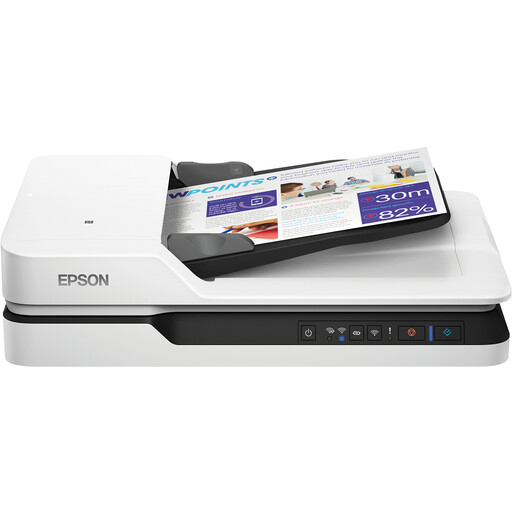 Image unavailable
Epson WorkForce DS-1660W A4 flatbed scanner, 1200 × 1200 DPI, Black, White
An A4 flatbed scanner to consider for loose letters that fit on the scanning surface.
A4 flatbed scanner; 1200 × 1200 DPI.
View on Joybuy
 Image unavailable
CZUR Shine 800 A3 Pro document scanner
A document scanner to consider for loose, flat letters within the stated size range.
According to the product name, it’s suitable for flat sheets up to A3 and features OCR; Windows & macOS compatibility is also listed. Test handwriting recognition with one of your own letters.
View on Joybuy
Frequently asked questions
Should I buy a book scanner for loose letters?
Not necessarily. If loose letters fit on an A4 scan area and can safely lie on glass, you could consider a compact flatbed scanner. Contactless scanning may be more suitable if you’d rather not place the original under a lid.
Can OCR make handwritten letters searchable without errors?
Don’t assume it can. A scanner first captures an image; the National Archives describes handwriting recognition as a separate process that involves training software using transcriptions. Test recognition on your own letters and check the text.
How can I set up scanning in a small room?
Measure both the device and the space where you’ll place the letter. Then check the scan area, the connection you’ll need and whether the software works with your computer. Keep the original image scan before applying text recognition.
Can I scan someone else’s handwritten letters and share them online?
Distinguish between keeping a copy privately and publishing it. The Government of the Netherlands states that copies of other people’s texts may be made for personal use; sharing them online is not automatically covered. The Dutch Data Protection Authority also describes conditions for the exception covering personal data published solely for personal or household use; a publication that is widely accessible is not covered.


