First, measure the map, including any borders and legend you want to keep. An A3 scanner is only suitable if the entire area you want to capture fits within its scanning area. Choose a contactless scanner if you want to avoid putting pressure on the original. If you need to examine fine details or compare locations, check the capture angle and distortion too. For larger maps, large-format digitisation may be a better option.
Who is this guide for?
Collectors with large, loose maps
If you want to capture the whole map, including its borders and legend, compare its size with the scanning area first. The University of Antwerp's scanning guidelines and Archive-IT's approach to large-format digitisation can help put your options into perspective.
People responsible for fragile atlases
For a fragile or bound original, consider how far the atlas can be opened safely and whether you can scan the page without putting unnecessary pressure on it. Ricoh's product information and the University of Antwerp's scanning guidelines cover relevant points about book scanning and distortion.
Map researchers working from home
If you want to read small place names or lines, or compare distances later, look beyond detail and consider skew and distortion too. The University of Antwerp highlights the need to avoid geometric distortion when digitising maps.
What should you consider?
Contactless A3 overhead scanner
Choose this option: if you don't want to place a bound or fragile map under a glass platen, and the area you want to capture fits within the supported scanning area.
Trade-off: a rippled map or skewed capture can distort its geometry; automatic correction is no guarantee of measurement accuracy.
Flatbed or book-edge scanner
Choose this option: if the map fits within the scanning area, or if you need to capture information close to an atlas's spine using a book-edge design.
Trade-off: a flatbed scanner requires contact with or handling of the original. If you're scanning an atlas, check how far it can safely be opened and laid flat.
Large-format digitisation
Choose this option: if the map is larger than the scanning area of suitable home devices and you want to capture it in one complete image.
Trade-off: Archive-IT offers digitisation of A2, A1 and A0 documents. Check in advance whether they can handle your map and how it will be treated.
The University of Antwerp highlights geometric distortion as something to consider when digitising maps. So compare not only scanner sizes, but also how the original will be captured and what you plan to use the scan for.
| Consideration |
What to look for |
Who should pay particular attention? |
| Capturing the whole map in one scan |
Measure the map, including the legend and any borders you want to keep; compare its dimensions with the actual scanning area. |
I want to preserve the map as a whole and avoid unexpectedly cutting off details. Around 33% of consumers make a complete fit their top priority. |
| Handling the original with care |
Decide whether the map can be opened and laid flat safely; compare contactless scanning with a book-edge design. |
For a fragile map or atlas, I want to minimise pressure and unnecessary handling. Around 27% of consumers make careful handling their top priority. |
| Detail and geometry |
Check a test scan for small text, lines, angles and distortion; don't rely on software correction alone. |
If I want to read place names or compare distances, the scan needs to show enough detail without stretching or skewing the image. Around 27% of consumers prioritise legibility or geometry. |
| Space and regular use |
Check the device's dimensions in use, computer and software compatibility, and whether the scanning process suits the number of maps you have. |
I want a practical setup for my hobby room that suits how often I scan maps. Around 13% of consumers give most weight to space and practical home use. |
Common buying mistakes
-
Assuming an A3 scanner will fit every map
A map that's larger than the scanning area won't fit in one scan. Scanning it in sections can make it harder to preserve the map, scale and legend as one whole.
Measure the entire area you want to capture and compare it with the stated scanning area, rather than relying on the A3 label alone.
-
Assuming automatic flattening guarantees accurate measurements
The capture angle and curve of the paper can affect proportions. A book-correction feature alone doesn't prove that a historical map will be captured with geometric accuracy.
If you plan to compare locations later, check lines and distances against one another in a test scan.
If distortion only becomes noticeable when you compare the image, you may need to scan it again or correct the image.
-
Choosing a fast scanner without considering the condition of the original
A bound atlas and a loose, flat sheet need different approaches to placing or opening them.
Put safe handling ahead of scanning speed, and choose an approach suited to how far the atlas can safely be opened.
Brands to consider
CZUR
CZUR describes the Shine 800 A3 Pro as suitable for loose, flat sheets up to A3, and its ET series as an overhead option for bound material.
- CZUR lists 8 MP and 205 dpi at A3 for the Shine 800 A3 Pro.
- The curve correction described by CZUR doesn't prove that a historical map will be captured with geometric accuracy.
Ricoh ScanSnap
According to Ricoh, the ScanSnap SV600 is a contactless overhead scanner for books, drawings and documents up to A3, among other things.
- Ricoh lists page-turn detection and book correction.
- The stated setup supports up to A3; check separately for distortion when scanning rippled maps.
Plustek
The OpticBook A300 Plus is a book-edge scanner designed for bound pages up to A3, among other uses.
- Plustek describes scanning close to the book spine and exporting to formats including TIFF.
- A book-edge design doesn't mean a larger map will fit in full or that a fragile atlas can be opened safely.
VIISAN
VIISAN describes the K36 as an overhead book scanner with A3 and A4 capture options.
- For A3, VIISAN lists a scanning area of 426 × 320 mm and an output of approximately 280 dpi.
- These manufacturer specifications aren't an independent assessment of colour or geometric accuracy.
Epson
The Expression 13000XL is an example of a graphics-focused A3 flatbed scanner.
- Epson lists a scanning area of 310 × 437 mm and device dimensions of 656 × 458 × 158 mm.
- Epson Netherlands lists the Expression 13000XL as discontinued. Use its specifications to compare flatbed and overhead setups, not as an indication that it's currently available.
Scanners on Joybuy
This selection includes a flatbed scanner for flat originals and an overhead scanner for loose, flat maps up to A3. Before buying, check that the scanning area and method suit your map.
 No image available
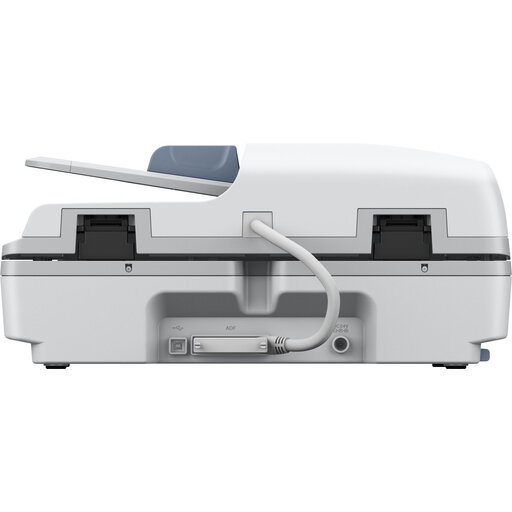
Epson WorkForce DS-6500 Power PDF
A flatbed option to consider for flat map originals. Check that the actual scanning area is large enough to capture the whole section you want.
The Joybuy product description lists 1,200 dpi horizontally and vertically, and 48-bit colour depth.
View on Joybuy
 No image available
CZUR Shine 800 A3 Pro
This overhead option is designed for loose, flat maps that fit within the stated A3 scanning area. Check the result for skew and distortion.
CZUR lists an 8 MP sensor and 205 dpi at A3. The product description also mentions a 90° folding design and a weight of 2.3 kg.
View on Joybuy
Frequently asked questions
Can I capture a map larger than A3 in one scan with an A3 book scanner?
Not if the entire area you want to capture falls outside the stated scanning area. Include the legend and borders in your measurements too; for larger originals, look into a suitable large-format solution.
How should I use an overhead scanner for maps I plan to compare spatially later?
Lay the map as flat as you safely can, taking care not to handle it beyond what is appropriate, and check a test scan for skew and perspective distortion. Ripples can leave some distortion even after software correction.
Which file formats and buying terms should I check?
Check that the scanner can create the file format you need and works with your computer. For example, Plustek lists TIFF for the OpticBook A300 Plus. ACM ConsuWijzer states that the legal guarantee applies if a product doesn't do what you could reasonably expect it to. For a standard online purchase, you generally have 14 days from delivery to change your mind, subject to legal exceptions.
Can I share scans of historical maps online?
Not automatically. According to the Dutch government, you may make a private copy of copyright-protected material for your own use, but you can't distribute or publish it without permission. Check the copyright status and any usage terms for the specific map before publishing it.


