For loose or sufficiently flat pages that fit on an A4 bed, a compact flatbed scanner is a practical option. If you regularly scan thick, bound sketchbooks, an overhead scanner may be a better choice because the book does not need to lie on glass. Measure the full double-page spread and the working area, too, and check colour reproduction with a test scan of your own drawing materials: specifications alone do not prove colour accuracy.
Who is this for?
Student with detailed drawings
You want to digitise fine lines and colours accurately enough to use, and can lay loose sheets or thin pages sufficiently flat. Compare a test scan of your own pencil, ink and colour work with the original. Canon Nederland and Epson Nederland provide model specifications, but these are not a colour test.
Student with thick sketchbooks
You regularly scan bound pages and would rather not press the spine against a glass plate. Remember to allow enough space to position the open book under an overhead scanner. ScanSnap describes the SV600 as a contactless scanner; Plustek describes the OpticBook 3800L as a flatbed scanner with a book-edge design.
Student with limited storage space
You want to put the scanner away after use, but you also need room for the open book while scanning. Compare the storage dimensions separately with the available working area; Canon and Epson state that certain flatbed models can be stored upright.
What should you look for?
First consider whether you mainly want to capture loose pages, a bound book or an open double-page spread. Then compare the space required and the output with your own sketching materials.
| What to consider |
What should you check? |
Who should prioritise this? |
| Detail and colour |
Where possible, make a test scan of your own pencil, ink and colour work. Compare it with the original and check whether automatic image correction can be turned off. |
If I want to preserve fine lines and subtle colours, I want to be able to compare the scan with my own work. Around 25% of consumers put detail and colour first. |
| Binding and spine |
Check how far the book opens and whether the fold is captured clearly. Contactless scanning and a flatbed with a book-edge design work in different ways. |
With a thick book, I don’t want to have to press the spine against glass, but I still want to see what happens at the fold. Around 20% of consumers prioritise protecting the binding. |
| Working and storage space |
Measure the storage space, the clear desk area needed during use and the room required to turn pages separately. |
If my desk is small, I want to know whether I can put the scanner away and still have room for the open book while scanning. Around 20% of consumers put space at the top of their list. |
| Page size and spreads |
Measure both a single page and the fully open spread, then compare those dimensions with the capture area of the exact model. |
If I want to capture a wide drawing or an open spread in one go, it needs to fit within the capture area. Around 15% of consumers name size as their first consideration. |
| Cost and ease of use |
Check the current total price, software, operating system, connections and returns policy for the exact model. |
If I want to scan easily and within my budget, I want to know which connections and software my computer needs. Around 20% of consumers prioritise cost and ease of use. |
Common buying mistakes
-
Focusing only on dpi or megapixels
A stated resolution or camera specification is not a measure of colour accuracy. An independent review by Larry Jordan reported limitations in colour accuracy with the CZUR ET24 Pro; this finding applies to that model and that review.
Where possible, compare a scan of your own drawing materials with the original and check the image-correction settings.
Checking colours and making any necessary edits can take extra time.
-
Assuming an A4 page is the same size as an A4 double-page spread
A single page may fit on the scan bed while the fully open sketchbook does not. Canon lists the CanoScan LiDE 400’s maximum document size as 216 × 297 mm.
Measure what you want to capture in one scan, not just the dimensions of the closed book.
If you scan a spread in separate sections, putting them together will take extra time.
-
Confusing easy storage with needing little space while scanning
A scanner that can be stored upright still needs room for the device and the open sketchbook while in use.
Measure the storage space and clear working area separately, including room to turn the pages.
-
Sharing a personal scan of someone else’s work without checking first
According to the Rijksoverheid, you may make a private copy for your own use, but you may not distribute or publish it without permission.
Keep the scan for your own use, or ask permission before sharing someone else’s copyrighted work.
Brands and models to consider
Canon
The CanoScan LiDE 400 is a compact A4 flatbed option for pages that can lie sufficiently flat on the glass.
- Canon Nederland lists a maximum document size of 216 × 297 mm, USB power and upright positioning.
- A larger open spread will not fit entirely on the scan bed; the specifications are not an independent test of sketchbook colour reproduction.
Epson
The Perfection V39II is an A4 flatbed scanner for photos and documents, with a stand for positioning the device upright.
- Epson Nederland lists 4800 dpi and USB connectivity.
- With a bound book, the page needs to lie sufficiently flat on the glass; this model is not presented as a contactless book scanner.
IRIS
The IRIScan Desk 7 Pro offers an overhead scanning option; the IRIScan Book 7 is a separate portable hand-held scanner.
- IRIS lists a short camera arm and 18 MP for the Desk 7 Pro, and a battery and A4 document scanning for the Book 7.
- These features belong to different models and do not show that the hand-held scanner offers the same book-scanning workflow or colour reproduction.
ScanSnap
The SV600 is a contactless overhead scanner for items including bound and fragile material up to A3 size.
- ScanSnap lists automatic correction of page curvature up to 30 mm deep.
- This is a manufacturer’s claim under applicable scanning conditions, not a guarantee that every sketchbook fold will be corrected.
Plustek
The OpticBook 3800L is an A4 flatbed scanner designed for books, offering an alternative to a standard flatbed scanner or an overhead setup.
- Plustek lists a 6 mm book edge and software for book pages.
- The book still rests on the scan bed; claims about shadow correction are not an independent performance measurement.
CZUR
The ET24 Pro is an overhead book scanner with page-correction features.
- An independent user review by Larry Jordan discusses this model’s book-scanning features.
- The same review reports limitations in colour accuracy and OCR; this assessment does not automatically apply to other CZUR models or all drawing materials.
Joybuy products for different scanning needs
These Joybuy products cater to different scanning needs, from A4 flatbed scanning to separate larger sheets and portable use.
 No image available
Canon imageFORMULA DR-F120, A4, 600 × 600 DPI
An A4 flatbed option to consider if you can place your pages on the glass.
The product title lists A4 and 600 × 600 DPI; the product description mentions books and fragile material.
View at Joybuy
 No image available
Epson WorkForce DS-1660W, A4, 1200 × 1200 DPI
This flatbed scanner may suit A4 pages that lie sufficiently flat on the glass.
The product title lists A4 and 1200 × 1200 DPI; the product description mentions books and bound documents.
View at Joybuy
 No image available
CZUR Shine 800 A3 Pro
A document camera to consider if you want to scan separate, flat A3 or A4 sheets and put the device away between sessions.
The product description lists a maximum size of A3 for flat sheets, an 8 MP CMOS sensor and a foldable design. It advises against scanning glossy materials.
View at Joybuy
 No image available
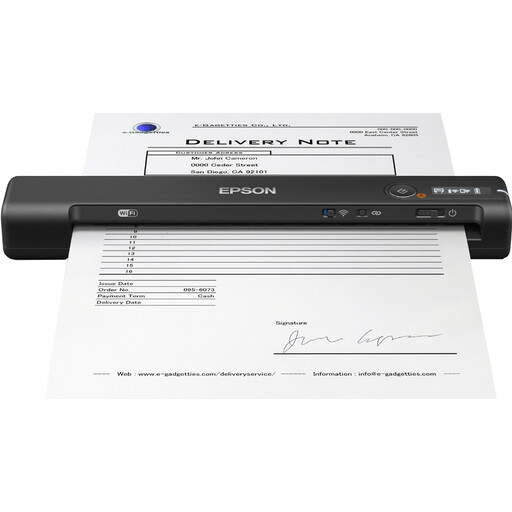
Epson WorkForce ES-60W, A4, 600 × 600 DPI
A hand-held scanner for anyone who wants to scan individual A4 pages on the go, moving the device across the page themselves.
The product title lists A4 and 600 × 600 DPI. The product description mentions Wi-Fi and a rechargeable battery.
View at Joybuy
 No image available
Epson DS-C330, A4, 600 × 600 DPI
This sheet-fed scanner may be suitable for thin booklets, but the stated thickness limit means it is not a general option for thick sketchbooks.
The product title lists A4 and 600 × 600 DPI. The product description mentions a U-shaped feed for booklets up to 5 mm thick.
View at Joybuy
Frequently asked questions
Do I need to be able to scan an entire sketchbook in one go?
No, not if separate pages are enough. If you want to capture an open spread as a whole, measure the full spread and compare it with the maximum capture area. Canon lists the CanoScan LiDE 400’s maximum as 216 × 297 mm.
How can I scan a sketchbook without putting unnecessary strain on the binding?
With a flatbed scanner, only place pages on the glass if you can open them sufficiently flat without forcing the binding. ScanSnap describes the SV600 as a contactless scanner; test the fold with a sample scan using your chosen method.
What should I check before buying?
For the exact model, check its software and connection requirements for your computer, the capture size and how much room it takes up with an open book. Also check the current total price and the seller’s returns information.
Can I share scans from someone else’s sketchbook in the Netherlands?
Not without permission: according to the Rijksoverheid, you may make a private copy for your own use, but you may not distribute or publish it. The Rijksoverheid also states that drawings are protected by copyright as creative works.


