
Volunteer with piles of contracts
Scans several separate contracts in a row and wants to reload less often and spot feeding problems promptly.


If your club needs to scan signed contracts, choose the document feeder capacity to suit the size of your usual batches. Check that the exact model scans both sides and detects double feeds. A larger feeder means less frequent reloading, while a compact model is easier to take with you. OCR makes text easier to find, but it doesn’t replace checking signatures and pages visually. If contracts contain personal data, make sure access to and storage of scans are set up appropriately, as required by the Dutch Data Protection Authority to protect personal data.
Scans several separate contracts in a row and wants to reload less often and spot feeding problems promptly.
Wants to decide who can access scans and where files are stored when contracts contain personal data.
Takes scanning work to meetings and needs a suitable power supply and a practical destination for files.
Start with the number of sheets you usually scan in one go. Then compare duplex scanning, double-feed detection and where files can be saved.
| What to consider | What to look for when buying | Who is this important for? |
|---|---|---|
| Batch processing | Compare the capacity of the automatic document feeder, automatic duplex scanning and double-feed detection. | If I scan several contracts in a row, I want fewer interruptions and to be able to check that every sheet has been scanned. Around 33% of consumers give top priority to processing complete batches. |
| Secure storage | Check which scan destinations the exact model supports and whether they suit the club’s secure storage arrangements. | When contracts contain personal data, I want to know in advance who can open and share the scans. Around 27% of consumers prioritise controlling access to contract scans. |
| Scanning at different locations | Check the power supply, connectivity and feeder capacity for the locations where you’ll use the scanner. | If I scan contracts at meetings, the scanner needs to be practical to use there, and files need to be saved somewhere appropriate. Around 20% of consumers put using a scanner at different locations first. |
| Finding and checking documents | Check whether the software can create searchable PDFs, and review test scans for page order, legibility and signatures. | If I need to find specific contract wording later, searchability helps. I also want to be able to check that signatures are visible. Around 20% of consumers give finding contracts top priority. |
Capacity tells you how many sheets you can load. Double-feed detection is a separate feature, and even with it, you still need to check the saved contract.
Compare both features for the exact model. After scanning, check the number and order of the pages against the original.
Allow time to check scans and rescan them if needed.
A destination that makes files easy to share doesn’t automatically control who can access them. The club remains responsible for appropriately protecting personal data. If you explain the processing to a service provider, also check whether you need an agreement with that processor.
Decide where files may be stored and who can access them before volunteers use the scanner settings. The Dutch Data Protection Authority sets out the security requirements and the agreements required when using a processor.
A model discussed previously may since have been replaced or discontinued. Specifications for an earlier model don’t automatically apply to another model.
Check the model name and current support before using the features of an older scanner as your point of reference.
The ADS models mentioned suit different working situations: smaller batches on the go, or a permanent wired network location.
The models mentioned range from the ES-590W, designed for larger batches, to the compact DS-C490 with two paper paths.
The iX2400 mentioned is designed as a USB scanner for a permanent workstation where searchable PDFs are useful.
The imageFORMULA DR-C340 is a desktop model for processing individual documents.
This selection of Joybuy products is suited to scanning individual contract pages, from larger batches at a permanent workstation to a compact model for use at different locations.
 No image available
Suited to a permanent workstation where larger batches of double-sided contract pages are scanned regularly.
100-sheet feeder; automatic duplex scanning; stated scan speed of 85 pages per minute.
The network interface for shared use is optional. After scanning, check that all pages and signatures have been captured in full.
 No image available
Suited to a permanent workstation where contracts are fed in batches and searchable files are useful.
100-sheet feeder; duplex scanning in a single pass; document management and searchable PDFs are listed.
The network interface for shared use is optional.
 No image available
Suited to batches of contracts at a permanent USB workstation, with features that help flag feeding problems.
100-page feeder; automatic duplex scanning; the description lists a double-feed prevention system and a slow mode for fragile documents.
Don’t treat slow mode as a guarantee that a fragile original will feed through undamaged. Check the paper and the scan.
 No image available
Suited to smaller batches when you scan contracts at different locations.
20-sheet feeder; automatic duplex scanning; stated scan speed of up to 30 images per minute; USB-powered.
Wi-Fi requires the optional WU10 unit. The feeder needs refilling more often than models with a larger capacity.
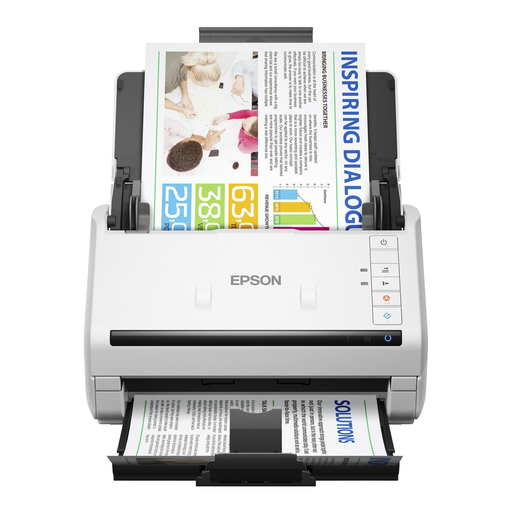 No image available
Suited to a permanent workstation for double-sided contracts, if a 50-page feeder matches the size of your usual batches.
Automatic duplex scanning in a single pass; Windows and Mac compatibility is listed.
The 50-page capacity means you’ll need to reload more often with larger batches. Check fragile originals and the resulting scan.
No, not just because you’ve made a scan. First, establish what retention requirements and evidential needs apply to the contract in question. The Dutch Tax and Customs Administration states that, for VAT records, basic records must generally be kept for 7 years. It also explains that the currency of information can matter, for example when a contract is ongoing. This isn’t general permission to destroy every paper original.
If contracts contain personal data, the club must protect the processing appropriately. The Dutch Data Protection Authority states that a written data processing agreement is required if a service provider processes personal data on the club’s behalf. The GDPR doesn’t set one general retention period for all personal data.
After scanning, compare the number and order of the pages with the original and check that signatures are fully visible. Remove fasteners before loading the documents and use a paper path suited to them. Brother and Epson list double-feed detection for the ADS-4300N and ES-590W; treat this feature as an aid and check the output yourself.
Check that parts and service are available for the exact model, and find out what terms and conditions apply. Brother lists a separate feed roller kit for the ADS-4300N. Epson lists extended warranty options for the DS-C490, subject to separate terms and conditions.