For bound pages that you don’t want to press flat, an overhead scanner is worth considering. For individual pages that can safely lie on glass, a book scanner with a flatbed may be a better fit. A handheld scanner is more suited to scanning a small number of loose pages on the go, while a standard flatbed scanner can be practical if the notebook lies flat easily. Save your scans as images and check a sample page of handwriting: an OCR feature doesn’t guarantee that ingredients and quantities will be recognised correctly.
Which type of scanner is right for you?
For scanning bound notebooks
If you want to capture several recipes without pressing the spine hard against a glass plate, check how much room there is for an open notebook and how clearly the page near the fold can be scanned. CZUR and IRIS describe overhead scanners with features for capturing curved pages.
For preserving handwritten recipes
If ingredients and quantities need to remain easy to read, keep an image of the original page alongside any recognised text. Manufacturers mention OCR, but check how well it works on a representative page yourself.
For scanning just a few pages for a project
If you only need a few pages, compare a basic scanner with a book-focused model, and consider whether you’ll also use it for loose documents or photos. Epson describes the Perfection V39II as a photo and document scanner, not as a dedicated book model.
What should you look for in a scanner for recipe notebooks?
Start with the spine and the notebook’s dimensions, then decide whether you need original images, recognised text or, above all, portability.
| What to consider |
What should you check? |
Who is this most important for? |
| Bound pages |
Compare an open notebook with the scanning area and check a sample scan near the fold. |
I want to capture readable pages without straining the spine; around 31% of consumers prioritise this. |
| Handwriting and quantities |
Keep an image of the page and check ingredients and numbers after any OCR. |
I want to be able to read handwritten recipes reliably, even if text recognition makes a mistake; around 25% of consumers prioritise handwriting legibility. |
| One-off use |
Count the pages you need and consider whether you’ll also use the scanner later for loose documents or photos. |
I only need a few pages and want to choose a scanner to suit this limited use; around 19% of consumers have this priority. |
| Scanning on the go |
Check whether you can save files without a computer and whether the scanner is suitable for the pages you’re taking with you. |
I want to scan a notebook elsewhere without a fixed setup; around 13% of consumers prioritise portability. |
| Size and number of pages |
Measure the notebook and compare its pages with the scanning area of the exact model. |
I need to scan lots of pages or pages in an unusual size; around 12% of consumers prioritise size or quantity. |
Common pitfalls when scanning recipes
-
Assuming OCR will copy handwritten quantities perfectly
The mention of an OCR feature doesn’t tell you how accurately it will recognise your handwriting. Misreading a quantity can change the transcribed text.
Start with a sample scan, keep the image and compare the recognised text with the original page.
Allow time to check the recognised text and correct it where necessary.
-
Choosing a standard flatbed scanner without checking the book spine
A flat glass plate isn’t automatically practical for a stiff or delicate notebook; forcing it open could put unnecessary strain on the spine.
Measure the page and see if the notebook can lie open without pressure. If necessary, compare an overhead scanner or a book-focused model.
-
Assuming specifications are the same across different versions
Plustek’s Dutch and European specification pages list different hardware details under the name OpticBook 3800L.
For a specific offer, ask which version is being supplied and compare it with the relevant specification sheet.
Relevant scanner brands to consider
CZUR
CZUR describes its Shine Ultra range as overhead scanners for books and other materials; the Shine Ultra and Shine Ultra Pro are different versions.
- The manufacturer lists curve correction, OCR and export to formats including JPG and PDF.
- These features don’t show how accurately your handwriting will be recognised; also check which version is on offer.
IRIS
IRIS describes the Desk 7 Pro as a document camera and book scanner, and the Book 7 as a portable handheld scanner.
- According to IRIS, the Desk 7 Pro has OCR and curved-edge correction; the Book 7 can scan directly to PDF and JPEG.
- The features listed don’t necessarily apply to both models. Check which scanning method suits your pages.
Plustek
Plustek’s Dutch specification describes the OpticBook 3800L as an A4 flatbed scanner for individual book pages.
- The Dutch specification lists a 6 mm book edge, OCR and a scanning area of 216 × 297 mm.
- The Dutch and European specification pages list different hardware details under the same model name. Check the specification sheet for the version on offer.
Epson
Epson describes the Perfection V39II as an A4 photo and document scanner, which can also be used for loose documents beyond a school project.
- Epson lists text enhancement features and a space-saving stand.
- It isn’t a book-focused model. Check that a stiff notebook can lie safely on the glass without pressure.
Joybuy products for scanning recipes
The products below include book-focused and standard flatbed scanners, an overhead scanner and portable scanners for loose pages. Check that each model’s scanning area and method suit your notebook.
 Image unavailable
Canon imageFORMULA DR-F120 Flatbed & ADF Scanner
The flatbed is designed for bound materials; use the document feeder for loose stacks.
600 × 600 DPI; A4; double-sided scanning via the ADF; output to editable PDF.
View at Joybuy
 Image unavailable
Epson WorkForce DS-1660W Flatbed Scanner
An A4 flatbed option for a notebook that can safely lie on the glass, as well as loose project documents.
1200 × 1200 DPI; A4; double-sided scanning; USB and wireless connectivity.
View at Joybuy
 Image unavailable
CZUR Shine 800 A3 Pro
An overhead scanner for capturing loose project sheets; check with a sample page that the setup also works for your notebook.
For A3 and A4 documents; OCR; automatic cropping; USB connection.
View at Joybuy
 Image unavailable
Epson WorkForce DS-80W handheld scanner
Suited to loose A4 recipe pages that you scan on the go; the document feeder isn’t designed for pages still attached to a bound notebook.
600 × 600 DPI; A4; Wi-Fi; battery-powered; output to PDF, JPG and TIFF.
View at Joybuy
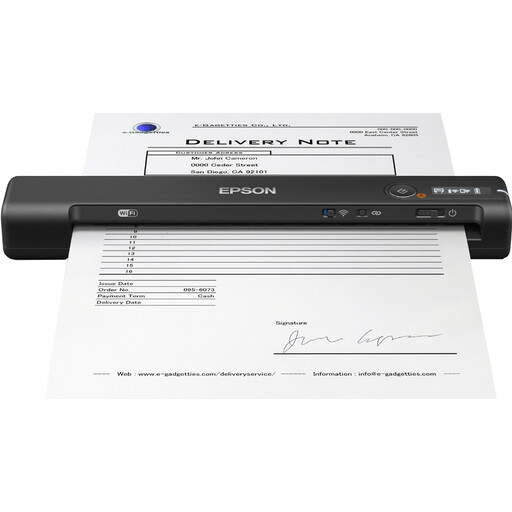 Image unavailable
Epson WorkForce ES-60W handheld scanner
A portable option for loose A4 pages; the automatic document feeder won’t scan pages still attached to a bound notebook.
600 × 600 DPI; A4; Wi-Fi; rechargeable battery; LCD screen; output to PDF and TIFF.
View at Joybuy
Frequently asked questions about scanners for recipe notebooks
Can I get rid of the original handwriting after using OCR?
For your project, keep images of the pages too, and use them to check the ingredients and quantities. The OCR features mentioned don’t provide a measured accuracy rate for your handwriting.
How can I scan a bound notebook without putting unnecessary strain on the spine?
Only open the notebook as far as it will go without forcing it. An overhead setup may be suitable for a stiff binding; with a book-focused flatbed scanner, you need to be able to place the page safely along the scanning edge.
What should I check before using a scanner at school?
Check the operating system on the available computer against the specifications for the exact model. If the school processes pupils’ personal data, it has obligations under the GDPR; the Dutch Data Protection Authority advises schools to follow the applicable privacy rules. Discuss permitted storage and working practices with the school.
Can I share scans of recipes from someone else’s notebook in my school project?
Not necessarily: the Government of the Netherlands distinguishes between making a copy for personal use and distributing or publishing it. There are exceptions for educational purposes under certain conditions for protected works, but a school project doesn’t give you unrestricted permission to publish complete scans. Check who owns the rights and how the work will be used.


