For individual, sturdy postcards that can lie flat, a compact flatbed scanner is usually the best fit; some models can be stored upright. Choose an overhead scanner if the cards need to stay in an album or you’d rather not place them on glass. A camera’s resolution in pixels cannot be compared directly with a flatbed’s dpi specification, so it’s worth assessing a test scan of one of your own cards too. Canon Netherlands and Epson Netherlands describe flatbed models for individual documents and photos, while the Library of Congress stresses that the appropriate resolution depends on the original and its intended use.
Which type of scanner is right for you?
Scanning individual cards with limited desk space
If you mainly have individual postcards and want to put the scanner away after use, compare compact flatbeds and their storage options. Epson Netherlands describes a built-in stand for upright use; Canon Netherlands lists an A4 scanning area for the CanoScan LiDE 400.
Handling delicate cards or albums with care
If the cards are in an album or you don’t want to place them on a glass plate, an overhead scanner may be a better fit for how you want to capture them. IRIS and CZUR describe models designed for overhead scanning.
Scanning a stack of individual cards
If you have lots of individual cards, you could consider a feed-through scanner, but only for originals in a condition that can withstand being fed through. Plustek describes the ePhoto Z300 as a scanner for individual photos; the Library of Congress advises handling photographic materials carefully by their edges.
What to look for in a scanner for old postcards
A4 flatbed scanner
A good fit if: you can place individual, sturdy cards on a glass plate and want to scan both sides separately.
Bear in mind: you’ll need to place and turn over each card by hand. Measure the card, including any borders you want to capture; Canon lists a scanning area of 216 × 297 mm for the LiDE 400.
Overhead or book scanner
A good fit if: the cards need to stay in an album or you’d rather capture them from above. IRIS describes the Desk 6 Pro as an overhead scanner; CZUR presents the Aura Pro as a foldable book scanner.
Bear in mind: a stated pixel count alone doesn’t tell you how much fine detail or colour variation will be visible. Look at a test scan and check the space you’ll need and the software’s output options.
Feed-through scanner
A good fit if: you have several individual cards in a condition that can withstand being fed through. Plustek positions the ePhoto Z300 as a scanner for individual photos.
Bear in mind: the card moves through the device. The manufacturer’s claim about soft rollers is no independent guarantee that a delicate original will remain undamaged.
| Consideration |
What to look for |
Who is this most important for? |
| Handling originals with care |
Choose between placing the card on glass, capturing it from above or feeding it through. First check whether the card is sturdy enough for your chosen method. |
If I have a delicate card, I want to put as little strain on it as possible. Around 33% of consumers put careful handling of the original first. |
| Legible front and back |
Check that the whole card fits on the scanning area, and look at small text, edges, colour and reflections in a test scan. The Library of Congress notes that the appropriate resolution depends on the original and its intended use. |
If both the image and a postmark or handwriting need to remain legible, I want to check both sides. Around 33% of consumers give readability and usable image quality top priority. |
| Desk space and storage |
Measure the space needed during use as well as where you’ll store the scanner. Also check which connection and software you’ll need; a storage stand doesn’t automatically mean a compact setup. |
In a small student room, I want to be able to use my desk again after scanning. Around 25% of consumers focus mainly on desk space and storage. |
| Speed when scanning several cards |
Compare the entire process for scanning both sides, not just the stated scanning speed. Don’t choose a feed-through model purely for speed if the cards aren’t in a suitable condition. |
If I have a stack of suitable individual cards, I want to avoid repeatedly placing and turning them over. Around 9% of consumers prioritise scanning several cards. |
Common mistakes when choosing
-
Assuming you need a book scanner when all your cards are loose
A flatbed may suit individual cards that can lie flat on glass; an overhead model simply offers a different way to position them.
First decide whether your cards are loose or need to stay in an album. Then compare the scanner types that suit the way you want to work.
-
Treating megapixels and dpi as directly comparable measures of quality
An overhead camera gives a pixel count, while a flatbed gives a scanning resolution. These figures alone don’t tell you how well small text, colours or edges on your card will be captured.
Look at a test scan of a card with fine text and check the edges, colour and any reflections.
-
Feeding every old card through a scanner
With a feed-through scanner, the card moves through the device. So you’ll need to be especially cautious with a delicate, curled or damaged card.
Separate sturdy individual cards from brittle or damaged ones before considering a feed-through scanner.
Brands to compare
Canon
According to Canon Netherlands, the CanoScan LiDE 400 is an A4 flatbed scanner for individual cards and documents.
- Canon lists USB-C, vertical scanning and a scanning area of 216 × 297 mm for this model.
- For cards in an album, you’ll need to be able to place each card on the glass.
Epson
According to Epson Netherlands, the Perfection V39II is an A4 flatbed scanner for photos and documents.
- Epson lists USB power and a built-in stand that allows the scanner to be used upright.
- The automatic photo enhancements described by Epson are not independent proof of more colour-accurate archival scans.
IRIS
The IRIScan Desk 6 Pro is an overhead scanner for capturing material from above.
- IRIS lists a 13-megapixel resolution and up to 4160 × 3120 pixels for this model.
- These specifications are not a comparative test of fine detail or colour in postcards.
CZUR
CZUR presents the Aura Pro as a foldable overhead book scanner.
- The manufacturer lists lighting, image correction and output in formats including JPG and TIFF.
- Before buying, check that the exact version, software and warranty suit your needs in the Netherlands.
Plustek
The ePhoto Z300 is a feed-through scanner for individual photos and cards.
- Plustek lists soft rollers and an optical resolution of 1200 dpi for this model.
- The product information is not specific to the Netherlands. Check the version, and only use the feed-through function for cards in a suitable condition.
Scanners at Joybuy
This Joybuy selection includes a flatbed scanner with ADF and scanners with document feeders. For old postcards, the flatbed is the option that lets you place the card on glass; only feed delicate cards through a scanner if their condition allows it.
 Image unavailable
Canon imageFORMULA DR-F120 Flatbed & ADF Scanner, 600 × 600 dpi, A4, Black
For cards that you can place on glass, you can use the flatbed; the ADF is a separate feeding method.
The product name lists 600 × 600 dpi and A4. The product description mentions books, magazines and delicate materials for the flatbed; don’t feed delicate cards through the ADF.
View at Joybuy
 Image unavailable
Epson DS-C330 ADF + Sheet-Fed Scanner, 600 × 600 dpi, A4, Black, White
This Epson feeds material through the scanner; only consider it for postcards if they’re in a condition that allows this method.
The product name lists 600 × 600 dpi and A4. The product description mentions a U-turn paper path and booklets up to 5 mm thick.
View at Joybuy
 Image unavailable
Epson WorkForce DS-70 Handheld Scanner, 600 × 600 dpi, A4, White
This scanner uses a feed slot; only choose it for old cards if they can be fed through without damage.
The product name lists 600 × 600 dpi and A4. The product description warns against inserting damaged, folded or stapled documents.
View at Joybuy
 Image unavailable
Epson WorkForce DS-80W Handheld scanner, 600 × 600 dpi, A4, White
This Epson has automatic feeding; only use it for postcards if they’re in a condition that allows them to be fed through.
The product name lists 600 × 600 dpi and A4. The product information mentions Wi-Fi and battery power, and warns against feeding damaged, folded or stapled documents into the scanner.
View at Joybuy
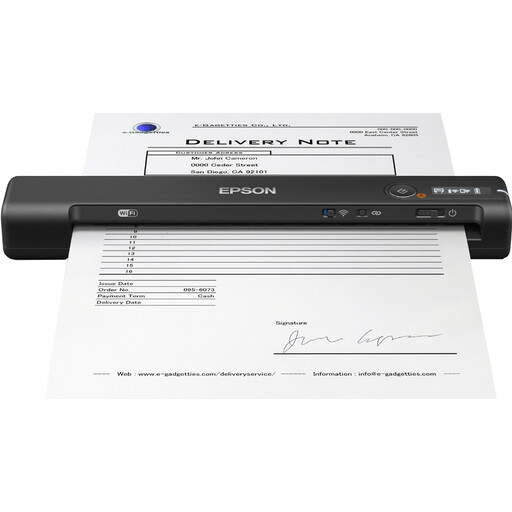 Image unavailable
Epson WorkForce ES-60W Handheld scanner, 600 × 600 dpi, A4, Black
This Epson uses handheld feeding; consider the condition of delicate cards before feeding them through the scanner.
The product name lists 600 × 600 dpi and A4. The product information mentions Wi-Fi, an LCD screen and a media weight range of 35–270 g/m².
View at Joybuy
Frequently asked questions
Should I scan every old postcard at the highest dpi setting?
No. Choose a setting that suits the card and how you intend to use the file. The Library of Congress stresses that the appropriate resolution depends on what you’re scanning and how you plan to use the digital image; also assess a test scan for the smallest details that matter.
How can I handle old cards carefully while scanning?
Work on a clean, dry surface and, where possible, handle photographic materials by their edges. The Library of Congress gives this as conservation advice; for delicate cards, also choose a scanning method that puts no unnecessary strain on the original.
What are my rights when buying a scanner online?
In the Netherlands, online distance purchases from a business usually come with a 14-day cooling-off period, although there are exceptions. The Dutch government advises checking the seller’s information about the cooling-off period and returns process.
Can I share scans of old postcards online?
Don’t assume you can make a scan public just because the postcard is old or belongs to you. The Dutch government distinguishes between a private copy for personal use and distributing or making copyright-protected work public; check the rights before sharing scans.


