
Teacher with delicate clippings
You want to scan old, torn or irregularly sized clippings without using an automatic paper feeder. An overhead scanner or a flatbed may be worth considering, depending on the dimensions.


Choose a scanner for newspaper clippings based on the largest dimensions and the condition of the paper. An overhead scanner lets you lay the sheet flat, while a flatbed is only suitable if the clipping fits on the glass. If you need searchable text, check the OCR output with a test scan. Automatic feeding is best suited to sturdy, loose sheets that are compatible with the feeder.
You want to scan old, torn or irregularly sized clippings without using an automatic paper feeder. An overhead scanner or a flatbed may be worth considering, depending on the dimensions.
You want to make teaching materials searchable and need to check whether OCR can accurately capture small or worn newspaper text.
You need to fit a scanner on a shared table and weigh up the space required against the number of loose sheets you need to scan.
First, measure your largest clipping and consider the condition of the paper. Then check the text output you need and how much space the scanner requires when in use.
| Consideration | What to look for | Who is this important for? |
|---|---|---|
| Size and paper preservation | Measure the largest original and compare its dimensions with the scanning area of the exact model. CZUR lists flat pages up to A3 for the Shine 800 A3 Pro; Canon Netherlands gives a maximum of 216 × 297 mm for the CanoScan LiDE 400. | If I’m scanning larger or delicate clippings, I want to lay them flat rather than feed them through a mechanism. Around 36% of consumers prioritise size and paper preservation. |
| Searchable text | Check that the file format you need is available, and test OCR on small print, names and dates from a representative clipping. IRIS lists searchable PDF output for the Desk 6 Pro. | If I want to find newspaper text in teaching materials, I want to check the recognised words first. Around 29% of consumers give searchable, verifiable text top priority. |
| Space on the scanning table | Measure the table with the scanner in its working position, allowing space for the paper as well. CZUR describes the Shine 800 A3 Pro as foldable; Epson lists a small footprint for the ES-C320W in U-turn mode. | On a shared or small table, I want to leave enough room for both the device and the clipping. Around 21% of consumers prioritise a practical scanning area. |
| Batch scanning | Work out how many sturdy, loose sheets you’ll scan in succession and whether they’re suitable for the feeder. Also allow time for manual loading and checking. Epson describes sheet-feed scanners as an option for larger volumes of suitable sheets. | If I’m scanning lots of loose sheets one after another, I want to avoid placing each sheet individually. Around 14% of consumers choose with batches of suitable sheets in mind. |
The maximum scanning area is a limit; a newspaper or loose clipping may be larger than the area available on your chosen model.
Measure the largest original and compare both its length and width with the specifications for the exact version.
Splitting a larger original into sections and combining the scans may require extra editing.
OCR is text recognition, but having the feature doesn’t prove that small or worn lettering will be captured without errors. The National Library of the Netherlands explains how the quality of historical newspaper images can make OCR work more difficult; this is not a performance test of these models.
Create a test file and check a few names, dates and examples of small print before scanning large quantities.
Manually checking and correcting recognised text can take extra time.
A feeder is mainly useful for sheets that are actually suitable for it. Delicate or torn clippings aren’t automatically safe to feed through.
Separate sturdy, loose sheets from delicate items and choose the right scanning method for each original.
Processing unsuitable or delicate items separately involves extra steps.
Permission and conditions may apply when digitally copying and sharing copyright-protected publications. The Dutch Government explains the reprographic rights scheme, while the education guide sets out separate arrangements for secondary education.
Before sharing, check which school type, how much material and which recipients are covered by the relevant scheme.
The Shine 800 A3 Pro is a foldable overhead scanner for flat items up to the A3 size specified by CZUR.
The IRIScan Desk 6 Pro is an overhead A3 document camera. IRIS lists searchable PDF among its output options.
The CanoScan LiDE 400 is a flatbed scanner for individual clippings that fit on the glass.
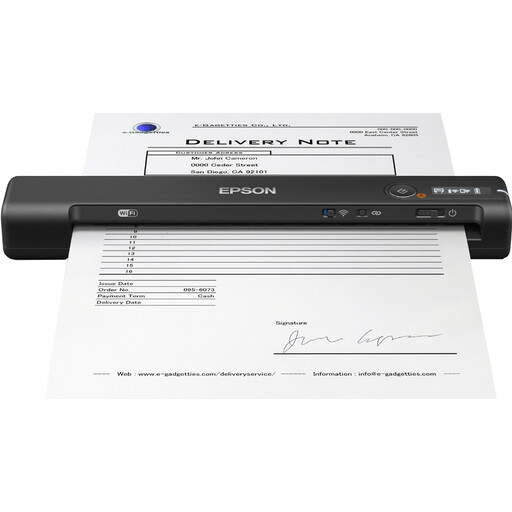
The ES-C320W is a compact A4 document scanner with automatic feeding.
This selection includes scanners for loose sheets, mainly in A4 format. For old, torn or delicate clippings, first check whether paper feeding is suitable.
 No image available
May suit loose sheets that are compatible with a sheet-fed scanner. Don’t use the feeder without first checking the condition of any delicate clippings.
Listed in the product name: A4 and 600 × 600 dpi.
 No image available
Consider this document feeder if you mainly scan sturdy, loose sheets. Check damaged clippings individually before feeding them through.
Listed in the product name: A4 and 600 × 600 dpi.
 No image available
For this version, check the supported paper size and feeding method, then compare them with the dimensions and condition of your clippings.
 No image available
If you want searchable teaching files, check the OCR output from this version using a representative newspaper clipping.
Listed in the product name: 600 × 600 dpi.
 No image available
Add this portable model to your shortlist if you need flexibility in where you scan. Check that the manual process suits the number of clippings you have.
Listed in the product name: 600 × 600 dpi.
Make a test scan of a representative clipping and check both the image and a few recognised words, names and dates. The National Library of the Netherlands explains that the quality of the original image can make OCR more difficult with historical newspapers; that research is not a performance test of these scanners.
Leave room beside the scanner for your largest clipping in scanning position. Compare the space required by an overhead scanner with that of a flatbed or document feeder, and check that the paper can lie flat without being damaged.
For the exact version, check which software, warranty and any additional support are included in the offer. Epson lists separate extended warranty options for the ES-C320W. Permission and compensation may also be relevant when using copyright-protected articles.
Not without limits: the Dutch Government states that permission is needed to digitally copy and share protected publications, and explains the reprographic rights scheme. For secondary education, the education guide sets out specific arrangements for sharing a limited extract, including one article, with pupils. The applicable conditions depend on the school type, the amount of material and how you share it.
Treat the file as potentially involving the processing of personal data. The Dutch Data Protection Authority says schools must be able to demonstrate which technical and organisational measures they use to protect pupil data. The appropriate measures depend on the content and how the file is stored and shared.