
Anyone scanning large, loose maps
You want to capture a map in a single pass, if possible. So measure the map first and compare its dimensions with the model’s scanning area.


First, measure the largest map you want to scan in a single pass. A compact A4 flatbed scanner suits smaller maps, while an A3 model gives you more scanning space if the map fits within its actual scanning area. Then consider the condition of the original and the space available on your desk and computer. If a map is fragile or will not fit on the glass, consider another scanning method before scanning it yourself.
You want to capture a map in a single pass, if possible. So measure the map first and compare its dimensions with the model’s scanning area.
Your main concern is how to handle the original safely. Assess its condition before choosing a standard glass bed or another scanning setup. The Netherlands National Archives describes condition checks as part of the digitisation process for its archives.
You need to weigh the scanning area against the device’s external dimensions, connection and the computers your colleagues use.
Choose this option: if the map fits within the scanning area and space on the shared desk is limited.
Bear in mind: larger maps will not fit in a single pass; a high dpi rating does not make the glass larger.
Choose this option: if the map fits on the glass and you can lay it flat safely.
Bear in mind: allow enough space and check the connection, drivers and condition of the map.
Consider this: if the map will not fit on the available glass or you are unsure how to handle it safely.
Bear in mind: the specialist method described by the Netherlands National Archives for its own archives is not automatically necessary for every privately owned map.
| What to consider | What to look for | Who it matters most to |
|---|---|---|
| Capturing the map in a single scan | Measure the width and height, then compare them with the maximum scanning area of the exact model. Canon lists a maximum of 216 × 297 mm for the CanoScan LiDE 400; Plustek lists a maximum of 297 × 431,8 mm for the OpticSlim 1180. | If I want to capture the map in a single pass, I measure the original first; around 33% of consumers prioritise map size. |
| Handling the original safely | Check for folds, tears and loose material before moving the map or placing it on the glass. If in doubt, ask a conservator or the institution responsible for it for advice. | If my map is fragile, I want to know how to handle it safely first; around 27% of consumers put preserving the original first. |
| Using a shared desk | Compare the external dimensions, power supply and USB connection with your workspace, and check that the required drivers are compatible with the computers. Canon lists external dimensions of 250 × 367 × 42 mm and USB power for the LiDE 400; Plustek lists 589 × 407 × 68 mm, a separate power supply and USB 2.0 Type B for the OpticSlim 1180. | If the scanner needs to sit in a shared workspace, I want to check the available space and connection in advance; around 20% of consumers prioritise their workspace. |
| Capturing map details clearly | Compare optical resolutions and assess a test scan for the details you need. Plustek lists 1200 dpi optical resolution for the OpticSlim 1180; VIISAN lists 2400 × 2400 dpi optical resolution for the VF3240. These figures alone do not prove that one will produce better results for your map. | If I want to preserve fine lines and lettering, I assess a test scan rather than relying only on the stated maximum resolution; around 20% of consumers prioritise useful map details. |
The scanning area varies from model to model. A higher resolution does not change the size of the glass, so a map may still be too large to capture in a single pass.
Measure your largest map and check both the maximum width and length of the exact model.
The physical condition of a map can affect the scanning method. A flatbed scanner does not, by itself, guarantee that a fragile map will be handled safely.
Assess the material first and, if in doubt, seek expert advice before moving or scanning the map.
Epson marks the Expression 13000XL and Expression 13000XL Pro as discontinued, even though their product pages also show pricing information.
Check the sales status of the exact model; a price listing alone does not confirm that it is still available.
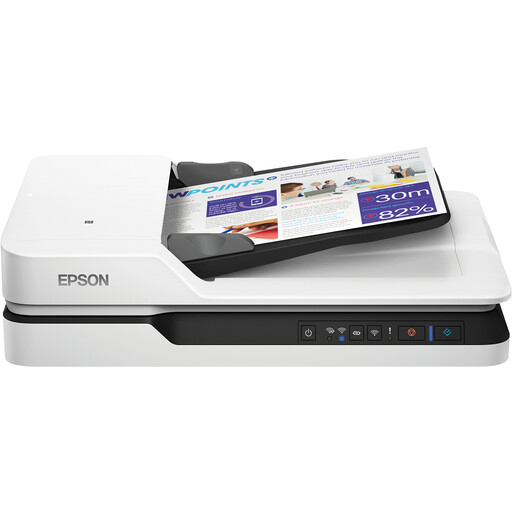
The OpticSlim 1180 is an A3 flatbed option for maps that fit within its stated scanning area.
The VF3240 is an A3 flatbed option to consider if the map’s size and your available workspace are suitable.
The CanoScan LiDE 400 is a compact A4 flatbed option for smaller maps and a shared desk.
The Expression 13000XL is an example of a graphics-focused A3 scanning option, but Epson marks this model and the 13000XL Pro as discontinued.
These picks include an A4 flatbed scanner for maps that fit within its actual scanning area and a portable document camera for flat sheets up to A3. The document camera is not a flatbed scanner; check that this alternative capture setup suits your map and scanning needs.
 No image available
Suitable for smaller maps that fit within the model’s scanning area; check the maximum scan size before buying.
The product name specifies A4 and 1200 × 1200 dpi. The product description mentions USB 3.0 and a wireless connection.
 No image available
An alternative capture setup for flat sheets up to A3; this is not a flatbed scanner, and the method needs to suit the condition of the map.
The product title specifies A3 as the maximum size for a flat sheet. The product description mentions a foldable design, USB, OCR and an optical resolution of up to 270 dpi at A4.
No, A3 is not large enough for every map. Compare the measured map with the actual scanning area; for example, Plustek lists a maximum of 297 × 431,8 mm for the OpticSlim 1180. For larger maps, consider another capture method.
First, assess its physical condition and handle fragile maps carefully. The Netherlands National Archives describes condition checks and physical preparation as part of its own digitisation process; this is an example of good practice, not a general legal requirement for private buyers.
Not automatically: the age of a map does not, by itself, mean you can distribute a scan freely. The Dutch Government states that a private copy of protected work for personal use must not be distributed or made public. Permission is required to make and share digital copies of protected publications within a business or institution; check the rights for the specific map and intended use.
According to the Dutch Government, the seller must offer a solution if a consumer product is faulty. There is no fixed statutory guarantee period; what you can expect depends, among other things, on the product, its price and whether it is new or second-hand. Check any additional warranty terms separately.