Who is this choice relevant to?

Manager of fragile letters

Wants to handle originals as little as possible and first checks whether loose or bound items can be handled safely. The Library of Congress and Metamorfoze stress that materials must remain safe to handle during digitisation and that visible information should be preserved.

Image-checking volunteer

Wants to check handwriting, reverse sides and page edges in the files, and make sure no pages have been missed. The National Archives describes image-quality checks and checks for missing pages as part of the digitisation process.

Scanning coordinator

Needs to choose between positioning items by hand and arranging faster processing for suitable loose sheets, and wants to be able to find the files again later. Handwritten letters also require a separate assessment of text recognition.

What should you look for when choosing?

Overhead scanner or document camera

Choose this option: when you want to capture a letter without pressing it down, for example because it is fragile, bound or larger than A4.

Bear in mind: the capture area and the legibility of a test scan; an A3 size alone says nothing about the level of detail.

A4 flatbed scanner

Choose this option: for loose letters that fit within A4 and can lie flat on the glass without harmful pressure.

Bear in mind: you need to position each side individually and check the full image when scanning larger or folded items.

Automatic document feeder

Choose this option: only for a separate stack of sturdy, loose sheets that your group has agreed are safe to feed through.

Bear in mind: speed is no reason to feed tear-prone, folded or bound originals through the scanner.

What to consider What to look for when buying Who should pay particular attention?
Keeping originals intact Assess the most fragile paper and check how it is supported and whether pressure is needed. If I have fragile or bound letters, I want to handle the originals as little as possible. Around 27% of consumers put preserving the originals first.
Legible, verifiable images Make test scans of the front and back, then check the ink, edges and show-through in the saved image. If faint ink or notes on the reverse matter, I want to be able to compare the image with the original. Around 27% of consumers put image fidelity first.
Keeping volunteers on pace Try scanning a small stack and assess the whole process, including handling and checking, not just the scanning speed. If we have lots of suitable loose letters to process, I want to know whether the workflow is practical for volunteers. Around 20% of consumers put volunteer-friendly speed first.
Finding letters again Check the file output and naming conventions; test recognition and searchability using handwriting from your own collection. If I want to find letters by name or subject later, I don’t want to assume that a folder of scans will automatically be searchable. Around 13% of consumers put findability first.
Access to digital letters Decide where files will be stored, who will have access and whether the letters contain personal data. If letters contain information about identifiable people, I want to agree on storage and access arrangements in advance. Around 13% of consumers put restricted storage first.

Common pitfalls

  • Choosing a fast sheet-fed scanner for every letter

    The stated speed doesn’t tell you whether your particular paper can safely pass through the feeder. Fragile, folded or bound letters may need a different scanning method.

    Separate sturdy loose sheets from fragile items before choosing a method. A test run and checks afterwards may take extra time.

  • Assuming A3, megapixels or dpi mean archival quality

    A product specification won’t show whether faint ink, page edges and information on the reverse of your letters will remain clearly visible.

    Compare test images of representative letters with the originals. Allow time for test scans, checks and rescanning if needed.

  • Confusing OCR with reliable handwriting transcription

    Text recognition support doesn’t prove that handwritten words will be converted accurately. The National Archives describes handwriting recognition as a separate process trained using transcriptions.

    Choose the image-capture method first, then test text recognition separately using your own letters. Manual transcription or correction may still be needed.

  • Seeing cloud scanning as just a convenient feature

    If letters contain personal data, the group should assess storage and sharing separately.

    Decide where files will be stored and who will have access before volunteers use scanning and sharing features.

Brands to consider

CZUR

Offers overhead scanners, including models for flat pages and an ET series with features for curved book pages.

  • According to CZUR, the Shine 800 A3 Pro has an 8-megapixel sensor and supports up to A3.
  • CZUR positions the Shine 800 A3 Pro for flat, loose pages; don’t automatically apply claims about book-page correction to this model.

Epson

The Perfection V39II is an A4 flatbed scanner for loose documents that can lie flat on the glass.

  • Epson lists 4800 dpi and features to reduce unwanted show-through when scanning double-sided documents.
  • Check the results with your own letters; the A4 scanning area won’t suit every original.

Canon

The CanoScan LiDE 400 is a compact A4 flatbed scanner for loose letters.

  • Canon lists USB-C power and a lid for thicker documents.
  • The lid doesn’t prove that pressing down on a fragile or tightly bound letter is safe.

IRIS

The IRIScan Desk 6 Pro is an overhead scanner for A3 documents, books and more.

  • Canon lists a 13-megapixel sensor, book-curve processing and OCR output for the IRIScan Desk 6 Pro.
  • These product specifications are not an independent test of old handwriting.

Plustek

The OpticBook 4800 is designed for bound material and features a book-edge design.

  • Plustek says the design reduces shadows near the book spine.
  • The material is positioned against a scanning surface; first check whether the binding allows this.

Brother

The ADS-1800W is a sheet-fed scanner for a separate stack of suitable loose documents.

  • Brother lists a 20-sheet feeder and double-sided scanning.
  • These features are useful if the originals can safely pass through the feeder.

Scanner options at Joybuy

These options are suited to sturdy loose letters that can safely pass through a feeder, and to flat, loose pages captured from above.
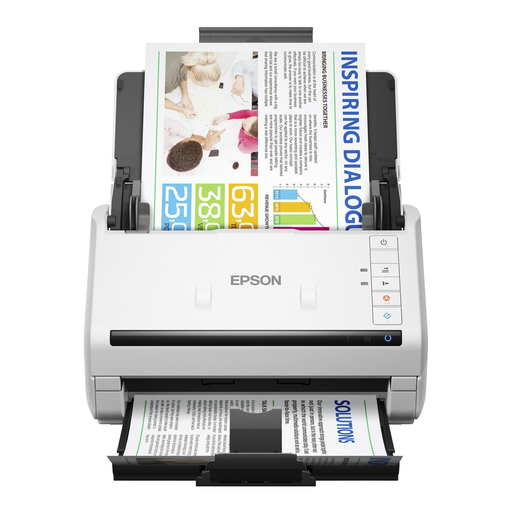
Epson WorkForce DS-530 II document scanner

Epson WorkForce DS-530 II

Suitable for a separate stack of loose letters that can safely pass through a feeder.

A4 sheet-fed scanner with an automatic document feeder and single-pass double-sided scanning. The stated resolution is 600 × 600 dpi.

Use the feeder only for loose sheets that are suitable for it.

View at Joybuy
CZUR Shine 800 A3 Pro document scanner

CZUR Shine 800 A3 Pro

Suitable for flat, loose letters up to A3 that you want to capture from above.

CZUR lists an 8-megapixel sensor; the product specification states a maximum of 270 dpi at A4.

CZUR positions this model for flat, loose pages, not for book-curvature correction. An OCR claim doesn’t prove that handwriting will be recognised reliably.

View at Joybuy

Frequently asked questions

Can I save handwritten letters as searchable text straight away?

First save and check a legible image. Standard OCR output or support for multiple languages doesn’t prove that handwriting from your collection will be recognised accurately. The National Archives describes handwriting recognition as a separate process trained using transcriptions.

How do you start a scanning session without losing any pages?

First assess the condition, run a small test batch, then check the image quality and make sure no pages are missing. The National Archives describes image-quality checks and checks for skipped pages as part of its digitisation process. This is a useful example, not a legal standard for your group.

Can the group put scans of personal letters online?

Not automatically. If letters contain personal data about identifiable people, the group must assess which legal basis applies to processing it. The Dutch Data Protection Authority also says that personal data cannot simply be shared with others. The outcome depends on the content, purpose and people involved.

What should the group ask about warranties and additional costs?

Ask about software support, any accessories and who the seller is. ACM ConsuWijzer explains that statutory warranty applies to purchases covered by Dutch consumer law, based on what you can reasonably expect from the product, rather than as a fixed two-year period. Whether those rules apply to your group depends on the buyer and the purchase agreement.
