
Teacher with piles of loose letters
Wants to capture loose sheets quickly in a limited workspace. A repeatable scanning setup may matter more than correcting curved book pages. CZUR positions the Shine 800 A3 Pro for flat, loose sheets.


If you mainly scan loose letters one after another, compare an overhead scanner with an A4 flatbed scanner: the first is designed for flat, loose sheets, while the second requires you to place each sheet on the glass individually. A book scanner is a better fit for bound letters; choose a document camera if your main aim is to show the letters live to the class. Whichever option you choose, check the size, lighting and whether you need an image or a transcript.
Wants to capture loose sheets quickly in a limited workspace. A repeatable scanning setup may matter more than correcting curved book pages. CZUR positions the Shine 800 A3 Pro for flat, loose sheets.
Wants to preserve small handwritten details and needs to consider how to handle the original safely. Loose sheets and bound letters call for different scanning methods. Canon Nederland describes the LiDE 400 as an A4 flatbed scanner; Plustek specifies a 2 mm book edge for the OpticBook 4800.
Wants to show an original on a screen during a lesson. Presenting live and creating a scan file are different goals; Epson describes the ELPDC21 as a document camera for materials up to A3, among other uses.
In a small classroom, your choice mainly depends on the format of the original and what you want to do with the image: preserve it, read it or show it straight away.
| What to consider | What should you check? | Who is this important for? |
|---|---|---|
| Processing loose letters | Check that the scanner is suitable for loose sheets, the maximum paper size and how the next sheet is loaded. | If I want to capture a pile of loose letters, a practical workflow matters more than book correction. Around 36% of consumers prioritise processing loose letters quickly. |
| Fine handwriting details | Check the stated resolution for the size you use, pay attention to the lighting and scan a sample of the smallest handwriting. | If I want to preserve small letters or faded ink, I need to be able to assess the result at actual size. Around 29% of consumers prioritise capturing fine details. |
| Showing letters live to the class | Check whether the device can connect to the screen available and test the image and readability from the seats. | If the class needs to view a letter together, showing it directly matters more than simply creating an archive file. Around 21% of consumers prioritise showing content live. |
| Bound letters | Check the size, binding and how much pressure or contact the original can withstand; see whether book correction is explicitly supported. | If I want to capture letters from an album or book, the positioning needs to work with the spine. Around 14% of consumers prioritise scanning bound letters. |
A scanner can save an image or offer text recognition, but that doesn’t prove it can accurately convert handwritten letters into text. Transkribus describes standard OCR as being intended for printed text.
Test recognition with representative letters and keep the original scan too.
Archiving may also require a separate scanning workflow.
If letters contain personal data, the school remains responsible for processing it, even when an external digital tool is used. The Dutch Data Protection Authority emphasises schools’ responsibility in this area.
Before uploading files, assess their contents and how they will be processed in line with the school’s privacy policy.
The Shine 800 A3 Pro is an overhead scanner option for flat, loose sheets up to A3; the ET series is a separate option for books with curved pages.
Desk overhead scanners are designed for documents and books; according to the Dutch manufacturer’s page, the Desk 6 Pro has an A3 capture area.
The CanoScan LiDE 400 is an A4 flatbed scanner for loose letters that you can place on the glass one at a time.
The OpticBook 4800 is designed for A4 material bound in a book or album.
The Perfection V39II is a compact A4 flatbed scanner; the ELPDC21 is a document camera for live classroom presentations.
These products are designed to capture loose documents, including sheet-fed scanners, an overhead scanner and a model with a flatbed and automatic document feeder.
 No image available
A sheet-fed scanner for processing loose A4 letters.
The product name specifies A4 and 600 × 600 dpi.
 No image available
An A4 sheet-fed scanner for feeding in loose letters.
The product name specifies 600 × 600 dpi and A4 size.
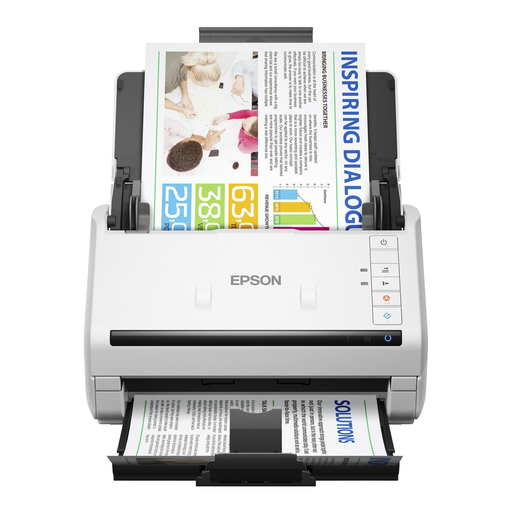 No image available
An A4 sheet-fed scanner for loose sheets; check that the feeder is suitable for your originals.
The product name specifies 600 × 600 dpi.
 No image available
According to CZUR, this model is designed for flat, loose sheets, not for book-curvature correction.
The manufacturer specifies an 8MP camera and 205 dpi at A3. This doesn’t guarantee that small writing will be legible.
 No image available
According to the product name, it combines a flatbed scanner with an automatic document feeder for loose letters.
The product name specifies A4 and 600 × 600 dpi.
Not necessarily. A scan initially saves an image; standard OCR is mainly intended for printed text. Test recognition with your own handwriting and check the results if you need a transcript.
First decide whether you want to create a file or project the image live. Lay loose sheets flat, check for shadows and glare with a test image, and, if presenting live, test the connection to the available screen in advance.
Check which scanning functions work locally and what software or connection is required. If you need handwriting transcription, test it separately and review the terms of the service you use; an OCR claim doesn’t prove that handwriting will be recognised.
First assess what personal data the letters contain and how you will process it. According to the Dutch Data Protection Authority, the school remains responsible for the personal data it processes, even when an external digital tool is used.
Don’t assume so: sharing something publicly is different from using it internally. The Dutch government states that permission is required to copy and share copyrighted publications digitally; check the rights and terms for the specific work.