If you regularly scan piles of loose, double-sided handouts, choose a scanner with an automatic document feeder and duplex scanning. Canon and Brother both specify a 20-sheet feeder for the models mentioned here. A compact scanner may be enough for a few loose pages scanned in different locations, while a flatbed scanner can be more convenient for bound material. However, you’ll need to place pages on the glass one at a time. Also check that the connection, OCR software and paper sizes are right for your computer and project.
Which scanner type is right for you?
Student with piles of handouts
If you regularly scan loose, often double-sided sheets for a project, look for an automatic document feeder and duplex scanning. The Dutch Consumers’ Association recommends considering double-sided scanning if you need it.
Student who scans on the go
If you mainly scan loose pages in different locations, consider whether power from a computer is enough or whether a built-in battery would be useful. Epson describes the ES-50 as USB-powered and the ES-60W as having a battery.
Student with mixed source materials
If you need to scan bound pages or pages that are difficult to feed, as well as loose handouts, consider a flatbed scanner. Plustek describes the OpticSlim 2610 Plus as having a lid that can accommodate thick books or documents.
What should you look for in a scanner?
Scanner with ADF and duplex scanning
Best if: you regularly scan piles of loose, double-sided handouts. Canon and Brother each specify a 20-sheet feeder and duplex scanning for the R10 and ADS-1300.
Bear in mind: stated speeds don’t guarantee how long your entire scanning, OCR and checking process will take. Also check the paper limits and software compatibility for your computer.
Portable scanner for loose sheets
Best if: space is limited and you usually scan a few pages in different locations. Epson describes the ES-50 as USB-powered, while the ES-60W has Wi-Fi and a built-in battery.
Bear in mind: continuous scanning isn’t the same as loading a stack into an ADF. Check whether you really need the battery and Wi-Fi features of a model such as the ES-60W.
Flatbed scanner with glass platen
Best if: you also want to scan bound pages or pages that are difficult to feed. Plustek describes the OpticSlim 2610 Plus as having hinges in the lid to accommodate thick books.
Bear in mind: you’ll need to place each page on the glass separately. Plustek specifies a maximum scan area of 216 × 297 mm for this model.
| What to consider |
What to check before buying |
Who should prioritise this? |
| Batch feeding and duplex scanning |
Check the exact model’s ADF capacity, duplex function and supported paper sizes. |
If I want to scan lots of loose, double-sided handouts in one go, being able to feed them without placing each sheet separately is a major consideration. Around 33% of consumers prioritise batch feeding. |
| Portability and power |
Check your computer’s connection and whether you want to scan without a computer or mains socket. |
If I scan in different locations, I want to know whether my computer can power the scanner or whether I’ll need to work without an external power source. Around 25% of consumers prioritise portability and available power options. |
| Searchable project files |
Check OCR support, output format and software compatibility with your operating system. |
If I want to find passages in my scans later, I need software that can create searchable files. Around 25% of consumers prioritise being able to search their scans. |
| Bound or delicate materials |
Compare the scan area and lid design with your source materials; a flatbed scanner won’t automatically feed a stack. |
If I also need to scan bound pages or pages that are difficult to feed, how safely I can place them on the scanner matters more than batch speed. Around 17% of consumers prioritise this type of material. |
Common buying pitfalls
-
Assuming an automatic mode means there’s a batch feeder
A software mode that scans pages one after another doesn’t necessarily mean you can load several sheets at once.
If you scan lots of loose handouts, check the exact model’s stated ADF capacity and duplex function.
-
Choosing a feeder scanner when you mainly scan bound material
A document feeder is designed for loose sheets; you can’t feed a bound page into it as if it were a loose sheet.
Before buying, work out how many of your sources are loose sheets and how many are bound or difficult to feed.
-
Looking only at the stated scanning speed
The scanner’s speed doesn’t tell you how long you’ll spend preparing, running OCR and checking the files. Brother also lists an output tray and mains adapter as separate accessories for the ADS-1300.
As well as speed, check what’s in the box, the power options and whether the software suits your needs.
Brands to consider
Canon
Canon positions the imageFORMULA R10 as a compact, USB-powered scanner for loose handouts.
- Canon specifies a 20-sheet ADF and duplex scanning for the R10.
- The stated speeds are manufacturer specifications, not a guaranteed speed for an entire study project. Check software and system compatibility.
Brother
Brother describes the ADS-1300 as a portable, USB-C-powered scanner with automatic feeding and duplex scanning.
- Brother specifies a 20-sheet ADF for the ADS-1300.
- An output tray and mains adapter are listed as separate accessories, so check which parts you’ll need.
Epson
Epson describes the WorkForce ES-50 as a compact USB scanner for loose sheets. According to Epson, the ES-60W adds Wi-Fi and a built-in battery.
- According to Epson, the ES-60W can be used without an external power source.
- Epson’s continuous scanning mode isn’t the same as a batch ADF. Check which model suits the way you want to feed pages.
Plustek
Plustek describes the OpticSlim 2610 Plus as a USB-powered flatbed scanner with a lid for thick books or documents.
- Plustek specifies a maximum scan area of 216 × 297 mm and software for searchable PDFs.
- The glass platen won’t automatically feed loose handouts as a stack, so check that the scan area is large enough for your materials.
Scanners at Joybuy
These Joybuy products are suited to handling loose handouts and double-sided documents. Check each model’s feeder capacity, connection and software compatibility with your computer.
 No image available
Canon imageFORMULA P-215II
Worth comparing for loose handouts and duplex scanning; check the feeder capacity and software compatibility with your computer.
600 × 600 DPI; A4.
View at Joybuy
 No image available
Canon imageFORMULA DR-M160II
Worth comparing for loose handouts and duplex scanning; check the feeder capacity and software compatibility with your computer.
600 × 600 DPI; A4.
View at Joybuy
 No image available
Canon imageFORMULA R10
Worth comparing for piles of loose handouts; Canon specifies a 20-sheet ADF and duplex scanning for the R10.
600 × 600 DPI; A4. USB-powered, according to Canon.
View at Joybuy
 No image available
Epson DS-C490
Worth comparing for loose handouts and duplex scanning; check the feeder capacity, paper limits and software compatibility with your computer.
600 × 600 DPI; A4.
View at Joybuy
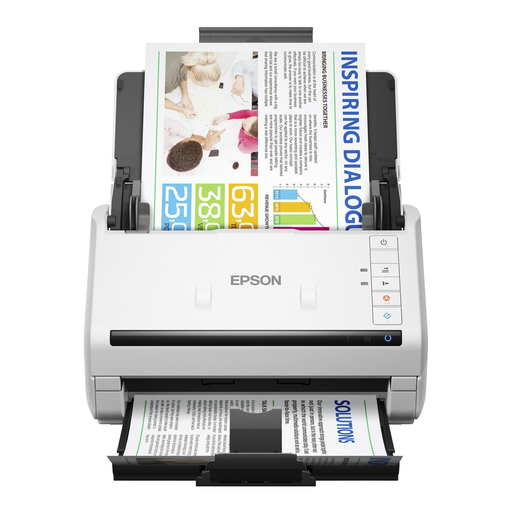 No image available
Epson WorkForce DS-530 II
Worth comparing for loose handouts you want to scan double-sided; check the feeder capacity and that the connection and software work with your computer.
600 × 600 DPI; A4.
View at Joybuy
Frequently asked questions
Can I feed a pile of handouts into a portable scanner all at once?
Not based on the term ‘automatic mode’ alone. Canon and Brother specify a 20-sheet ADF for the R10 and ADS-1300 respectively, while Epson describes the ES-50 as offering continuous scanning. Check the exact model’s feeder capacity.
How do I get started with scanning, and what should I check afterwards?
Follow the manufacturer’s connection instructions, choose your preferred PDF and any OCR settings, then check a test file for missing reverse sides, page order and readability. Before buying, check that the software supports your computer.
What if the scanner develops a fault, or I find I need a different type after buying online?
If a product is faulty, the seller is responsible for the statutory guarantee; a manufacturer’s guarantee doesn’t replace it. According to the Netherlands Authority for Consumers and Markets’ ConsuWijzer service, online consumer purchases generally come with a 14-day cooling-off period from delivery, subject to applicable exceptions.
Can I share scanned handouts with my project group?
For copyright-protected material, the Dutch Government allows a copy for personal use, but you can’t distribute or publish it under that private-copy exception. Before sharing, check whether you have permission or whether another arrangement applies to the specific use. If the scans contain pupils’ personal data and the school processes it, schools must also meet privacy obligations, as explained by the Dutch Data Protection Authority.


