For individual handwritten letters that fit on the scanning bed, a flatbed scanner is one option. For fragile or bound originals that you don’t want to feed through rollers, an overhead scanner may be more suitable. Measure both your largest sheet and the available space on the shared desk. A searchable PDF feature doesn’t prove that handwriting will be recognised accurately.
Who is this guide for?
Keeper of individual family letters
You want to preserve the handwriting and appearance of individual letters digitally, without handling the originals more than necessary. The National Archives of the Netherlands describes digitisation as a way to reduce wear and tear on paper records.
Shared-desk user
You’re looking for a scanning setup that fits on your desk and want to prevent others from seeing personal letters or files. The Dutch Data Protection Authority stresses that personal data must be protected from access by unauthorised people.
Keeper of fragile correspondence
You scan fragile or bound letters that may not be suitable for feed rollers or being pressed flat. Contactless overhead scanning and a flatbed with a book-edge design are two different ways to capture these items.
What should you look for?
Compact A4 flatbed scanner
Choose this option: you mainly scan individual letters that fit on the scanning bed and can lie flat on the glass.
Bear in mind: larger sheets or bound items may not fit properly for a single flat scan.
Overhead scanner or document camera
Choose this option: you want to capture fragile items from above without feeding them through rollers.
Bear in mind: measure the space needed for the arm, mat and original while scanning.
Flatbed scanner with book-edge design
Choose this option: you scan bound letters or pages that can safely lie on the glass and fit within A4 for each scan.
Bear in mind: the book must be able to lie open without harmful pressure, and the page will be in contact with the glass.
| What to consider |
What to look for when buying |
Who it’s for |
| Clear image copy |
Check that the whole sheet, including the edges and any envelope, fits on the scanning bed. |
I want to keep a clear image of the letter and handle the original as little as possible; around 36% of consumers prioritise preserving the image. |
| Desk space and privacy |
Measure the space needed during and after use, and check where files are stored and who can access them. |
At a shared desk, I want to be able to put the scanner away and keep personal scans private; around 29% of consumers prioritise workspace and privacy. |
| Careful handling of originals |
Check that the item lies open without being forced, and that contact with the glass or overhead scanning is suitable for the original. |
For fragile or bound letters, I want to avoid unnecessary pressure and feeding; around 21% of consumers prioritise careful handling. |
| Searchable text |
Check whether the feature specifically supports handwriting recognition and test it with similar letters. |
If I want to find passages in handwritten letters, I need more than just an image; around 14% of consumers prioritise searchable text. |
Common buying mistakes
-
Assuming a searchable PDF means handwriting has been recognised
A PDF with searchable text is not automatically an accurate transcription of handwritten letters. The National Archives of the Netherlands describes handwriting recognition as a separate application.
Ask whether the feature recognises handwriting, test it with a representative letter of your own, and keep the original image scan.
Checking or manually transcribing recognised text can take extra time.
-
Assuming other CZUR models’ book features are available on the Shine 800 A3 Pro
CZUR positions the Shine 800 A3 Pro for flat sheets; the book-flattening features described are found in other product ranges.
Compare the features of the exact model with the condition and format of the letters you want to scan.
-
Only checking the scanner’s storage dimensions
An overhead setup needs space for the original and equipment while scanning. With an A4 flatbed, the scanning bed determines whether a larger sheet will fit in one go.
Measure your largest unfolded original and the available desk space with the scanner set up and ready to use.
-
Leaving scans on a shared computer
Letters may contain names or addresses. Files saved on a shared workstation could be accessible to others.
Check the storage folder and access permissions, and put away papers and delete temporary files when you’ve finished.
Brands worth comparing
CZUR
CZUR positions the Shine 800 A3 Pro for flat sheets; other CZUR ranges are designed for books.
- CZUR lists A3 and 8 MP for the Shine 800 A3 Pro.
- Book-flattening features from other product ranges aren’t available on this model.
Ricoh ScanSnap
Ricoh describes the SV600 as an overhead scanner for books and fragile documents, among other items.
- Ricoh lists contactless scanning and book correction for the SV600.
- These features don’t prove that handwritten letters will be converted into text accurately; check how much desk space you’ll also need.
Plustek
The Dutch specifications position the OpticBook 3800L as an A4 flatbed scanner with a book-edge design.
- Plustek Netherlands lists a 6 mm book edge and a 216 × 297 mm scanning area.
- Check that the bound page can lie on the glass without harmful pressure.
Epson
The Perfection V39II is a flatbed scanner for photos and documents.
- Epson lists a built-in stand that lets you position the device upright.
- It’s still a flatbed scanner, so check whether individual letters will fit on the scanning bed.
Canon
The CanoScan LiDE 400 is an A4 flatbed scanner with a USB-C connection and a Z-lid.
- Canon lists a maximum scanning size of 216 × 297 mm and five scan buttons.
- A larger sheet won’t fit fully in one flat scan; PDF features don’t prove that handwriting is recognised.
IRIS
The IRIScan Desk 6 Pro is a document camera with several output options.
- The Dutch manufacturer’s catalogue lists both image PDFs and searchable-text PDFs.
- A file with searchable text isn’t, on its own, proof that handwritten letters will be recognised accurately.
Joybuy products
These Joybuy products offer two options for individual handwritten letters: an A4 flatbed scanner and a document camera for flat sheets up to A3.
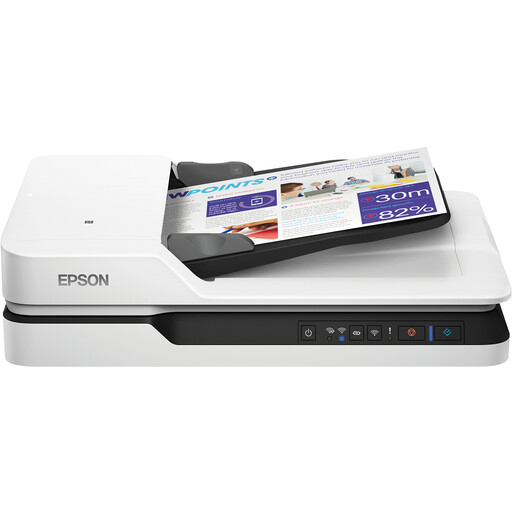 Image unavailable
Epson WorkForce DS-1660W flatbed scanner, A4, 1200 × 1200 DPI
A flatbed option for individual letters that fit on the scanning bed.
The product name lists A4 and 1200 × 1200 DPI; check that your largest sheet fits on the scanning bed.
Joybuy
 Image unavailable
CZUR Shine 800 A3 Pro document camera
An option for larger, flat letters when you have enough space for an overhead setup.
The product description lists flat sheets up to A3 and OCR; this doesn’t prove that handwriting will be recognised accurately.
Joybuy
Frequently asked questions
Can a book scanner automatically make my handwritten letters searchable?
Not automatically: an image scan and readable text are two different things. The National Archives of the Netherlands describes handwriting recognition as a separate application; a reference to OCR or a searchable PDF doesn’t prove that your handwriting will be read accurately. Keep the image scan and check any transcript.
What should I check before setting up a scanner on a shared desk?
Measure the space the scanner needs while it’s in use, and check where files are stored and who can access them. The Dutch Data Protection Authority stresses that personal data must be protected from access by unauthorised people; keep personal letters private when you leave your workspace.
Can I scan personal letters and share the scans?
This depends on factors including how the scans will be used and what the letter contains. According to the Dutch Data Protection Authority, processing carried out solely for personal or household purposes falls outside the GDPR; this exemption doesn’t apply to organisations. The Government of the Netherlands also distinguishes between making a copy for personal use and distributing or publishing copyright-protected work.
What cooling-off period applies when buying a scanner online?
For many online purchases by consumers from a business in the Netherlands, there’s a statutory 14-day cooling-off period, although exceptions apply. The Government of the Netherlands describes this as a consumer right; check whether it applies to your specific purchase.


