If you regularly scan bound catalogues without pressing the spine flat, start by looking at an overhead scanner with a capture area large enough for the open pages. A book-focused flatbed scanner may suit you if the pages can lie on the glass; for the occasional loose page, a more compact scanner may be enough. Test-scan glossy images and text near the spine, check the software on your classroom computer, and find out what permissions apply before sharing scans.
Who is this for?
Teachers with bound catalogues
If you repeatedly scan catalogues with a sturdy or delicate spine, consider an overhead model so you don’t have to press the spine flat against a glass platen. CZUR, IRIS and Ricoh describe book-scanning or correction features on specific models.
Teachers who need catalogue images
For glossy pages, the scan size and the result on your own paper matter: use a test scan under your classroom lighting to assess reflections and captions. CZUR describes side lighting on its ET series, but that doesn’t tell you how every page will look.
Teachers short on desk space
If you mainly scan loose pages or occasionally scan a suitable book, storage space may matter more to you than book correction. Epson says the Perfection V39II has an integrated stand for storing the scanner on its side; CZUR positions the Shine 800 A3 Pro for flat pages.
What should you look for when choosing?
Overhead scanner for bound books
Choose this if: you often scan catalogues whose spines shouldn’t be pressed flat against glass, and the open pages fit within the capture area.
Trade-off: curvature correction doesn’t guarantee that small text, colours or details near every spine will be clear. You’ll also need space for the open book.
Book-focused flatbed scanner
Choose this if: the page fits on the scanning surface and you can position the book carefully against the glass edge. Plustek specifies a 2 mm book edge for the OpticBook 4800.
Trade-off: you’ll need to reposition the pages each time, so check that the size and binding allow for this.
Compact flatbed scanner for occasional use
Choose this if: you mainly scan loose A4 pages or occasionally scan a catalogue that opens easily, and want to put the scanner away after use. Epson says the Perfection V39II has an integrated stand.
Trade-off: this is an A4 flatbed scanner, not an overhead scanner designed specifically for thick books. Check that the page and binding fit on the glass.
Foldable camera for flat sheets
Choose this if: you mainly want to capture loose, flat pages and be able to put the device away after use. CZUR positions the Shine 800 A3 Pro for flat pages up to A3.
Trade-off: CZUR distinguishes this model from scanners with book correction, so don’t treat it as a book-focused scanner for bound catalogues.
For bound books, measure the open pages and check a test scan near the spine. If images, limited workspace or searchable text will influence your choice, check the points below too.
| Key consideration |
What should you check? |
Who should prioritise this? |
| Binding and text near the spine |
Measure the open catalogue and check that it fits within the capture area; assess a test scan near the spine. |
If I often scan a firmly bound catalogue, I don’t want to press the spine flat and need to be able to read text near it. Around 33% of consumers prioritise binding and readability near the spine. |
| Images and glare |
Under your classroom lighting, test-scan a glossy image with a small caption. |
If I want to use images from catalogues, I need to assess reflections and loss of detail. Around 27% of consumers prioritise usable images. |
| Workspace and storage |
Compare the space needed during use and storage; decide whether you mainly scan books or loose pages. |
If I have limited desk space, I want to know whether the scanner can be put away after class and whether its feed method suits my pages. For around 20% of consumers, a storable scanning setup is the top priority. |
| Searchable text and software |
Check the export format, the software on your classroom computer and a test file with small captions. |
If I want to find text and captions later, I need to be able to create a searchable file and check for recognition errors. Around 20% of consumers give searchable text and software top priority. |
Things to watch out for when buying
-
Confusing a document camera with a book scanner
According to CZUR, the Shine 800 A3 Pro is designed for flat sheets and differs from models with book correction. That feature may therefore be a deciding factor when choosing a scanner for a bound catalogue.
Check the features of the exact model, and choose this camera mainly if you want to capture flat pages.
-
Focusing only on scan speed or stated resolution
A stated speed or feature won’t necessarily tell you whether reflections, fine details and text near the spine will be clear in your catalogue.
Test a glossy page, a dark image and a page with a small caption before choosing a model.
-
Assuming you can share a scanned catalogue freely
A scan of copyrighted material isn’t automatically free to distribute. The Dutch government outlines conditions for digital copying and sharing; educational use may be covered in certain circumstances.
Before sharing, check what material you’re using, who you’re sharing it with, and what permission or arrangement applies.
Brands to consider
CZUR
According to CZUR, the ET series is designed for bound books and includes curvature correction. The Shine 800 A3 Pro is a different option for flat pages.
- CZUR lists contactless capture and side lighting for the ET series.
- According to CZUR, the Shine 800 A3 Pro is a document scanner and doesn’t have the book correction found on the Shine Ultra series. Don’t assume that ET series features are included on this model.
IRIS
IRIS positions the IRIScan Desk 6 Pro for book capture up to A3, curved-page correction and export to searchable PDF.
- These features may be useful if you want to scan book pages and find text later.
- Stated speed and correction features don’t guarantee that small details in every catalogue will be readable. The IRIS Helpdesk lists camera access as a setting required for installation on Windows and macOS.
Plustek
The OpticBook 4800 is a book-focused flatbed scanner for pages that fit on the glass.
- Plustek lists a 2 mm book edge and the option to create searchable PDFs.
- You’ll need to position the pages individually. Check that the software and version of the model on offer suit your classroom computer and intended use.
Ricoh ScanSnap
Ricoh describes the SV600 as a contactless overhead scanner for books and A3 documents, among other things.
- Ricoh lists automatic book correction and page-turn detection.
- Ricoh specifies a maximum document thickness of 30 mm for this model. Check that your catalogue is within the product specifications.
Epson
According to Epson, the Perfection V39II is an A4 flatbed scanner for pages that fit on the glass, and for anyone who wants to store their scanner compactly.
- Epson lists an integrated stand that lets you store the scanner on its side.
- This model isn’t specifically designed as an overhead scanner for thick books. Check that the catalogue page and binding fit on the glass.
Joybuy product picks
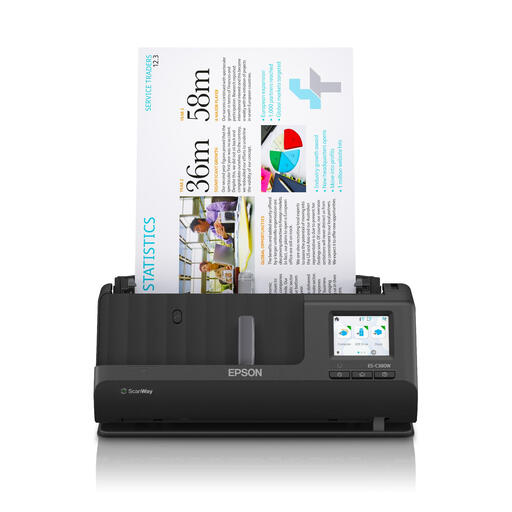
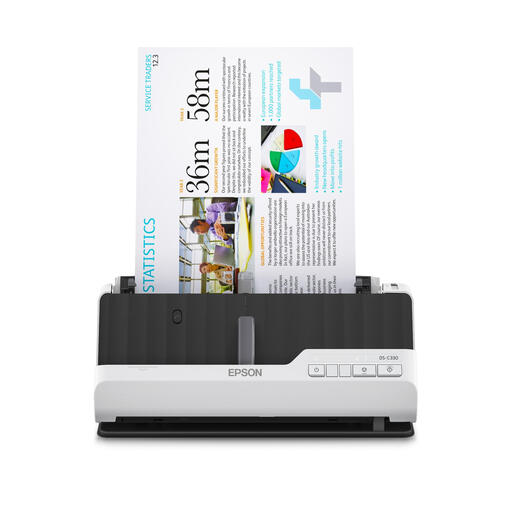
These products are intended for thin booklets fed through the scanner or for flat, loose sheets. For a bound catalogue, check that the exact model suits its thickness, binding and feed method.
 No image available
EPSON ES-C380W ADF Sheet-Fed Scanner 600 x 600 DPI, A4, Black
The description mentions a U-shaped paper path for booklets up to 5 mm thick. Check that your catalogue is within this thickness limit and suits the feed method.
The product name lists 600 x 600 DPI and A4.
View at Joybuy
 No image available
EPSON DS-C330 ADF Sheet-Fed Scanner 600 x 600 DPI, A4, Black, White
The description mentions support for booklets up to 5 mm thick and a U-shaped paper path. Check that the thickness and feed method suit your catalogue.
The product name lists 600 x 600 DPI and A4.
View at Joybuy
 No image available
CZUR Shine 800 A3 Pro
This foldable model is designed for flat, loose sheets up to A3, not for the book correction offered by a book scanner.
The product name lists OCR and compatibility with Windows and macOS. The product description advises against scanning high-gloss materials.
View at Joybuy
Frequently asked questions
How can you check whether a large catalogue will fit on the scanner?
Measure the open catalogue and compare the page you want to capture in a single scan with the capture area of the exact model. Check any thickness limits too, and test-scan near the spine; the A3 label alone won’t tell you how a thick book will sit on the scanner.
What do you need to use an IRIScan Desk 6 Pro with a classroom computer?
Check whether you’re allowed to install software on the classroom computer and whether the software can access the camera. The IRIS Helpdesk provides installation guidance for Windows and macOS and lists camera access as a required setting.
Can you share scans of exhibition catalogues with pupils?
Not automatically. The Dutch government outlines the conditions for getting permission to digitally copy and share protected publications; auteursrecht.nl describes educational use subject to certain conditions. Check what permission or arrangement applies to the material, the educational purpose and how you intend to share the scan.
Can you assume a fixed statutory two-year guarantee when buying for a school?
Don’t assume so. The Dutch government says there is no fixed statutory guarantee period in the Netherlands, and that the seller is the point of contact for a faulty consumer product. When buying on behalf of a school, also check the contractual terms and whether consumer rules apply.


