
Keeper of bound minutes
You want to digitise meeting pages without taking the book apart. Check how well the scanner captures text near the spine, how much desk space you need and whether the book can lie open without being forced.


For bound club minutes, a book scanner or book-friendly flatbed is a better fit. For lots of loose, double-sided sheets, a document scanner with a paper feeder may be more practical. Also check how much desk space you have and whether the files you create contain searchable text. A stated OCR feature doesn’t guarantee that old minutes or handwriting will be recognised accurately.
You want to digitise meeting pages without taking the book apart. Check how well the scanner captures text near the spine, how much desk space you need and whether the book can lie open without being forced.
You want to be able to search for words later. The National Library of the Netherlands explains that OCR can make text searchable, so check whether the output file contains recognised text rather than just page images.
You process loose, possibly double-sided sheets and want to know whether a paper feeder is more convenient than positioning each page individually. A feeder is designed for loose documents, not an intact book.
A good fit if: you want to scan bound minutes regularly without putting them through a paper feeder. IRIS describes the Desk 7 Pro as compact and says it corrects curved book edges.
Bear in mind: the space you’ll need and the results near the spine. CZUR positions the Shine 800 A3 Pro mainly for flat, loose pages, not as a proven solution for thick bound volumes.
A good fit if: you can take your time positioning pages one by one. Plustek lists a 2 mm book edge for the OpticBook 4800; Epson says its cover can be removed to accommodate thick bound material.
Bear in mind: you’ll need to position and turn the pages by hand. Check the scanning area and whether the book can lie open without being pressed in a way that could damage it.
A good fit if: the minutes are mostly loose, double-sided sheets. Canon lists a 20-sheet feeder and single-pass double-sided scanning for the imageFORMULA R10.
Bear in mind: an intact bound original can’t go through the feeder as a book. First work out what proportion of your archive consists of loose sheets.
A good fit if: you want to scan a few pages in different locations without setting up a permanent workstation. IRIS says the Book 7 works independently and creates PDF or JPEG files directly.
Bear in mind: you move the device over the page yourself. Try it out to see whether positioning and scanning near the spine works for your minutes.
When you’re scanning club minutes in a small room, your choice largely depends on the format of the originals, how you’ll use the archive and how much workspace you have.
| What to consider | What should you check? | Who is this most important for? |
|---|---|---|
| Bound pages | Check the scanning area, the space near the book’s spine and whether the book can lie open without being forced. | If we want to keep the minutes book intact, I also want to capture text near the spine without forcing it open. Around 33% of consumers say bound originals are their top purchase priority. |
| Searchable files | Check whether the output contains recognised text and search a test file for words from your own minutes. OCR can make text searchable, but recognition errors are still possible. | If we want to find names or topics from meetings later, I want to know whether the PDF contains more than page images. Around 27% of consumers prioritise being able to find information again. |
| Loose sheets | Check whether the originals are suitable for feeding through the scanner, as well as the feeder capacity and double-sided scanning capability of the specific model. | If the minutes are mostly loose, double-sided sheets, I want to avoid having to position every sheet individually. Around 20% of consumers prioritise processing loose sheets. |
| Space and portability | Check how much room the scanner takes up when in use and whether you can put it away or move it afterwards. | If the room is shared or cramped, I want a scanner that suits the available workspace and storage options. Around 20% of consumers make portability their top priority. |
CZUR positions the Shine 800 A3 Pro mainly for flat, loose pages. That doesn’t prove it will capture text near the spine of a thick book well.
Check the exact model and, if possible, scan a test page from a bound book before you decide.
If the scan near the spine isn’t usable, you may have to capture the pages again.
A PDF may contain only page images. OCR converts text into recognised, searchable text, but the results can include recognition errors.
Check the output format and search a test file for words you can recognise from your own minutes.
Without reliable text recognition, finding information later could involve extra manual work.
A paper feeder is designed for loose sheets and can’t process an intact bound minutes book.
Separate loose pages from bound volumes first, then choose a scanner based on the originals you process most often.
If you regularly have both types of original, you may need two different scanning methods.
Worth considering both for a fixed overhead set-up and for scanning independently with a handheld scanner.
The Shine 800 A3 Pro is most relevant for flat minutes and larger loose pages.
The OpticBook 4800 is a book-friendly flatbed scanner for pages you position one at a time.
The Perfection V39II offers a compact flatbed option for individual pages and bound material.
The imageFORMULA R10 is worth considering if your club minutes are kept as loose sheets.
This selection focuses on loose minutes and flat pages: the Epson WorkForce models are designed for loose sheets, while the CZUR Shine 800 A3 Pro is for flat pages. None of these feeder scanners is designed for an intact bound minutes book.
 No image available
An option for loose A4 minutes if a portable scanner suits your workspace; not designed for an intact bound book.
600 × 600 DPI; A4; white.
 No image available
Suitable for loose minutes if you’re looking for a portable feeder scanner; check first that your sheets are suitable for feeding through it.
600 × 600 DPI; A4; white.
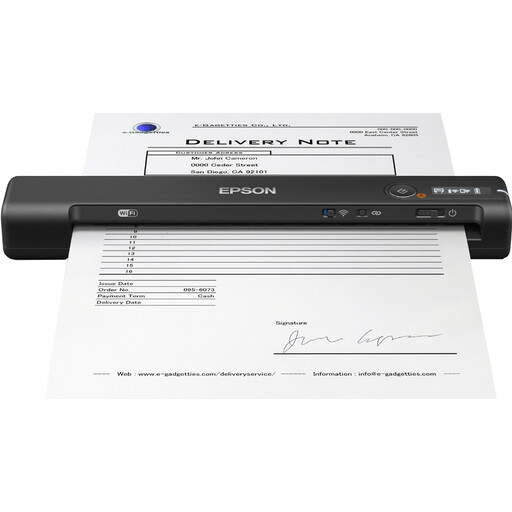 No image available
A portable option for loose minutes in a room where you need to be able to move the scanner around; not for bound originals.
600 × 600 DPI; A4; black.
 No image available
Worth considering for loose, flat minutes when you’re looking at an overhead camera; don’t treat this model as a proven solution for thick bound books.
Supports flat sheets up to A3; CZUR lists an 8 MP sensor for this model.
Check whether the software creates the searchable output format you need, and test text recognition on your own minutes.
Open the output file and search for a recognisable word from the minutes. A PDF made up of images alone isn’t enough: OCR makes text searchable, but check a test file for recognition errors too.
No. Use the paper feeder for suitable loose sheets. For an intact book, choose a suitable book scanner or flatbed and check that it can capture the pages properly near the spine.
If the minutes contain personal data, the organisation must identify an appropriate lawful basis under the GDPR for processing it and restrict access appropriately. The Dutch Data Protection Authority states that personal data must not be kept for longer than necessary, and that the GDPR does not set a general fixed retention period for this. The lawful basis and retention period that apply to a particular club depend on its circumstances.
Not necessarily when you make a consumer purchase in the Netherlands. ACM ConsuWijzer explains that statutory rights apply alongside any manufacturer’s warranty. Check whether the purchase is legally classed as a consumer purchase made on behalf of the club; choosing a particular scanner doesn’t determine this on its own.