For scanning bound reference books regularly, an overhead scanner that doesn’t flatten the spine is best suited to the job. Check with a test scan that text near the gutter remains legible. A compact scanner or document camera may be a better fit for loose pages, limited workspace or live display, but these devices aren’t interchangeable. Before sharing or displaying scans digitally, also check which educational licence applies to your institution and intended use.
Who is this guide for?
Teachers with bound reference books
You want to capture pages from books regularly without flattening the spine. Look at how the scanner captures the gutter, and check the image correction using one of your own books. CZUR and IRIS describe these features for specific models.
Teachers who use text digitally
You need legible or searchable pages for permitted teaching use. Check the OCR output as well as the terms for sharing it. IRIS and CZUR describe OCR features for certain models; Education and Copyright explains the terms for educational use.
Teachers with limited desk space
You want to show a page quickly or scan one occasionally on a small desk. Compare a compact overhead scanner with a document camera, and check that the device you choose produces the files you need. CZUR and Epson describe different uses for their models.
What should you look for?
Overhead scanner for bound books
Choose this option: if you scan books regularly and don’t want to flatten the spine. CZUR describes the ET series as capturing images without pressing on the spine; IRIS describes book scanning and curved-edge correction for the Desk 7 Pro.
Keep in mind: correction and OCR don’t guarantee that small text near the gutter will be legible in every book. Try a test scan and check the software requirements.
Compact overhead scanner
Choose this option: if easy storage and a scanning area of up to A3 matter, for example, for loose pages or occasional scans. CZUR describes the Shine 800 A3 Pro as a foldable model with an adjustable arm.
Keep in mind: don’t treat the Shine as an ET model: the laser correction described for the ET series has not been confirmed for the Shine 800 A3 Pro.
Book-focused flatbed scanner
Choose this option: if you want to scan individual pages from bound books on a glass platen. Plustek positions the OpticBook 3800L as an A4 scanner designed for books.
Keep in mind: you’ll need to position the book on the glass platen; consider whether this is practical for your book and intended use.
Document camera for live teaching
Choose this option: if your main aim is to display and discuss pages on a screen. Epson positions the ELPDC21 for live classroom display.
Keep in mind: a live image isn’t automatically an OCR file. Check file export separately if you need searchable scans.
| Buying concern |
What should you check? |
Who is this important for? |
| Scanning bound pages |
Look at a test scan of a similar book, especially near the gutter and where the text is small. Check how the model handles the book’s spine. |
If I scan bound reference books often, I don’t want to flatten the spine, and I check the text near the gutter. Around 36% of consumers say preserving bound books is their main buying concern. |
| Legible digital text |
Compare a sample page as an image and as a searchable PDF; check the text recognition against the original page. |
When I want to use text digitally, I look for legibility and searchability, and check for OCR errors. Around 29% of consumers prioritise usable digital text. |
| Workspace and classroom use |
Measure the available desk space and check compatibility with the classroom display or school computer. |
On a small desk, I want to be able to fit the device, or show pages to the class straight away. Around 21% of consumers give limited workspace or live classroom use their highest priority. |
| Set-up and support |
Check the exact model, software requirements, compatibility with the school computer and the warranty terms offered. |
If I want to use the scanner with existing school equipment, I check in advance that the software and connection are compatible. Around 14% of consumers say easy set-up and support are their main buying concern. |
Common buying mistakes
-
Mistaking a document camera for a specialist book scanner
A camera designed mainly for live display won’t necessarily replace a scanner made for OCR or correcting curved pages. Features vary by model.
Start with your main task: showing pages live or scanning bound books repeatedly. For the latter, assess a test scan of a page near the gutter.
You may need to spend extra time correcting curved pages or recognition errors afterwards.
-
Assuming models in the same brand range share the same features
A feature the manufacturer describes for one model won’t automatically be available on another model from the same brand. For example, the laser correction described for the CZUR ET series isn’t necessarily a feature of the Shine 800 A3 Pro.
Check the full model name and the features listed specifically for that version.
-
Assuming a scan can automatically be shared
A scanner doesn’t give you permission to distribute copyright-protected teaching materials. The terms vary depending on the type of education, institution, amount and use.
Before sharing, check which licence applies to your situation and ask for permission if your intended use falls outside it.
You may need permission or to pay a fee; the terms depend on the applicable licence and how you use the material.
Brands to compare
CZUR
CZUR describes the ET series as designed for bound books, with features for correcting page curvature. According to CZUR, the foldable Shine 800 A3 Pro is a separate model with an adjustable arm and an 8 MP camera.
- CZUR describes the ET series as capturing images without pressing on the book spine, with laser-guided correction.
- Don’t assume ET features are available on the Shine 800 A3 Pro without checking that model’s specifications.
IRIS
IRIS positions the Desk 7 Pro as a compact document camera that is also designed for book scanning.
- IRIS lists an 18 MP sensor, OCR, text-to-speech and curved-edge correction for this model.
- These are IRIS specifications and claims; check legibility for yourself using pages from your own books.
Plustek
The OpticBook 3800L is an A4 flatbed scanner designed for books, offering a different approach from an overhead camera.
- Plustek describes features to reduce shadows near the book gutter, as well as OCR output.
- You position the book on the glass platen; check whether this approach is suitable for the book you want to scan.
Epson
Epson positions the ELPDC21 as a document camera for live classroom display, rather than primarily as a specialist OCR book scanner.
- Epson Nederland lists Full HD live imaging and an A3 scanning area that fits two textbook pages.
- Check file export and text recognition separately if you want to save scans or need searchable text.
Joybuy products
These options are intended for compact scanning of loose pages and thin booklets. Check the limit for bound materials and whether the version you choose suits the way you work.
 No image available
CZUR Shine 800 A3 Pro
Suitable for loose pages or occasional book pages if you need a foldable overhead model and a scanning area of up to A3.
The product name lists OCR, an A3 area for loose pages and compatibility with Windows and macOS. The laser correction described for the ET series has not been confirmed for this model.
Joybuy
 No image available
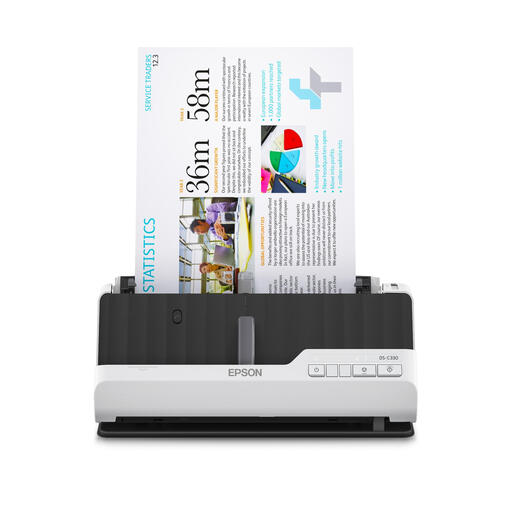
EPSON DS-C330 ADF + Sheet-Fed Scanner
Consider this model only for thin booklets: the product information for this model limits use to materials no more than 5 mm thick.
The product name lists A4 and 600 × 600 DPI. Check whether the feed method is suitable for your bound reference book.
Joybuy
 No image available
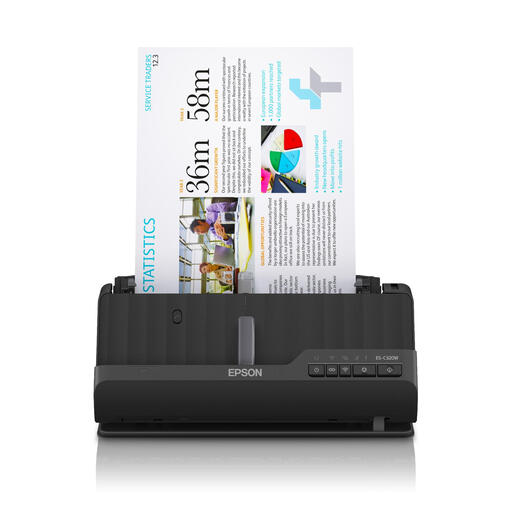
Epson ES-C320W ADF + Sheet-Fed Scanner
Consider this model only for thin booklets: the product information for this model limits use to materials no more than 5 mm thick.
The product name lists A4 and 600 × 600 DPI. Check whether the feed method and software are suitable for using it with your bound reference books.
Joybuy
Frequently asked questions
Can I hand out scanned reference pages to pupils or students?
Not automatically: a scanner doesn’t grant copyright permission. The Dutch Government states that a private copy for personal use may not be distributed; the terms for teaching use depend on factors including the type of education, institution, amount and method of distribution. Check which educational licence applies or ask for permission.
Is there one maximum page limit for every classroom in the Netherlands?
No, the limits mentioned apply to specific educational arrangements and types of use. Education and Copyright states that the use described for secondary education is limited to no more than 10% and a maximum of 10 pages. For affiliated UNL universities, Stichting UvO lists a maximum of 40 pages under the 2026–2031 arrangement, capped at 20% of the work; for affiliated VH universities of applied sciences, the foundation lists a maximum of 50 pages or 25%. First check which arrangement applies to your institution and intended use.
Is a searchable PDF the same as a checked text copy?
No. OCR can make text searchable, but check names, small print and text near the book gutter against the original page before using the file.
Can I use a document camera instead of a book scanner?
It may be suitable if your main aim is to show pages directly to the class; Epson positions the ELPDC21 for live display. If you need searchable files, check OCR and file export separately. There may also be conditions on displaying protected material; Education and Copyright covers display in primary education separately.


