
Home archive keeper
You want to organise scanned documents locally and, above all, be confident you can retrieve them if your computer or drive fails. The NCSC recommends making backups and testing them.


If your scan archive will mainly stay at home and storage space is your priority, a portable HDD could be a good fit. If you often take the drive with you or regularly transfer files, consider an SSD. First, check how much space your scans take up, make sure the connection and file system are right for you, and keep a separate copy: one external drive is not a complete backup strategy.
You want to organise scanned documents locally and, above all, be confident you can retrieve them if your computer or drive fails. The NCSC recommends making backups and testing them.
You might store documents containing personal data and want to restrict access if a drive you take with you goes missing. The Dutch Data Protection Authority, Microsoft and Apple provide information about security and encryption.
Your collection is growing, and you want to weigh up capacity, connections and portability before choosing an HDD or SSD. The Consumers' Association and manufacturers outline relevant differences and product specifications.
A good fit if: the drive will mainly stay at home and you need space for a growing scan archive.
Trade-off: an HDD has moving parts and, according to the Consumers' Association, is more vulnerable to knocks than an SSD. So make sure you also keep a separate copy.
A good fit if: you regularly take the drive with you or often transfer files.
Trade-off: don’t pay extra for a high advertised speed if you only copy documents occasionally. An SSD won’t replace a second copy either.
| Consideration | What to check before buying | Who should prioritise this? |
|---|---|---|
| Recovery without the cloud | Plan a separate copy and test that you can restore files; after a test restore, open a few scans. | If my computer or drive fails, I want to be able to retrieve my scans from a separate copy. The ability to recover files is the top priority for around 36% of consumers. |
| Confidentiality | Check how to encrypt the drive with your operating system and how to regain access without the cloud. | I store scans containing personal data and want to restrict access without locking myself out if I lose a key. Confidentiality is the main priority for around 29% of consumers. |
| Capacity | Check the size of your current scan folders and allow for growth and any extra copies. | I need space for my existing scans and anything I add later, while still being able to keep a separate copy. Having the right capacity is the top priority for around 21% of consumers. |
| Portability and connection | Check the ports available, the cables included and the file system format you need. | I regularly take the drive with me or use it with different computers, and want to make sure the connection is suitable. Portability and connectivity are the main priority for around 14% of consumers. |
If it fails or goes missing, you could lose the only stored copy of your scans. The NCSC recommends making backups and checking that files can be opened.
Keep a separate copy and test from time to time that you can retrieve a few documents.
An extra local copy requires a second storage device or location.
A drive that falls into someone else’s hands could contain scans they can access if it isn’t encrypted. Losing a recovery key, on the other hand, could prevent you from accessing your own files.
Check which encryption options work on your computer and make a plan for restoring access without the cloud.
Encryption and managing passwords or recovery keys require some attention.
Kingston says the XS1000’s advertised top speed requires a suitable USB 3.2 Gen 2 host. Copying documents occasionally has different requirements from regularly transferring large files.
First choose the capacity and connection that suit your needs, then consider whether extra speed matters to you.
Apple warns that formatting erases the files on the drive.
Check the format you need before filling the drive, and make a separate copy of any existing files first.
You’ll need another place to store any files already on the drive.
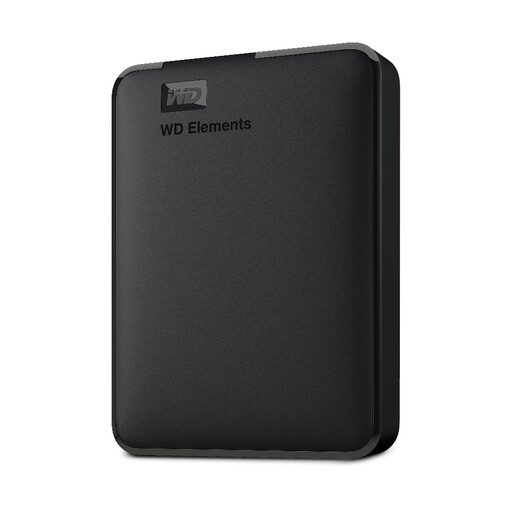
The WD Elements Portable WDBU6Y0020BBK-WESN is a portable HDD with an advertised capacity of 2 TB.
According to Seagate’s data sheet, the Expansion Portable range includes the 2 TB HDD variant STKM2000400.
The 2 TB Portable SSD T7 reviewed is a portable SSD variant; the T7 Shield is a separate model.
Kingston describes the XS1000 as a compact external SSD, available in 1 TB and 2 TB variants.
The Portable SSD SDSSDE30-1T00-G26 reviewed is a 1 TB portable SSD variant.
This selection includes portable HDDs for local storage and a portable SSD for anyone looking for a solid-state drive to store scans without the cloud.
 No image available
A portable HDD option for storing scans locally, with stated compatibility with Windows and Mac.
Capacity: 2 TB. Connection: USB-C. The product description lists exFAT and 256-bit AES hardware encryption with password protection.
 No image available
An HDD option for a local archive that needs more space. Check how much room your scans take up before choosing a capacity.
Capacity: 4 TB. Connection: USB-C. The product description lists exFAT, use with Windows, Mac and mobile devices, and 256-bit AES hardware encryption with password protection.
 No image available
A portable HDD for local storage. The product name says it’s formatted for PC and Mac.
Capacity: 2 TB. The product name lists USB 3.0; the product description mentions USB 3.2 Gen 1 and plug-and-play.
 No image available
A portable HDD option for scans you want to store locally.
Capacity: 2 TB. The product description lists USB 3.2 Gen 1 and 256-bit AES hardware encryption with password protection.
 No image available
A portable SSD option for anyone who wants to store scans on a solid-state drive and regularly take it with them.
Capacity: 1 TB. The product name lists USB Type-C and USB 3.2 Gen 2. The product description mentions AES-256 encryption with password protection, plus USB-C-to-C and USB-C-to-A cables.
Not if it contains the only copy of your scans. Keep a separate copy too, and check that you can restore or open a few files. The NCSC provides backup advice for organisations; the principles of keeping multiple copies and checking that you can restore them can also help you set up a local backup routine.
It depends on the file system format. Apple recommends ExFAT for an external drive larger than 32 GB that you want to use with both systems. Formatting erases the files on the drive, so make a separate copy first.
Check which encryption options work on your computer and how to regain access without the cloud. Microsoft lists BitLocker To Go for removable drives on Windows Pro, Enterprise and Education, but not Windows Home. Apple offers APFS (Encrypted) for Mac volumes. Keep any recovery key you need somewhere you’ll be able to find it.
According to the Dutch Data Protection Authority, the GDPR exemption applies to processing carried out solely for personal or household use. If you use scans for an organisation or professional purpose, you can’t automatically rely on that exemption; organisations must protect personal data appropriately.