
Calorie-conscious snackers
You want to take a savoury snack with you for a walking break and know in advance how much energy your portion provides. Compare the nutritional values per 100 g, then weigh out the amount you plan to eat.


For a calorie-conscious walking break, the portion you weigh out matters more than the small difference between the savoury coated nuts compared here. Product labels list 527–542 kcal per 100 g, which is above the 40 kcal per 100 g limit for a ‘low energy’ claim, as explained by the European Commission. If you’re planning a longer, strenuous walk, getting enough energy is part of your preparations too: the Voedingscentrum discusses sports nutrition for this kind of exertion, but that advice isn’t automatically a plan for every walk.
You want to take a savoury snack with you for a walking break and know in advance how much energy your portion provides. Compare the nutritional values per 100 g, then weigh out the amount you plan to eat.
You’re looking for something to eat on the go, but a snack alone isn’t a complete food and drink plan for prolonged, strenuous activity. Bear in mind how long and how challenging your walk will be, as well as what else you’re taking with you.
You pay attention to salt as well as calories. To compare, check the exact flavour variant for the same quantity; a brand name or flavour description won’t tell you how much salt it contains.
Start with the energy per 100 g, then work it out for your own portion. For a longer, strenuous walk, also consider how the snack fits into everything else you plan to eat on the way.
| What to consider | What should you check? | Who is it most relevant to? |
|---|---|---|
| Calories per portion | Compare kcal per 100 g and weigh your portion; calculate kcal per portion as kcal per 100 g × portion weight in grams ÷ 100. | If I want to limit how much I snack during a short break, I look at the energy in my own portion. Around 42% of consumers put portion information first. |
| Walk duration and effort | Decide whether you’re looking for a snack for a break or also planning what to eat during a longer, strenuous activity. | For a longer walk, I want to choose a snack that fits in with what else I eat, rather than focusing only on keeping calories as low as possible. This is the main consideration for around 25% of consumers. |
| Salt and flavour variant | Check the salt content per 100 g for the exact variant, and calculate it for your portion if needed. | If I’m also watching my salt intake, I want to see the nutritional values for the flavour I’ve chosen; ‘mild’ doesn’t tell me how much salt it contains. Around 17% of consumers prioritise salt. |
| Taking portions with you and storing the rest | Check the pack size and storage advice, and take only the amount you plan to eat. | For a practical walking break, I want to be able to portion out what I need in advance and store the rest according to the label. Around 16% of consumers consider this their top priority when choosing. |
Portion values can only be compared directly when the weights are the same. A different portion size doesn’t change the energy per 100 g.
Compare the values per 100 g first, then calculate them for one chosen, weighed portion.
For solid foods, the European Commission sets a maximum of 40 kcal per 100 g for a ‘low energy’ claim. A smaller portion doesn’t lower the nutritional value per 100 g.
Describe your choice as a smaller portion unless the product itself meets the requirements for the claim.
The PLUS Borrelnoten Mild product reviewed lists salt and ingredients including peanuts, wheat, milk and celery. The flavour name doesn’t provide this information.
Check the nutritional declaration and allergen information for the exact variant.
Pack size and portion size are different things. Once you’ve portioned out the contents, it’s still important to follow the storage advice for the rest of the pack.
Weigh out how much you want to take with you in advance, then follow the storage advice on the packaging.
Duyvis describes a range of savoury coated nut flavours and pack sizes. Cocktail and Provençale have separate Dutch product declarations.
The AH own-brand Cocktail variant comes in a 300 g pack, with nutritional information and a stated portion size of 25 g.
Jumbo Cocktailborrelnoten in a 300 g pack lists nutritional values per 100 g and per 25 g portion.
PLUS offers Borrelnoten Mild, among other products, in a 300 g bag with nutritional values and allergen information.
Lidl lists savoury coated nuts in various 250 g variants, which product information says are available in store.
Aldi product information lists Trader Joe’s savoury coated nuts in flavours including Bacon-kaas, Poesta and Paprika, in 300 g bags.
The products below are Duyvis savoury coated nuts in a range of flavours and pack sizes. Compare the declared values per 100 g and weigh out your own portion for your walk; none of the variants listed is low in energy according to the European threshold for that claim.
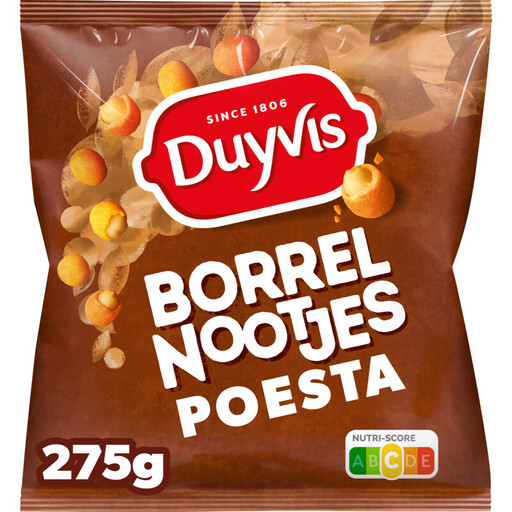 No image available
If you take this variant for a walking break, weigh out your portion in advance.
Nutritional values: 539 kcal and 1,4 g salt per 100 g.
Pack size: 275 g.
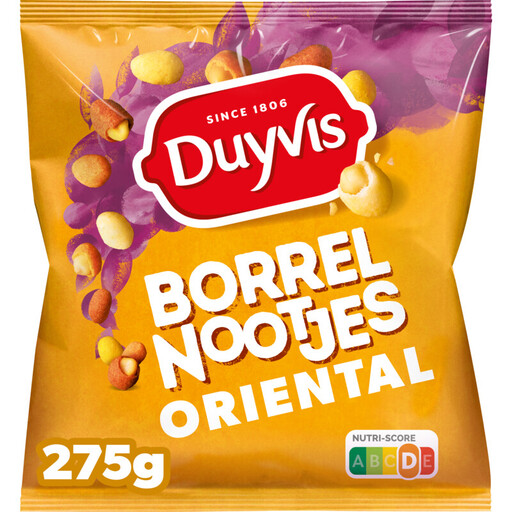 No image available
If you choose this variant to take with you, weighing out a portion will help you decide how much to bring.
Nutritional values: 539 kcal and 1,4 g salt per 100 g.
Pack size: 275 g.
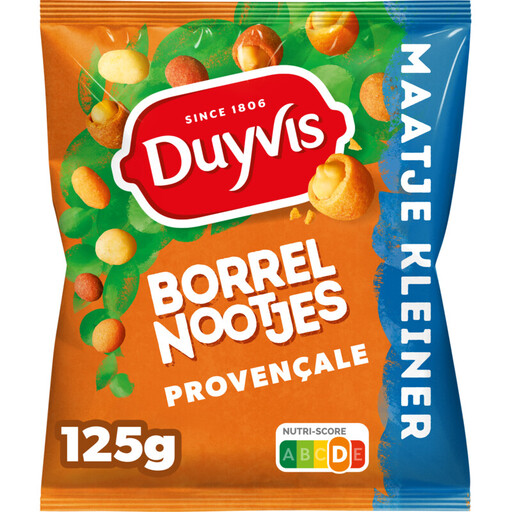 No image available
The stated 30 g portion can be a useful starting point when weighing out how much to take with you.
Nutritional values: 527 kcal and 1,2 g salt per 100 g.
Pack size: 125 g; the description lists 30 g portions.
 No image available
If you take this variant as a savoury snack, weigh out the amount you want rather than treating the whole bag as one portion.
Nutritional values: 542 kcal and 1,3 g salt per 100 g.
Pack size: 275 g.
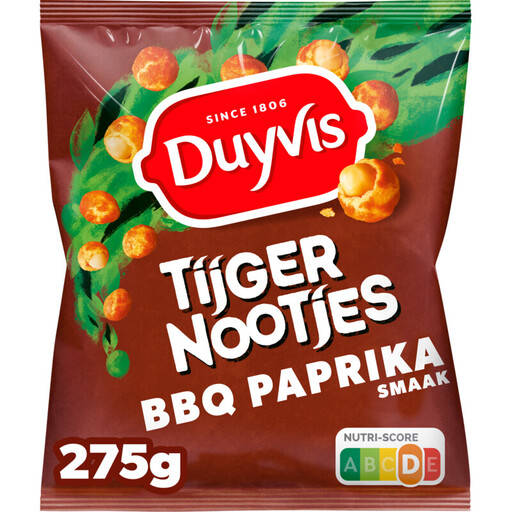 No image available
Weigh out your portion if you want to take this variant as a snack for a walking break.
Nutritional values: 535 kcal and 1,5 g salt per 100 g.
Pack size: 275 g.
No, not just because the portion is small. For solid foods, the European Commission sets a maximum of 40 kcal per 100 g for a ‘low energy’ claim; the five product declarations compared here are all above that, at 527–542 kcal per 100 g.
No. According to the European Commission, a ‘reduced energy’ claim requires at least 30% less energy and must state the characteristic responsible for the reduction. This is a different claim from ‘low energy’.
Multiply the kcal per 100 g by the number of grams you’ve weighed out, then divide by 100. For example, 25 g of a product with 541 kcal per 100 g provides 135,25 kcal; this is a calculation based on the product declaration.
Follow the advice for the exact variant. Duyvis Cocktail recommends storing it in a cool, dry place and keeping an opened bag in a light- and airtight container; AH Cocktail recommends closing the pack securely and storing it somewhere cool, dark and dry.
Always check the allergen information for the exact variant. The Duyvis Cocktail product reviewed lists milk as present, while Provençale lists milk as possibly present. The Netherlands Food and Consumer Product Safety Authority explains that allergen information for prepacked foods must appear on the label.
Not necessarily. The Voedingscentrum says that sports bars and gels can help maintain energy levels during prolonged, strenuous activity. That advice doesn’t turn every leisurely walk into an intense training session or a personal nutrition plan.