
Weekend cook with a favourite loaf tin
Wants to bake a savoury nut loaf in their own tin and is mainly looking for enough oven space and useful cooking settings. Albert Heijn Allerhande’s recipe uses a 1-litre cake tin.


Start by measuring your loaf tin and choosing an oven with a suitable cooking setting: fan-assisted cooking isn’t automatically right for every recipe. A freestanding model is a good fit if you don’t have a suitable built-in space; a built-in oven may suit you if you do, and want to use it for larger dishes or on multiple shelf levels.
Wants to bake a savoury nut loaf in their own tin and is mainly looking for enough oven space and useful cooking settings. Albert Heijn Allerhande’s recipe uses a 1-litre cake tin.
Is looking for a freestanding model and wants to check not only that there’s room for the tin, but also that the oven can be positioned safely according to the instructions for that specific model. Inventum and Severin offer examples of freestanding ovens.
Wants to use the oven for other dishes or on multiple shelf levels, as well as for a single loaf, and is therefore comparing the available oven space and features. Bosch and Siemens offer examples of built-in models.
| What to consider | What to look for | Who is this important for? |
|---|---|---|
| Cooking setting and results | Check which settings the model has and follow the setting specified in your recipe. Heel Holland Bakt points out that air circulation can dry out bakes more quickly. | If you want to match the cooking setting to your recipe, this matters more than extra features; around 33% of consumers give cooking settings and results top priority. |
| Room for your baking tin | Measure the tin, including any handles, and compare it with the usable internal dimensions and shelf position. Albert Heijn Allerhande’s recipe uses a 1-litre tin. | If you want to keep using your own loaf tin, you’ll want to know whether it will actually fit in the oven; around 27% of consumers prioritise space for their baking tin. |
| Positioning | For a freestanding model, check the positioning instructions and available space; for a built-in oven, compare the niche dimensions and connection requirements with your kitchen. | If you don’t have a suitable built-in space, or need an oven to fit an existing niche, the installation method is key; around 27% of consumers start with positioning. |
| Energy use and maintenance | Where available, compare energy use per cycle using the same cooking setting, and check which cleaning features the exact model has. Milieu Centraal also recommends considering the oven size and energy use per cooking session. | If you mainly want to weigh up energy use and cleaning, these factors matter more than the energy rating alone; around 13% of consumers prioritise energy use and maintenance. |
A title may not tell you enough about the features of the exact variant. Severin states that the TO 2052 does not have a fan-assisted function.
Check the full model number and heating settings in the manufacturer’s product information before you order.
The capacity in litres doesn’t tell you whether your loaf tin will fit on the shelf or whether there’s enough room beneath the heating element. Albert Heijn Allerhande’s recipe uses a 1-litre cake tin; that’s not the same as the oven’s capacity.
Measure the outside of your tin and compare it with the usable internal dimensions and shelf positions of the exact model.
The energy rating alone won’t tell you which size is best for your needs. Milieu Centraal also recommends considering energy use per cooking session and the size of the oven.
Where available, compare energy use in kWh per cycle using the same cooking setting, and choose the capacity based on what you usually cook.
Freestanding ovens; the OV457B is an example with fan-assisted cooking and top and bottom heat.
Built-in ovens; the HBA534BS3 is an example with several heating settings for a suitable niche.
Compact freestanding ovens; the TO 2068 is an example with fan-assisted cooking.
Built-in ovens; the NBS6C521AB is an example with several heating settings and a food sensor.
Built-in ovens; the HB278GEB7F is an example with fan-assisted cooking, top and bottom heat, and pyrolytic cleaning.
These models are designed for baking and roasting with circulating hot air, in either freestanding or built-in form. Check for each model that the cooking settings, available space and positioning suit your loaf tin and kitchen.
 Image unavailable
This freestanding fan-assisted oven suits anyone looking for a worktop model; check the internal dimensions against your loaf tin.
Capacity: 35 L. The product name lists a four-level baking rack.
 Image unavailable
This built-in model may suit you if you have a suitable niche; check the installation instructions and cooking settings for your recipe.
Capacity: 66 L. The product name lists five cooking programmes.
 Image unavailable
This built-in model is an option if you have a suitable niche and are looking for an oven with 3D HotAir; check the dimensions and cooking settings for your recipe.
Capacity: 71 L. The product name lists 3D HotAir and EcoClean Direct.
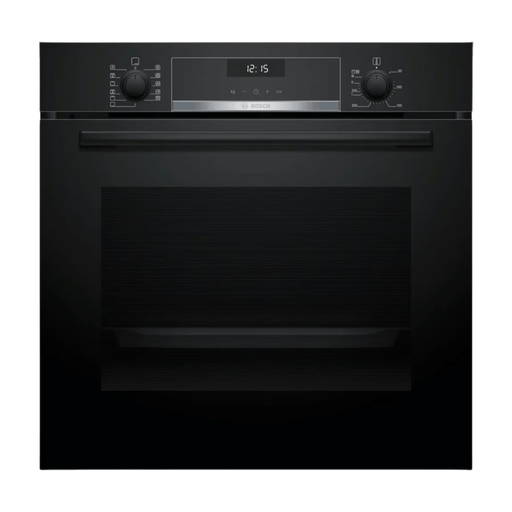 Image unavailable
This built-in model may suit you if you have a suitable niche; check that the heating settings work for your recipe and how you’ll use the oven.
Capacity: 71 L. The product name lists Air Fry and EcoClean Direct.
 Image unavailable
This freestanding oven with circulating hot air may suit you if you’re looking for features beyond baking; check the dimensions and positioning instructions.
Capacity: 30 L. The product name lists 21 presets and a power rating of 1800 W.
No, follow the cooking setting in your recipe first. Fan-assisted cooking and top and bottom heat work differently, and air circulation can dry out bakes more quickly. The loaf recipe we looked at specifies 175 °C, but that isn’t a universal setting for every oven or loaf.
Check the instructions for the exact model before positioning the oven. Pay attention to the required clearance, connection and guidance on hot surfaces; the instructions for the Inventum OV457B don’t automatically apply to other ovens.
According to ACM ConsuWijzer, you may have statutory rights in addition to any manufacturer’s warranty. If a product doesn’t meet the reasonable expectations you were entitled to have, the seller is responsible for providing an appropriate remedy free of charge, subject to the applicable conditions. There isn’t one fixed statutory warranty period that applies to all ovens.
No, not every compact oven is subject to the same labelling requirements. The European Commission includes household ovens within the scope of the rules, but excludes small and portable ovens. So don’t compare compact freestanding models as if they all have to display the same oven label.