
Vandaag of morgen in huis

Kwaliteit gegarandeerd

Welkomstaanbiedingen ontgrendelen: GRATIS bezorging | Tot 80% korting | Gratis 30 dagen JoyPlus-proefperiode
Download de app
You can use a saucepan for much more than just potatoes. Think soup, sauce, rice, pasta, vegetables and stews. Even so, choosing one isn’t always straightforward. A pan may appear suitable for induction, but have a base that’s too small in practice. A non-stick coating can be handy, but often needs a little extra care. And a large saucepan can take up more space than you’d expect from its diameter.
Use this guide to compare a saucepan on practical points: capacity, heat source, material, lid, care and intended use.
A 24 cm saucepan may have a relatively small capacity, while a deeper pan with the same diameter can hold several litres. So don’t look at the size alone: check the usable capacity, height and shape too. For one or two people, 1.7 to 2.5 litres is often practical. Families are more likely to need 3.5 to 5.5 litres or more.
A pan described as suitable for all heat sources must also have a magnetic or otherwise suitable base for induction. This is particularly important with aluminium: it conducts heat well, but doesn’t work on induction by itself. It usually needs an induction disc.
Check the product information to make sure the saucepan is explicitly suitable for gas, induction, ceramic and electric hobs. Also consider the diameter of the cooking zone. A base that’s much smaller than the induction zone may not heat as evenly.
“Dishwasher-safe” doesn’t mean the pan will look the same or last as long after every wash. Bakelite handles, wooden parts, non-stick layers and some coatings may benefit from being washed by hand. Always follow the manufacturer’s care instructions, and don’t use a metal scouring pad on a coated interior.
A saucepan measuring 16 to 18 cm is handy for sauce, milk, porridge or small portions of rice. A 20 to 22 cm saucepan with a capacity of around 2.5 to 3.5 litres is better suited to everyday cooking for two or three people. For pasta, soup or a larger meal, a 24 cm saucepan or a large stockpot makes more sense.
Don’t fill a pan to the brim. You’ll need room to stir soup, pasta and sauces, and to help prevent them boiling over. A glass lid with a steam vent can help, although it won’t prevent boiling over in every situation.
An aluminium saucepan is generally lightweight and responds quickly to changes in temperature. Aluminium needs a suitable base to work on induction. If the pan has a non-stick coating, wooden, silicone or plastic utensils are a better choice than metal spatulas.
A stainless steel saucepan is suitable for high temperatures and usually doesn’t have a non-stick coating. How evenly it distributes heat depends largely on how the base is made. Models with a multi-layer or composite base may distribute heat more evenly than thin, single-layer steel.
A non-stick saucepan is handy for sauces, porridge and dishes that tend to stick. Some brands state in their product descriptions that certain coatings are free from substances such as PFAS or PFOA. Treat this as a manufacturer’s product claim and check the latest specifications on the product page. Don’t leave a coated pan empty on high heat, and replace it if the coating becomes visibly damaged.
A saucepan with a lid holds on to heat and moisture more effectively. With a glass lid, you can keep an eye on the cooking without constantly opening the pan. Check whether the lid has a steam vent and whether the knob and handles are heat-resistant.
Pay attention to the construction too. Welded handles don’t have rivets or gaps on the inside where food residue can collect. Hand-washing is usually a better choice than a hot dishwasher cycle for pans with wooden handles.
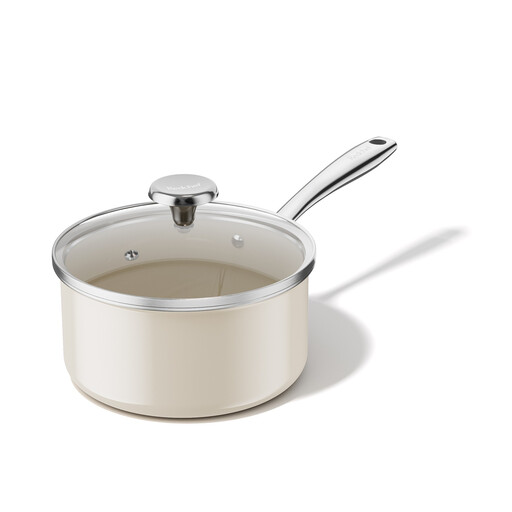
Why it suits this profile: With a capacity of 2.5 quarts, this pan is designed for one or two portions. This aluminium saucepan is handy for making sauce, soup, pasta or porridge in a smaller kitchen.
The product description explicitly states that it’s compatible with gas, induction, electric, ceramic and halogen hobs. The manufacturer also mentions a thick aluminium core and a ceramic non-stick coating; use soft utensils to protect the coating.
2.5-quart capacity, glass lid, pouring spout and, according to the product information, dishwasher-safe. Hand-washing is recommended to help the coating last longer.

Why it suits this profile: This stainless steel saucepan combines internal capacity markings with a glass lid and the versatility you need for everyday family meals.
The specifications state a capacity of 5.5 litres, a steam vent and suitability for induction, gas, electric, ceramic and halogen hobs. So you don’t have to rely on a marketing term such as “universal”.
Welded stainless steel handles, internal capacity markings and, according to the product information, dishwasher-safe. The pan is also suitable for oven use; check the limits for the glass lid.
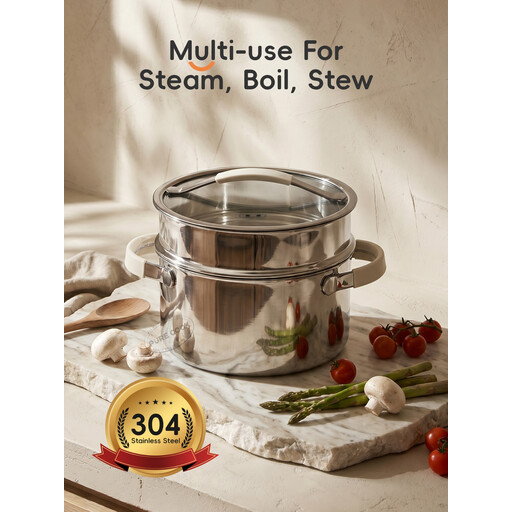
Why it suits this profile: This 24 cm stockpot is designed for meals for around three to five people, and lets you cook and steam in the same pan.
The product information specifies an uncoated 304 stainless steel interior, a composite magnetic base and compatibility with gas, induction and ceramic hobs.
Two steaming tiers, a glass lid and, according to the product description, dishwasher-safe. Use a soft sponge and dry the pan after cleaning.
We’ve put together a complete, up-to-date list of products that meet these strict selection criteria and current European safety regulations.
Choose a model that the manufacturer explicitly states is suitable for induction. Aluminium pans usually need a magnetic induction disc. Also check that the base diameter suits your cooking zone.
Around 2.5 to 3.5 litres is often enough for two people. For three to five people, 4 to 6 litres is more practical, especially for soup, pasta and stews. Check the height too, so you have enough room to stir and drain comfortably.
It depends on how you’ll use the pan. Aluminium is lightweight and heats up quickly, while stainless steel is generally suited to frequent use and high temperatures. A multi-layer base can improve heat distribution with either material. The right choice mainly depends on your hob, care preferences and the capacity you need.
