
Vandaag of morgen in huis

Kwaliteit gegarandeerd

Welkomstaanbiedingen ontgrendelen: GRATIS bezorging | Tot 80% korting | Gratis 30 dagen JoyPlus-proefperiode
Download de app
A good knife is half the battle in the kitchen. More and more home cooks and professionals are opting for a santoku knife, the versatile Japanese chef's knife. But its popularity also brings pitfalls. Many knives look beautiful at first glance but prove to be clumsy, quick to dull, or even unsafe in practice.
Before you buy a santoku knife, it's wise to know what to look for. We'll discuss the three most common marketing traps and explain which specifications truly make the difference between a bad purchase and an investment you'll enjoy for years.
To make a good choice, focus on the objective features that determine performance.
The type of steel determines how sharp the knife is, how long it stays sharp, and how you should maintain it.
Those indentations or dimples on the blade (also known as a Granton edge) are not just for show. They create small air pockets between the knife and the food. This helps prevent moist or starchy products, such as cucumber, potato, or raw fish, from sticking to the blade. This makes it an ideal vegetable knife and fish knife, as you can work more smoothly and quickly.
We have selected a number of santoku knives that suit different user profiles, based on their specifications and design.
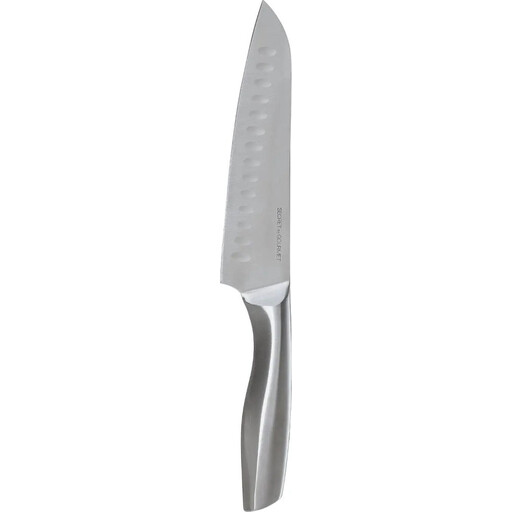
Why This Fits Their Persona: An excellent start for those seeking a functional and durable knife without a large investment. It's a no-nonsense knife that does what it's supposed to do: cut well.
This knife is fully forged from a single piece of stainless steel, providing better balance than many stamped knives in this price range. It avoids the pitfall of a misleading appearance and focuses on functional build quality.
Fully forged from stainless steel. Dishwasher-safe for easy maintenance.
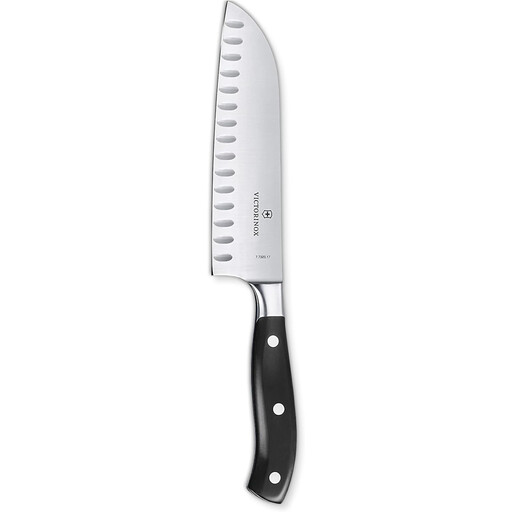
Why This Fits Their Persona: For the serious home cook looking for a reliable and versatile knife. Victorinox offers a great balance between price and performance, with a focus on ergonomics and functionality for daily use.
This knife focuses on performance rather than looks. The forged construction ensures good balance, and the dimples are a functional addition, not a gimmick. You're paying for Swiss reliability and a well-thought-out design.
Forged blade with dimples to reduce sticking. Ergonomic handle for comfortable, extended use.

Why This Fits Their Persona: An investment for the (semi-)professional cook who seeks precision and durability. This Wüsthof santoku knife is designed for performance and longevity, made in Solingen, Germany.
This knife makes no compromises. It uses high-quality X50CrMoV15 steel and a perfectly balanced design. The focus is entirely on cutting performance and ergonomics, which avoids the pitfall of an uncomfortable or quickly dulling knife.
Made from high-carbon steel for long-lasting sharpness. According to Wüsthof, the knife is exceptionally sharp thanks to a special sharpening technique.
We have compiled a complete, up-to-date list of products that fully meet these strict selection criteria and local regulations.
The main difference lies in the shape of the blade and the cutting technique. A santoku knife is a Japanese chef's knife with a shorter, wider, and straighter blade. It is designed for quick, downward chopping motions. A European chef's knife has a more curved blade, making it suitable for the "rocking" cutting technique. A santoku is often lighter and is considered ideal for finely slicing vegetables, fish, and boneless meat.
Proper maintenance significantly extends the life of any knife.
Not necessary, but functional. A santoku knife with dimples really does help prevent food from sticking, which makes cutting things like potatoes or cucumbers much more pleasant. If you mainly cut dry products, you will notice the difference less. It's a handy feature, but a good knife without dimples can be just as effective. The choice depends on your personal preference.
