
Same-day & Next-day Delivery

Quality Guaranteed

Unlock Your Welcome Offers: FREE Delivery | Up to 80% OFF | Free 30-day JoyPlus trial
Download the APP
A good kitchen knife is the foundation of every meal. If you're looking for a versatile workhorse, chances are you're considering a santoku knife. This Japanese chef's knife is popular for its easy handling and all-around performance. But this popularity has a downside: the market is flooded with knives that promise more than they deliver. Many home cooks invest in a knife that ends up gathering dust in a drawer after just a few months.
Before you buy a santoku knife, it's important to recognise the common pitfalls. This will prevent you from wasting money on marketing hype and help you choose a knife that truly suits your needs.
To make a lasting choice, it's best to focus on a few verifiable specifications. These determine 90% of how the knife performs in practice.
The type of steel is crucial. High-quality stainless steel, such as the X50CrMoV15 often used by German brands like Wüsthof, is a popular choice. This steel is rust-resistant, relatively easy to sharpen, and strong enough for daily tasks. It's a reliable middle ground that doesn't chip easily and can withstand the humid environment of a kitchen. For most home cooks, this is a wiser choice than exotic, high-carbon steels that require much more maintenance.
A quality knife has a full tang construction. This means the steel from the blade runs all the way to the end of the handle. This provides excellent balance, making the knife feel like an extension of your hand. A knife without a full tang (a "partial tang" or "stick tang") often has poor weight distribution, which is tiring during prolonged cutting and offers less control. You can often identify a full tang by the metal edge visible along the top and bottom of the handle, secured with rivets.
Santoku knives typically have a blade length between 14 and 18 cm. A 17 cm blade is often considered the ideal all-rounder. It's long enough to handle a head of lettuce or a piece of meat, but also compact and agile enough for finely chopping herbs or an onion. This makes it an excellent vegetable knife and meat knife in one.
Not everyone needs the same knife. Below is a selection of santoku knives tailored to different types of home cooks.
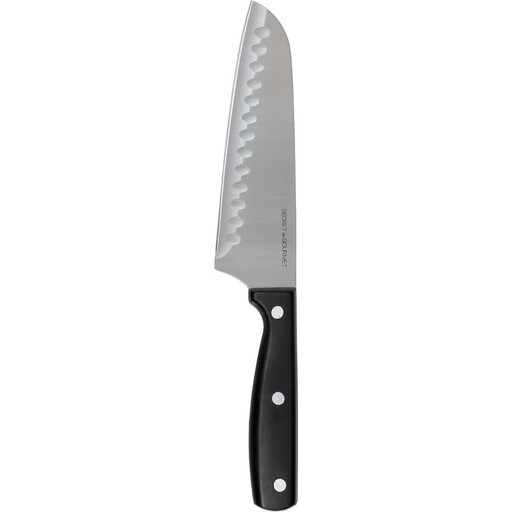
Why This Fits Their Persona: Ideal for those taking their first steps toward better kitchen tools. This knife offers the classic santoku shape and functionality without a major investment. Perfect for daily cutting tasks and a clear upgrade from a standard supermarket knife.
This knife makes no false promises about being "forged." It's an honest, stamped stainless steel knife that focuses on functionality for a low price. What you see is what you get: a functional, basic santoku knife.
Very accessible price and ease of maintenance. According to the manufacturer, the knife is dishwasher-safe, making it a practical choice for a busy household.
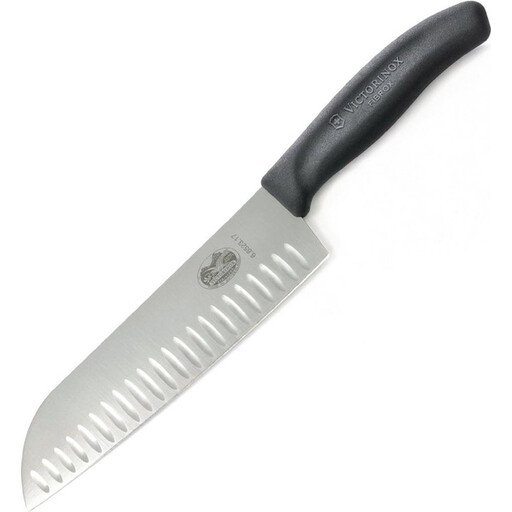
Why This Fits Their Persona: For the home cook who wants a reliable, no-nonsense knife from a reputable brand. Victorinox is known for its functionality and durability, making this a safe and smart choice for years of cooking enjoyment.
This dimpled santoku knife has a functional design. The dimples are effective at reducing sticking, ensuring the feature is not just a marketing gimmick. The knife focuses on practical sharpness rather than extreme hardness, making it less vulnerable to chipping.
Excellent value for money. The knife is lightweight, very sharp out of the box, and the polypropylene handle is hygienic and provides a good grip, even with wet hands.

Why This Fits Their Persona: For the serious home chef willing to invest in top-quality tools. This Wüsthof santoku knife is designed for precision, comfort, and a lifetime of performance. An investment that pays off with every use.
This is an authentic forged knife, crafted from a single piece of steel (full tang). Its balance and durability are therefore a fact, not a marketing claim. The X50CrMoV15 steel used offers a proven, professional balance between sharpness and robustness.
Exceptional balance and ergonomics thanks to the design of the Classic Ikon series. According to Wüsthof, their laser-guided sharpening technology ensures long-lasting sharpness, making it a reliable professional chef's knife.
A good knife is a personal choice. If the recommendations above aren't exactly what you're looking for, check out our full range.
Yes, provided it's well-designed. The dimples (also called grantons) create small air pockets between the blade and the food. This reduces friction and helps prevent sticky or moist ingredients, like slices of potato, cucumber, or salmon, from clinging to the blade. On lower-quality knives, the dimples are often too shallow and have little to no effect.
Proper maintenance is essential. Follow these simple steps:
The main differences are in the blade shape and the cutting technique.
