
Vandaag of morgen in huis

Kwaliteit gegarandeerd

Welkomstaanbiedingen ontgrendelen: GRATIS bezorging | Tot 80% korting | Gratis 30 dagen JoyPlus-proefperiode
Download de app
A sandwich maker may seem like a simple kitchen appliance, but the differences between models can be significant. Some appliances are mainly suitable for making two toasties, while others can also be used as a contact grill, panini press or waffle maker. The right model therefore depends on the space you have in your kitchen, how often you plan to use it and the dishes you want to prepare.
Pay particular attention to these three common pitfalls:
Too many features for your actual needs
A 3-in-1 sandwich maker sounds versatile, but removable plates take up space and need to be stored somewhere. If you only make a toastie occasionally, a simple toastie maker may be more practical.
A non-stick coating that is difficult to maintain
“Easy to clean” does not automatically mean that all parts are dishwasher-safe. Check whether the plates are removable and which cleaning method the manufacturer recommends.
Insufficient capacity or power
A compact sandwich maker for two sandwiches is useful for one or two people. For a family or intensive use, a larger grilling surface, higher wattage and adjustable temperature may be more important.
Power is measured in watts. Models with 700 to 750 watts are suitable for simple toasties and waffles. A 1000-watt sandwich maker can heat up more quickly and is better suited to panini or grilled vegetables. Larger contact grills can have a power rating of up to 1800 or 2000 watts.
A higher wattage does not automatically mean better cooking results. Also look for:
Some features are based on a brand’s own claims. According to Tefal’s own information, for example, the OptiGrill sensor detects the thickness of food and adjusts the programme accordingly. Treat this as an available feature, not a guarantee of a particular result.
A sandwich maker with a non-stick coating often prevents cheese and bread from sticking directly to the plates. It is best to use wooden, silicone or nylon utensils on these plates. Metal spatulas can damage the coating.
Check the following before buying:
A fixed grill plate is often ready to use quickly, but is less flexible when it comes to cleaning. A model with interchangeable plates offers more possibilities, but requires additional storage space. Also look out for conflicting product information: always check the specifications on the product page and in the manual.
With coatings such as PTFE or other non-stick materials, correct use is important. Do not heat the appliance unnecessarily while empty, and follow the manufacturer’s temperature and care instructions. A product specified as PFAS-free, such as the Fritel SW 1451 according to the product information, may be relevant if this is something you specifically look for. Do not make assumptions based solely on the term “non-stick coating”.
Capacity is usually stated as the number of sandwiches. Two sandwiches is standard for compact models. Larger appliances can prepare several portions at once or have a wider grilling surface.
Do not just measure the appliance itself; also allow for:
A compact electric grill measuring approximately 23 by 14.5 centimetres is better suited to a small kitchen than a contact grill that is more than 35 centimetres wide. For meat or vegetables, a grill that opens flat is often more practical than a classic toastie maker with triangular recesses.

Why it suits this profile: This model is designed for everyday use, making two sandwiches at once with 1000 watts of power, without extra plates to store.
The specifications mention a non-stick coating, removable drip tray and cleaning aid. The plates are not interchangeable, keeping operation straightforward.
Capacity for two sandwiches, 1000 watts, non-slip base and cool-touch handle.
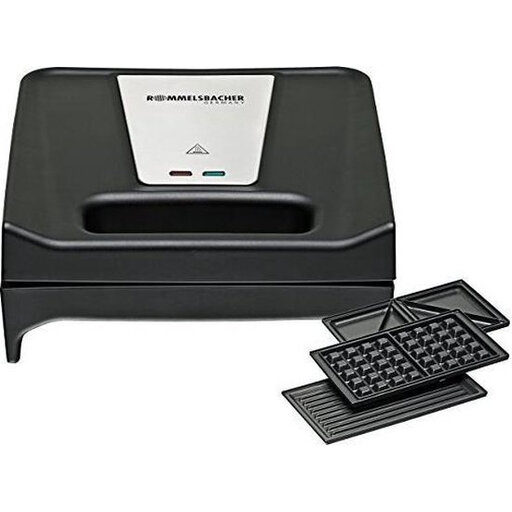
Why it suits this profile: If you want one appliance for sandwiches, panini and waffles, this compact model comes with six plates and an adjustable hinge.
The features are linked to specific components: three types of plate, an ejector button, drip tray and vertical storage.
Six plates, capacity for two sandwiches and 700 watts of power.

Why it suits this profile: This model is designed for users who regularly prepare panini, vegetables, meat or sandwiches and want control over the temperature.
The appliance has an adjustable thermostat, floating hinge and drip tray. This means it is not limited to thin toasties.
1800 watts, spring-loaded plates, temperature control and vertical storage.
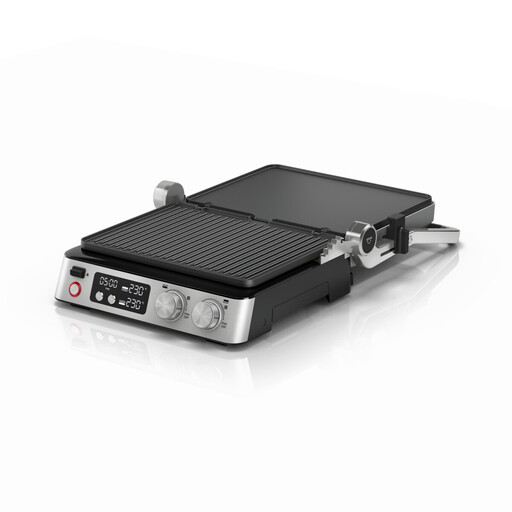
Why it suits this profile: The two cooking surfaces, measuring 29 by 23 centimetres, are suitable for larger portions and meals for several people.
The grill has two independently adjustable temperature zones and can be used as a contact grill, open grill or in oven mode.
2000 watts, two temperature controls and removable, dishwasher-safe parts.
We have put together a complete, up-to-date list of products that fully meet these strict selection criteria and the applicable European safety regulations.
A sandwich maker will generally last longer if you follow the basic instructions:
A visible CE marking is a relevant conformity mark for the European market, but in itself says nothing about cooking performance or lifespan. Also check the warranty conditions. For the products mentioned, a statutory warranty of at least two years is generally stated; additional manufacturer terms may vary.
Not always. A classic toastie maker often has shaped plates for two triangular sandwiches. A contact grill usually has flat or ridged plates and is better suited to panini, meat and vegetables. Some appliances combine both functions.
For simple toasties, 700 to 750 watts is often sufficient. Choose around 1000 watts for faster heating and more versatile use. Models ranging from 1500 to 2000 watts are available for large portions or intensive grilling. As well as power, consider the plate size and temperature control.
Unplug the appliance and allow it to cool completely. Clean removable plates according to the manual; some are dishwasher-safe. For fixed plates, a soft, damp cloth is usually sufficient. Do not use abrasive cleaners or metal objects, as these can damage the non-stick coating.
