
If you have limited storage space
You want to slice salami and put the machine away afterwards. So, compare not only its folded dimensions, but also how much room it takes up with the carriage extended.


For occasional salami slicing in a small kitchen, a foldable slicer is an obvious choice, provided there’s enough room for the carriage when it’s unfolded and the machine stands securely. If you slice cold meats regularly and want a dedicated cold-meat blade, compare larger models too; they need more worktop and storage space.
You want to slice salami and put the machine away afterwards. So, compare not only its folded dimensions, but also how much room it takes up with the carriage extended.
You’re mainly looking at the adjustable slice thickness, how you feed the food into the machine and whether the blade suits the cold meats you’ve chosen. Manufacturers quote a range of 0–15 mm for models including the Graef MYtiny and ritter markant⁷; this isn’t an independent test of their performance when slicing salami.
You’d like to use the machine for bread or cheese, for example, and are weighing up these extra uses against the space it needs. FRITEL lists bread and charcuterie among the uses for the SL 3110; check the specifications for the exact version of any other model.
First, measure both the space where you’ll store the slicer and the clear worktop space needed when the carriage is in use. Then consider the blade, controls and cleaning options for the way you plan to use it.
| What to consider | What to look for | Who should pay particular attention? |
|---|---|---|
| Worktop and storage space | Compare the folded and unfolded dimensions, and measure the clearance needed for the carriage to move. For example, the manufacturer of the ritter markant⁷ lists a folded width of 10.5 cm. | If my worktop is small, I want to be able to put the machine away and still have enough room to use it without feeling cramped. Around 26% of consumers say storage space is their top priority. |
| Control over slice thickness | Check the stated slicing range and which blade comes with the exact version. Severin lists a cold-meat blade for the AS 3915; don’t confuse this version with the AS 3912. | I want to choose the thickness of my salami slices, so I look at the adjustment settings and the blade supplied. Around 26% of consumers prioritise control over slicing. |
| Cleaning and operation | Check which parts can be removed, how scraps are collected and what cleaning instructions apply. Use clean utensils and keep raw and cooked foods separate, as advised by the Netherlands Nutrition Centre (Voedingscentrum). | If I want to clean the machine thoroughly after slicing cold meats, I also consider how the controls around the blade work. Around 21% of consumers put cleaning and safe operation first. |
| Versatility | Check whether the manufacturer says the appliance is suitable for the food you want to slice and which blade is supplied for that purpose. FRITEL lists bread and charcuterie as uses for the SL 3110. | I want to slice other foods as well as salami, and weigh this up against the space the machine takes up. Around 16% of consumers say versatility is their main reason for buying. |
| Purchase and aftercare | Check what’s included in the box, whether suitable replacement parts are available and who to contact if something is faulty. The Dutch government notes that the retailer must provide a solution if a product is legitimately faulty. | If I’m expecting a particular blade or want to know who will deal with a problem, I check these points before buying. Around 11% of consumers make purchase and aftercare their top priority. |
A machine that’s compact when stored may still need plenty of space for the carriage and food when in use. So, measure your work area too and check that the machine can stand securely there.
Measure both the storage space and the clear worktop area you’ll need while using it.
A model that fits in a drawer may still take up too much room on your worktop.
The blades supplied can vary from model to model. Severin lists a cold-meat blade for the AS 3915; don’t assume it’s included with the AS 3912 too.
Check the exact model number and what’s included in the box.
An extra blade may need more storage space and will also need cleaning after use.
A manufacturer’s warranty doesn’t replace the retailer’s responsibility for a product that doesn’t meet the required standard. According to the Dutch government, the retailer must provide a solution if a product is legitimately faulty.
Keep your proof of purchase and contact the retailer if something is faulty.
These brands offer different models and features. Always check the specifications for the exact model, rather than relying on the brand name alone.
The MYtiny is a foldable metal food slicer for anyone who values compact storage.
The markant⁷ is a foldable plastic model with a food catcher.
The AS 3912 is foldable, while the larger AS 3915 comes with a cold-meat blade.
FRITEL describes the SL 3110 as a foldable slicer for foods including bread and charcuterie.
The DO521S is a larger model for anyone with enough worktop and storage space.
This selection includes electric slicers for cold meats, with both foldable and larger models. Compare the dimensions and supplied blades with your kitchen and how you plan to use the machine.
 No image available
An option if you want to slice cold meats to your preferred thickness; check which blades and parts come with this version.
The product name specifies a metal construction, a DC motor and electronic speed control.
 No image available
A foldable model for anyone who wants to put their slicer away after use; also measure the space needed when the carriage is extended.
The product lists a slicing range of 0–15 mm, a Ø 17 cm serrated blade and 100 W.
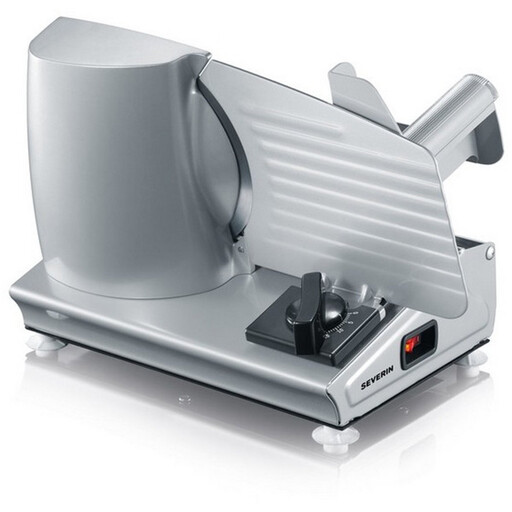 No image available
A larger model for anyone who slices cold meats and has room for a separate cold-meat blade. Severin gives the dimensions for this model as 27.6 × 38.2 × 25 cm; allow for the worktop and storage space it needs.
The product name specifies two blades included and an adjustment range of 0–15 mm.
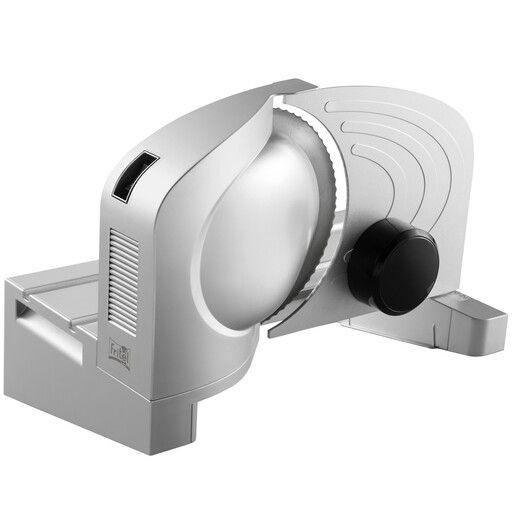 No image available
A larger slicer to consider if you want to use it for the listed applications and have enough room in your kitchen.
The product lists an adjustment range of 0–20 mm, a Ø 17 cm blade and 160 W. The stated dimensions are 400 × 306 × 263 mm.
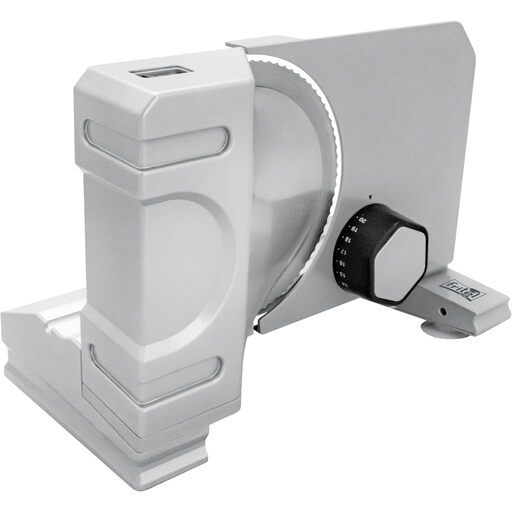 No image available
A larger model to consider if you want to use it for the listed applications and have enough room to set it up and store it.
The product lists an adjustment range of 0–20 mm, a Ø 19 cm blade and 150 W. The stated dimensions are 420 × 312 × 240 mm.
Not every slicer comes with a smooth blade. Severin lists a separate cold-meat blade for the AS 3915, while FRITEL lists a serrated blade for the SL 3110 and includes charcuterie among its uses. Check the exact version and what’s included in the box; these specifications aren’t a comparative slicing test.
Use clean utensils and keep raw and cooked foods separate, advises the Netherlands Nutrition Centre (Voedingscentrum). Also follow the manual for removing and cleaning the blade and carriage.
A mains-powered slicer covered by the Dutch rules for electrical equipment must carry a CE mark. The low-voltage rules apply to nominal AC voltages of 50–1,000 V; check whether they apply to the specific model. According to the NVWA, a CE mark on its own isn’t proof that the individual appliance has been independently inspected.
If a product is legitimately faulty, the retailer must provide a solution, according to the Dutch government. There’s no fixed two-year statutory warranty period in the Netherlands; any manufacturer’s warranty is in addition to your legal rights.
No. The Netherlands Nutrition Centre (Voedingscentrum) advises against eating salami that is still partly raw without cooking it during pregnancy; heating it thoroughly changes the advice on eating it uncooked. The slice thickness and type of slicer don’t remove this concern.