
People with coeliac disease looking for breakfast
You’re looking for a rye bread alternative that’s clearly labelled gluten-free. You also want to avoid crumbs from ordinary bread getting onto your breakfast while you prepare and add your toppings.


Rye bread is not a gluten-free option if you have coeliac disease: according to the Netherlands Nutrition Centre, rye naturally contains gluten. For savoury toppings, choose a product labelled ‘gluten-free’ and avoid contact with crumbs from ordinary bread. Then decide whether you prefer slices, rolls or crackers, and compare the nutritional information for your chosen option.
You’re looking for a rye bread alternative that’s clearly labelled gluten-free. You also want to avoid crumbs from ordinary bread getting onto your breakfast while you prepare and add your toppings.
You’re looking for a gluten-free base for toppings such as cheese, egg or hummus. A slice of bread, a roll or a cracker each has a different role at the table.
You want to choose a suitable pack size and check whether the specific option will be available again next time you shop. The information on the current packaging is always the most reliable source for product details.
Start by checking for a gluten-free label and avoid cross-contamination during preparation. Then choose the type of bread that suits your savoury toppings.
| What to consider | What should you check? | Who is this important for? |
|---|---|---|
| Gluten-free option | Look for a ‘gluten-free’ label on the current packaging and keep the product away from gluten-containing crumbs during preparation. | If you have coeliac disease, you’ll want a clearly gluten-free base for breakfast, even after the pack has been opened; this safety is the top priority for around 33% of consumers. |
| Shape to suit savoury toppings | Choose between slices, rolls, flatbread and crackers based on the portion and texture you want; check that the specific option is labelled ‘gluten-free’. | If I want to add cheese or hummus to a slice, a cracker doesn’t serve the same purpose; the type of bread is the top priority for around 27% of consumers. |
| Pack size and availability | Check the weight or number of pieces and look at the current range at the shop where you do your grocery shopping. | If you regularly eat the same breakfast, you’ll want to use the pack before its use-by date and be able to find the same option again; this matters most to around 20% of consumers. |
| Nutritional information and iodine | Compare fibre and salt per 100 g. Check the ingredients for baker’s salt, but don’t use this to infer the amount of iodine. | If I’m regularly replacing rye bread, I want to know the nutritional information for the new product; this comparison takes priority for around 20% of consumers. |
According to the Netherlands Nutrition Centre, rye contains gluten. ‘Wheat-free’ doesn’t automatically mean ‘gluten-free’: barley and rye, among other grains, also contain gluten.
If you have coeliac disease, choose a product labelled ‘gluten-free’. Don’t judge whether it’s suitable by its dark colour, the name of the bread or the absence of wheat alone.
The Dutch Coeliac Society points out that gluten from another product can get onto gluten-free food. At home, this can happen via a shared chopping board, knife, toaster or jar of spread.
Use separate or thoroughly cleaned kitchen utensils and avoid contact with crumbs from ordinary bread.
Gluten-free bread doesn’t have to have the same composition as the rye bread you’re replacing. The Netherlands Nutrition Centre describes bread as an important source of iodine, but that doesn’t tell you how much iodine is in any particular gluten-free option.
Compare the nutritional information and ingredients for your chosen product, including fibre, salt and whether baker’s salt is listed.
Albert Heijn’s gluten-free range includes own-brand bread, rolls and crackers.
Jumbo lists gluten-free white and brown bread from its own range, alongside other types of bread and brands.
Schär is a specialist gluten-free brand featured in the ranges shown by Albert Heijn and Jumbo.
Lidl distinguishes between its standard range and extra gluten-free products, which may only be available from time to time.
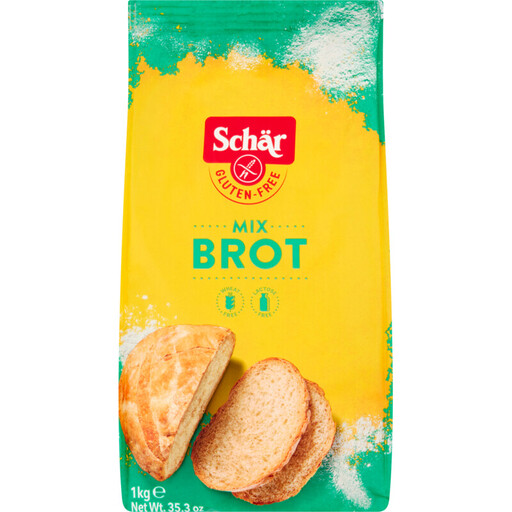
This gluten-free bread mix is for anyone who wants to make their own bread to go with savoury toppings. It isn’t a ready-to-eat alternative to a slice of rye bread.
 No image available
If you want to bake your own bread for a savoury breakfast, this 1 kg mix labelled gluten-free needs to be prepared first. Check the current packaging and avoid contact with gluten-containing crumbs while preparing it.
No. Rye bread is not a gluten-free option if you have coeliac disease, because rye naturally contains gluten. The Netherlands Nutrition Centre lists rye as one of the grains containing gluten; a dark colour or a mention of fibre doesn’t change that.
‘Wheat-free’ doesn’t mean the same as ‘gluten-free’. According to the Netherlands Nutrition Centre, rye and barley also contain gluten. For a suitable alternative, choose a product labelled ‘gluten-free’ and read the current packaging.
Under Commission Implementing Regulation (EU) No 828/2014, the label ‘gluten-free’ may only be used when the food sold to the final consumer contains no more than 20 mg/kg of gluten. This EU rule also applies in the Netherlands.
Keep gluten-free food away from gluten-containing crumbs and use separate or thoroughly cleaned kitchen utensils. The Dutch Coeliac Society describes the transfer of gluten between products as cross-contamination, so take care with shared toasters and jars of spread, too.
You can’t tell from the ‘gluten-free’ label. The Netherlands Nutrition Centre describes bread as an important source of iodine; the Netherlands Food and Consumer Product Safety Authority (NVWA) explains that iodine compounds may be present in bread and bread substitutes through baker’s salt. Check the ingredients for your chosen option, and don’t assume it contains the same amount of iodine without product-specific information.