
Vandaag of morgen in huis

Kwaliteit gegarandeerd

Welkomstaanbiedingen ontgrendelen: GRATIS bezorging | Tot 80% korting | Gratis 30 dagen JoyPlus-proefperiode
Download de app
An RV trip is all about freedom. Whether you're exploring the coast or venturing into the mountains, you want peace of mind on the road. An unexpected tyre issue, like a slow leak or a blowout, is the last thing you want to deal with. A quality tyre pressure monitoring system for your RV (also known as a TPMS) isn't just a luxury; it's an essential tool for a safe and relaxing journey.
This system continuously monitors the pressure and temperature of your tyres, alerting you immediately to any anomalies. This allows you to take timely action and prevent potentially dangerous situations, such as avoiding a blowout. In this article, we'll help you make the right choice by breaking down the key considerations and highlighting some popular options.
The market offers many different systems. To find a model that suits your RV, caravan, or trailer, here are the most important points to consider.
A standard car has four tyres, but an RV with a caravan or a tyre monitor for a trailer can easily require six, eight, or more. Check how many sensors a set includes and whether it's expandable. For longer combinations (RV plus caravan), a stable, wireless tyre pressure system is crucial. Some kits come with a signal booster (repeater) to ensure the signal from the rearmost tyres reliably reaches the monitor in the cab.
There are two types of tyre pressure sensors for a caravan or RV: internal and external.
The purpose of a TPMS is to alert you. Therefore, pay close attention to the alarm functions. A good system not only warns of low or high tyre pressure but also of a fast leak and high temperature—a key indicator of an impending blowout. A clear, easy-to-read display that is also clearly visible at night without being distracting completes the system.
Based on specifications and features, we have selected TPMS systems that offer excellent solutions for different types of travellers.
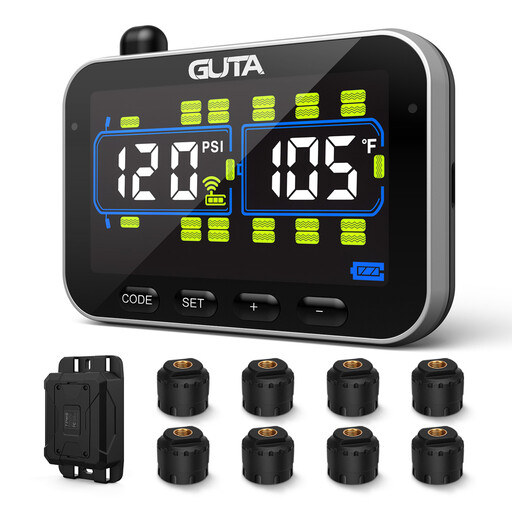
Why It Stands Out: This kit is designed for large and long vehicles. With eight sensors and an included signal booster, it's a complete solution for RV owners who also tow a large caravan or trailer.
Key Features:
Who It's For: Ideal for owners of large RVs, trucks, and combinations with a caravan or dual-axle trailer who need a reliable system with many sensors and a long range.
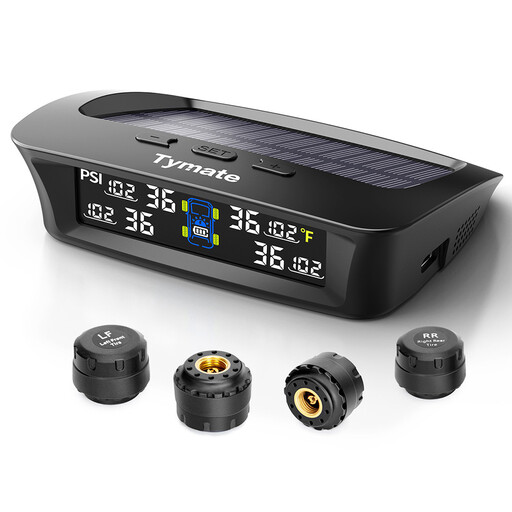
Why It Stands Out: This system from Tymate is a practical and compact solution, aimed at standard RVs and passenger cars. The monitor is rechargeable via solar power, which enhances its convenience on the go.
Key Features:
Who It's For: Suitable for drivers of standard RVs, campervans, or passenger cars (vehicle length ≤ 20 feet / 6 metres) who want an easy-to-install and low-maintenance system.
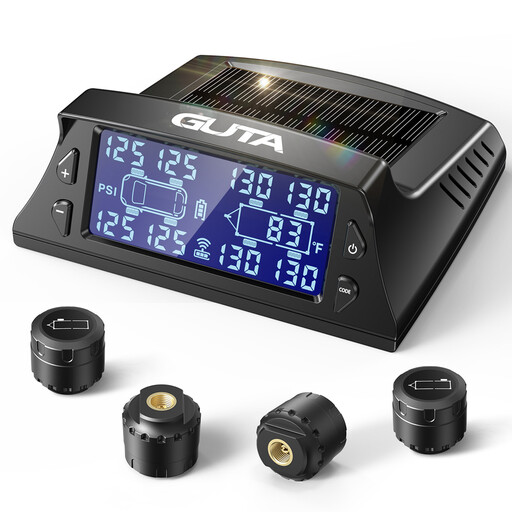
Why It Stands Out: This GUTA system combines a wide pressure range with the convenience of solar charging. It's a robust choice for RVs with heavier tyres that don't tow an extra trailer.
Key Features:
Who It's For: An excellent choice for RV owners with a vehicle up to 20 feet (approx. 6 metres) who are looking for a system with a high pressure range and the convenience of solar charging. For longer vehicles, the manufacturer recommends a signal booster.
These recommendations are a starting point. Every RV and every journey is different. Are you looking for a system with a different number of sensors, specific alarm functions, or a different type of display? More options are available that might better suit your specific needs.
Explore more options in our Alarm category
In the EU, a TPMS is mandatory for new passenger cars (Class M1) sold after November 1, 2014. The rules for RVs can be more complex, depending on the vehicle class and year of manufacture. Regardless of legal requirements, it is a highly recommended safety accessory for any RV owner looking to minimise the risk of tyre-related breakdowns.
Installation is typically very straightforward. You unscrew the existing valve caps from the tyres. Then, you screw the included anti-theft nut onto the valve stem, followed by the corresponding sensor. Using a special wrench, you tighten the nut against the sensor to secure it. Once all sensors are in place and the monitor in the cab is turned on, the data will be displayed automatically.
The main differences are the pressure range, signal strength, and the number of sensors. RVs often have higher tyre pressure than cars, so the system must support this range. Due to the greater length, especially with a caravan, a strong signal (sometimes with a booster) is necessary. Finally, a combination of an RV and a trailer requires more sensors than a standard car.
Sincerely,
