
Vandaag of morgen in huis

Kwaliteit gegarandeerd

Welkomstaanbiedingen ontgrendelen: GRATIS bezorging | Tot 80% korting | Gratis 30 dagen JoyPlus-proefperiode
Download de app
Traveling with your RV is all about freedom. But that freedom only feels truly liberating when you know the fundamentals are in order. Your tires are crucial in this regard. Incorrect tire pressure not only increases fuel consumption and accelerates tire wear but also poses a direct safety risk. A good TPMS system for your RV is therefore not a luxury, but a wise investment.
However, the market is flooded with systems that over-promise and under-deliver. Many RV owners fall into the same traps, leading to frustration and wasted money. Let's look at the most common mistakes so you can avoid them.
To avoid a bad purchase, it's important to look past the marketing jargon and focus on what technically matters. For an RV, caravan, or trailer, these are the three most important points of attention.
A wireless tire pressure gauge communicates via a radio signal, usually on the 433.92MHz frequency. This is rarely an issue for a standard passenger car, but for a 7-meter RV or a combination with a TPMS for a trailer, the distance can become too great.
There are internal and external sensors. For the DIY market, external tire pressure sensors are the standard, as you can easily screw them onto the valve yourself.
The tire pressure monitor in your cabin needs to be practical.
We've compared a number of systems and looked at which models are a good match for different types of RV owners, based on objective product features.
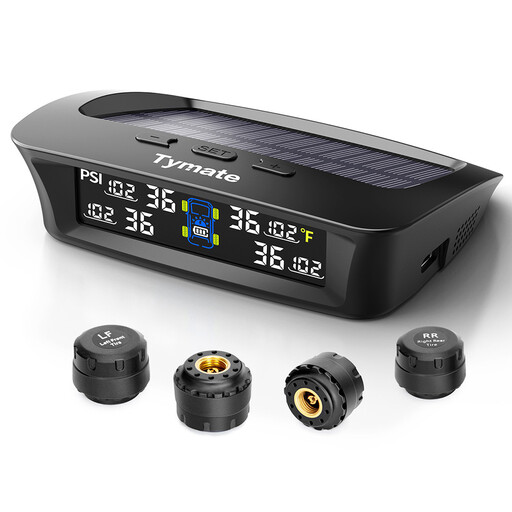
Why it's a match: A solid choice for standard camper vans or semi-integrated motorhomes up to about 6-7 meters. The installation is straightforward, monitoring is reliable, and the display charges via solar power. No unnecessary frills, just a functional system.
This system is designed for vehicles up to 20 feet (±6 meters) and provides a stable connection within that range without a repeater. The external sensors are installed in minutes, and according to the manufacturer Tymate, the batteries last for about 2 years.
Solar-powered display with automatic backlighting. The system has 6 alarm modes, including for rapid leaks, high/low pressure, and temperature.
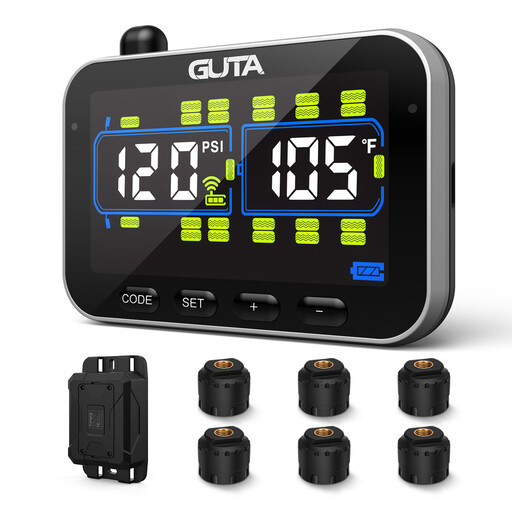
Why it's a match: Ideal for those traveling with a longer combination, such as a large over-cab motorhome with a bike rack or an RV with a trailer. The included repeater ensures a reliable signal over the entire length.
The included repeater effectively solves the signal loss problem on long vehicles. The system is also designed for a higher pressure range (up to 188 PSI), making it suitable for the more heavily loaded tires of large RVs or caravans.
Includes a repeater for a stable signal up to ±15 meters. According to the manufacturer GUTA, the sensors have a battery life of up to about 4 years (CR2032 battery).
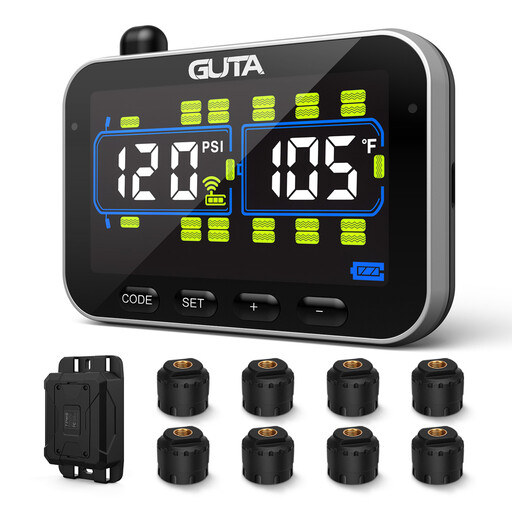
Why it's a match: Suitable for large RVs with a rear dual axle, or for those who want to monitor both the RV and a heavy boat or horse trailer simultaneously. The system is designed for more complex and heavier configurations.
With 8 sensors and a repeater, you are assured of complete coverage for almost any recreational combination. According to the manufacturer, the sensors are pre-paired, which keeps the installation manageable despite the larger number of tires.
Monitors up to 8 tires simultaneously and is expandable. The high pressure range (up to 188 PSI) makes it suitable for the tires of heavy vehicles that require higher pressure.
We have compiled a complete, up-to-date list of products that meet these selection criteria and current regulations.
Yes, the systems with external sensors discussed here are designed for DIY installation. It's a matter of screwing the sensors onto the valves instead of the caps. You place the monitor on the dashboard and connect it. Most systems are already paired from the factory.
This varies by brand and model. According to manufacturer specifications, the batteries in external sensors last an average of 2 to 4 years. They typically use standard coin cell batteries (like CR1632 or CR2032) that you can replace yourself.
If the total length of your car and caravan (or RV and trailer) exceeds 7 to 8 meters, a repeater is highly recommended. It guarantees a stable signal between the rear sensors and the monitor in the cabin, significantly reducing the risk of signal loss, especially on the highway.
