
Vandaag of morgen in huis

Kwaliteit gegarandeerd

Welkomstaanbiedingen ontgrendelen: GRATIS bezorging | Tot 80% korting | Gratis 30 dagen JoyPlus-proefperiode
Download de app
Hitting the road with your RV or caravan means freedom. But before you set off, checking your tyre pressure is a crucial step for a safe journey. Incorrect tyre pressure can lead to increased fuel consumption, accelerated tyre wear, and in the worst-case scenario, a blowout. A tyre pressure monitoring system, or TPMS, helps you continuously monitor tyre pressure and temperature. This article will help you choose a suitable system, so you can travel with peace of mind.
The market offers a variety of systems. To make the right choice, it's helpful to pay attention to a few key aspects.
A wireless TPMS system operates with sensors on the tyres and a display in the cabin. You have the choice between external and internal sensors. External TPMS sensors are the most popular for RVs and caravans. You simply screw them onto the valve, just like a valve cap. You can do this yourself without needing to dismount the tyres. Internal sensors are mounted inside the tyre and require a visit to a garage. For convenience and simple installation, we will focus here on systems with external sensors.
The display in your cabin needs power. Many modern systems offer a dual charging option. A solar-powered tyre pressure system has a small solar panel that charges the monitor during the day. This eliminates another cable on your dashboard. For darker days or when the monitor isn't in direct sunlight, you can charge it via a USB cable. This flexibility is ideal for long journeys.
Not every TPMS is suitable for every vehicle. It's important to measure your RV's tyre pressure with a system that has the correct range. RVs often require higher tyre pressure than passenger cars. Therefore, always check the maximum pressure range (expressed in PSI or Bar) of the TPMS. There are also specific systems for a caravan tyre pressure monitoring system or trailer TPMS, which may require a signal booster for longer vehicle combinations.
Based on product specifications and functionalities, we have highlighted a few systems for you.
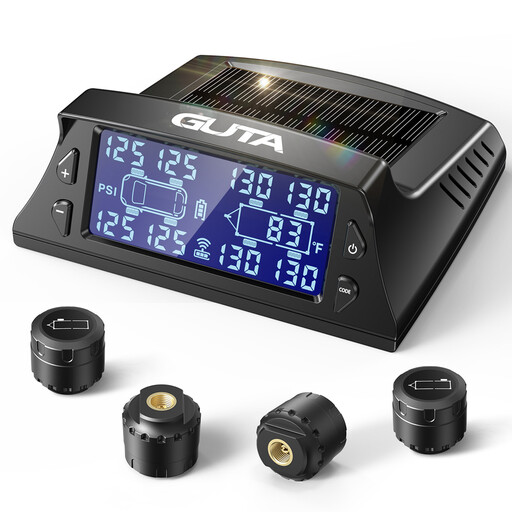
Why it stands out: This system is specifically designed for larger vehicles. With a wide measurement range up to 188 PSI, it is suitable for most RVs, trailers, and even smaller trucks.
Benefits:
Who is it for? This system is an excellent choice for owners of heavier RVs, caravans, and trailers who need a reliable system with a high-pressure range.
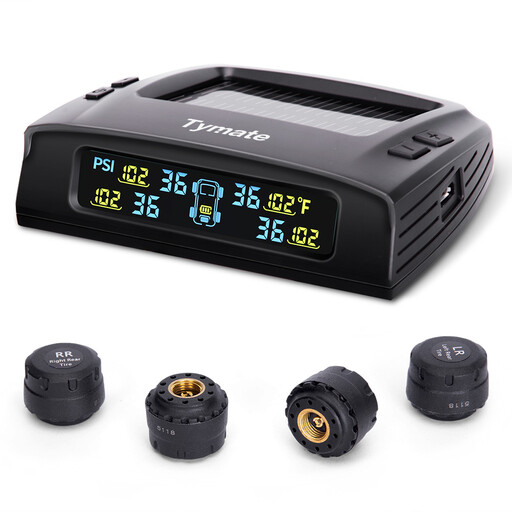
Why it stands out: This Tymate system combines a colour screen with a compact design and is optimised for vehicles with a tyre pressure up to 87 PSI.
Benefits:
Who is it for? Ideal for drivers of lighter RVs, campervans, SUVs, and passenger cars who want a visually clear and user-friendly system.
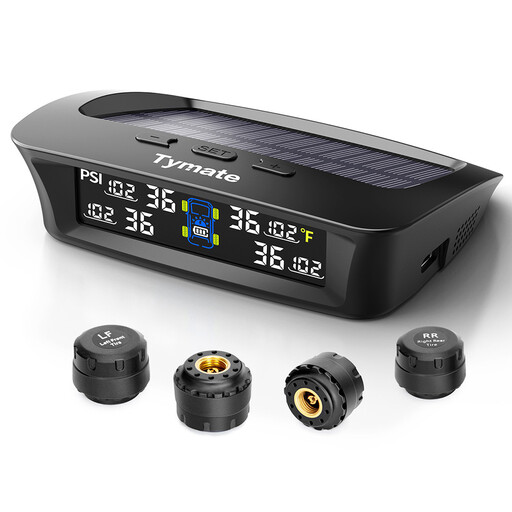
Why it stands out: This model from Tymate is similar to the previous one but is equipped with a monitor featuring a larger battery capacity (500mAh), which, according to the manufacturer, ensures longer operation between charges.
Benefits:
Who is it for? Suitable for users who appreciate the features of the Tymate system but prefer a monitor with a larger battery for extra peace of mind on long journeys.
Haven't found what you're looking for, or are you curious about other smart accessories for your vehicle? There are more products that use solar power to enhance convenience and safety on the road.
Explore more solar-powered products
How does an RV TPMS system work? A TPMS consists of sensors that you place on your tyre valves and a display for the cabin. The sensors continuously measure pressure and temperature and send this data wirelessly to the display. If there's a deviation, such as low pressure, you receive an immediate warning.
Is a wireless TPMS system reliable? Modern wireless TPMS systems are generally very reliable. They use a stable radio frequency (usually 433.92MHz) to transmit data. For very long vehicles or combinations (RV with a trailer), a signal booster (repeater) may be necessary to ensure a stable connection.
Can I install external TPMS sensors myself? Yes, a major advantage of systems with external TPMS sensors is the simple installation. You replace the existing valve caps with the sensors. A small wrench is often included to secure the sensors as an anti-theft measure. You do not need to visit a garage for this.
