
First-time shopper with limited cupboard space
You want to have rusks in for breakfast or lunch without buying more packs than you need. The weight and number of pieces can help you plan how much to stock up on.


Plain rusks are a simple option for your first food shop. Check the pack weight and number of pieces to work out how many you want to stock up on. Choose wholemeal if that’s your priority. For both types, check the ingredients, allergens and storage instructions on the pack.
You want to have rusks in for breakfast or lunch without buying more packs than you need. The weight and number of pieces can help you plan how much to stock up on.
You’re looking for a pack clearly labelled as wholemeal rusks and comparing the nutritional information per 100 g with other varieties.
You check the latest ingredients and allergen information before buying. This is particularly important if wheat, gluten, egg or possible traces of other allergens are relevant to you.
Before your first food shop, decide whether pack size, a preference for wholemeal or the suitability of the ingredients and storage instructions is your main priority.
| What to consider | What to check | Who it matters to |
|---|---|---|
| Quantity per pack | Compare the weight and number of pieces with the amount you want to stock up on. | When I’m just starting to do my food shopping, I want enough rusks in the cupboard without storing more packs than I need. Around 50% of consumers make the quantity they need their top priority. |
| Wholemeal and fibre | Look for the wholemeal label on the pack and compare the fibre per 100 g in the nutritional information. | I want to choose a wholemeal variety deliberately, rather than judging by the colour of the rusks alone. For around 30% of consumers, wholemeal is the top priority. |
| Label and storage | Read the latest ingredients, allergen information and storage instructions on the packaging. | If the ingredients are a deciding factor for me, I want to know whether I can eat these rusks and how to store them after opening. Suitability is the top priority for around 20% of consumers. |
Rusk packs can vary in weight and number of pieces. You don’t necessarily need an extra pack for a small first shop.
Check the quantity in each pack and think about how many rusks you expect to use before your next food shop.
The fibre content alone doesn’t tell you whether rusks are labelled as wholemeal. According to the Netherlands Nutrition Centre, wholegrain products generally contain more fibre than white grain products made from flour, but nutritional values vary by product.
Check both the product description and the fibre per 100 g.
Information from Albert Heijn, Jumbo, PLUS and Bolletje lists wheat or gluten among the ingredients of the rusks described; egg is also listed for several varieties.
Read the ingredients and allergen information on the pack you’re buying, even if you’ve had that variety before.
The fact that iodine compounds are permitted in bakery products under Dutch regulations says nothing about the contents of an individual pack of rusks.
If you have a question about a specific product, check the label or ask the manufacturer which ingredients are used.
Albert Heijn sells plain rusks and an AH BASIC variety labelled as wholemeal.
Jumbo sells its own-brand plain rusks in a 125 g pack containing 13 pieces.
PLUS sells its own-brand plain rusks, as well as varieties made with other ingredients.
ALDI sells plain and wholemeal rusks under the Goud Gebakken name.
Lidl sells 140 g packs of wholemeal rusks as a store-brand product.
Bolletje Echte Beschuit is a branded variety whose manufacturer lists ingredients including wheat, rye and egg.
These two products suit shoppers choosing between branded and plain rusks for their first food shop. Compare the pack contents and check the label of the variety you’re considering.
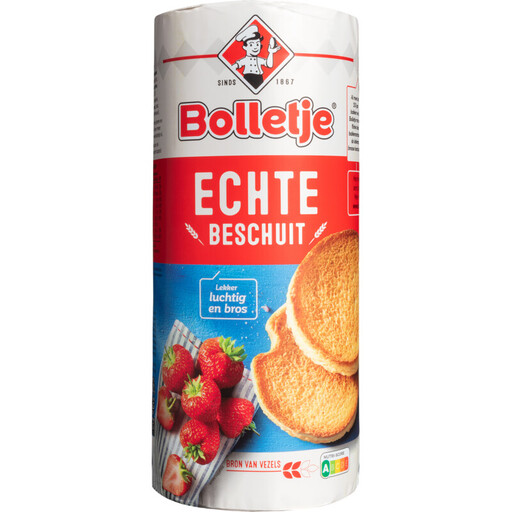 Image unavailable
An option if you’re specifically looking for Bolletje rusks for your first stock-up. The product name states that the pack contains 13 pieces; check the latest ingredients and allergen information on the pack.
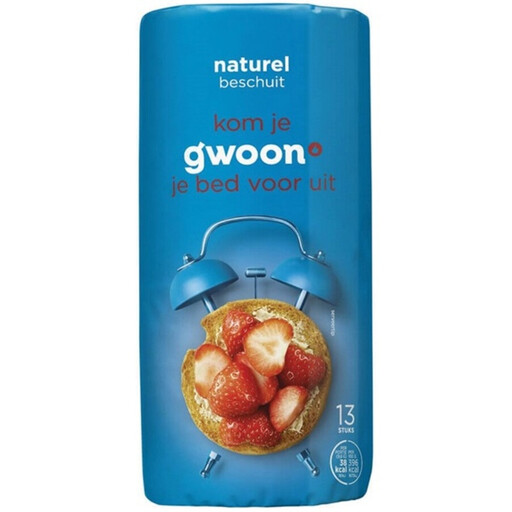 Image unavailable
A plain variety if you’re looking for a simple pack of rusks for your first food shop. The pack is labelled as 125 g; check the ingredients and allergen information on the pack before buying.
Not for everyone. Choose wholemeal rusks if you specifically want a wholegrain product. The Netherlands Nutrition Centre says wholegrain products generally contain more fibre than white grain products made from flour. Also check the nutritional information, ingredients and allergens on the pack.
Follow the instructions on the packaging and seal the rusks well after opening to protect them from moisture. Albert Heijn recommends storing its plain rusks in a sealed tin; Jumbo and PLUS advise keeping their respective varieties in a dry place.
No. Check the ingredients and allergen information for the specific pack first. The products described by Albert Heijn, Jumbo, PLUS and Bolletje list wheat or gluten, and egg is mentioned for several varieties. Information about possible traces of other allergens may also vary.
No. You can’t tell from the product type alone whether a pack of rusks contains iodine. The Netherlands Food and Consumer Product Safety Authority sets out the conditions under which iodine compounds may be used in bakery products. For an individual product, check the ingredients information or ask the manufacturer.