
Breakfast lovers looking for a crisp rusk
If texture comes first for you, look at plain and baker’s rusks. Consider descriptions of flavour and crispness alongside the ingredients and nutritional information on the pack you’re thinking of buying.


If you’re mainly after a crisp rusk for weekday breakfasts, choose based on texture and ingredients. If you’d prefer a wholemeal base, start with the type of grain and compare the fibre per 100 g. A larger rusk or a variety with seeds may appeal if that’s the texture you’re looking for, but compare portion sizes, salt and allergens too. A premium appearance alone says nothing about nutritional value.
For a weekday breakfast, your main priority makes all the difference: are you looking for a crisp texture, a wholemeal base or a larger rusk with seeds?
If texture comes first for you, look at plain and baker’s rusks. Consider descriptions of flavour and crispness alongside the ingredients and nutritional information on the pack you’re thinking of buying.
If you’d like to make rusks a regular part of a wholemeal breakfast, compare the fibre and salt per 100 g. The Netherlands Nutrition Centre explains that wholegrain cereal products contain more fibre than products made with white flour; the values for individual rusks will vary by product.
If you’re looking for a larger rusk or a variety with seeds, check the weight per piece too. If you have an allergy, read the ingredients and allergen information for the specific variety.
First decide what matters most for your breakfast, then compare the nutritional information per 100 g. This lets you compare rusks with different weights per piece on a like-for-like basis.
| What to consider | What to check when buying | Who is this important for? |
|---|---|---|
| Wholemeal and fibre | Check the grain base and compare fibre and salt per 100 g. | If I often have rusks for breakfast, I want to know whether the variety suits my preference for wholemeal. For around 42% of consumers, choosing wholemeal and fibre comes first. |
| Crispness and flavour | Read the ingredients and nutritional information alongside the description of the texture. | For a quick breakfast, I’m mainly looking for a rusk with a crisp texture I enjoy; for around 33% of consumers, flavour and texture are the main priority. |
| Size and seeds | Compare the weight per piece and check the ingredients and allergens. | I want a larger rusk or a variety with seeds, without treating different portion sizes as if they were the same. For around 25% of consumers, this preference is the deciding factor. |
An artisan-style description, organic ingredients and visible seeds each tell you something different about a rusk. None of them replaces comparing fibre, salt and energy.
Compare the nutritional information per 100 g, then decide whether texture, wholemeal or seeds matter most to you.
Ingredients can vary between rusks. The Netherlands Food and Consumer Product Safety Authority says allergens must be listed on the label, so don’t assume the ingredients are the same as those in a pack you’ve bought before.
If you have an allergy, check the current ingredients and allergen list for the exact variety before buying.
A larger rusk may weigh more per piece. That means nutritional values per piece are only useful for comparison when the portions are the same size.
Compare products per 100 g first, then consider how many rusks you have for breakfast.
These brands offer different ranges of rusks to compare; the features of one variety don’t automatically apply to the rest of the range.
Bolletje offers plain, wholemeal, baker’s and farmhouse rusks, among other varieties.
The own-brand range includes wholemeal rusks and organic wholemeal multiseed rusks.
The own-brand range includes plain and wholemeal rusks, as well as varieties made with other types of grain.
PLUS offers plain and wholemeal rusks, as well as varieties with seeds.
Lidl Netherlands lists wholemeal rusks in a 140 g pack.
ALDI lists Goud Gebakken rusks in plain and wholemeal varieties.
These Bolletje rusks suit different weekday breakfast preferences: a wholemeal variety, seeds or a simple rusk as a starting point. The product names show the number of pieces; use the label for your chosen variety to compare nutritional values and allergens.
 No image available
For anyone looking for a rusk labelled wholemeal to have at breakfast. The pack contains 10 pieces; check the fibre, salt and weight per piece on the label before comparing this variety with another rusk.
 No image available
An option if seeds are your main priority when choosing a breakfast rusk. The pack contains 10 pieces. Check the grain base and allergens on the label; the name alone doesn’t confirm that it’s a wholemeal variety.
 No image available
For anyone who looks for a wholegrain label when choosing rusks for everyday breakfasts. The pack contains 13 pieces. Check what the nutritional values are based on before comparing fibre per 100 g with another product.
 No image available
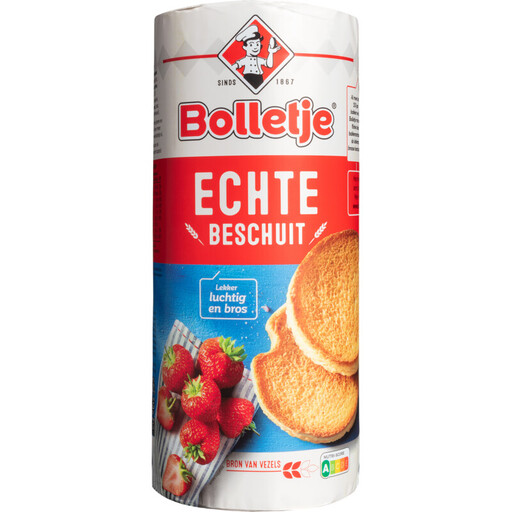
A rusk to consider if you’re not looking for a specific seeded or wholemeal variety for breakfast. The pack contains 13 pieces; check the ingredients and nutritional information if these matter to your choice.
No, seeds alone don’t tell you that. Compare fibre, salt and energy per 100 g, and look at the portion size and ingredients of the varieties you’re considering.
Check the ingredients and allergen information for the exact rusk variety before buying. The Netherlands Food and Consumer Product Safety Authority says allergens must be listed on the label; checking the ingredients of another product from the same brand isn’t a substitute.
No. The Netherlands Food and Consumer Product Safety Authority explains that iodine compounds may only be present in bread, bread substitutes and other bakery products through baker’s salt. This doesn’t confirm that every pack of rusks contains baker’s salt; check the product ingredients if this matters to your choice.
Follow the storage instructions on the pack and seal it tightly after opening. Jumbo recommends keeping its plain rusks in a cool, dry, dark place; check the packaging for other varieties.