What should you look for when choosing?
When choosing rusks for toppings, start with a suitable size. Then compare the nutritional information per 100 g and per serving, and read the ingredients and allergen declaration for the variety you want to buy.
| What to consider |
What to check |
Who should pay particular attention? |
| Size for toppings |
Check the product description and the weight of each rusk. ‘Extra large’ is not a measure of thickness or resistance to breaking. |
I want to add generous toppings to a rusk, so I’m looking for a size that suits my snack; this is the main priority for around 50% of consumers. |
| Fibre, wholegrains and salt |
Compare fibre and salt per 100 g and per serving; check which grains and seeds are used. |
If rusks are a regular part of my meals, I want to compare the nutritional information for wholegrain and multiseed varieties. Around 30% of consumers give this comparison the highest priority. |
| Protein and allergens |
Read the protein value, ingredients and allergen declaration for the variety you’ve chosen. |
I compare protein values or need to know which ingredients are in my rusks before buying; this is the most important consideration for around 20% of consumers. |
Multiseed rusks on Joybuy
These two multiseed varieties are options if you’re looking for rusks to use as the base for an autumn half-term snack. Compare the pack size and check the ingredients before buying; neither product name gives an indication of thickness or resistance to breaking.
 Image unavailable
Bolletje multiseed rusks, 10 pieces
An option if you’re looking for multiseed rusks and want to consider the number of pieces in the pack. Check the size and ingredients on the packaging if generous toppings or allergens are important to you.
View on Joybuy
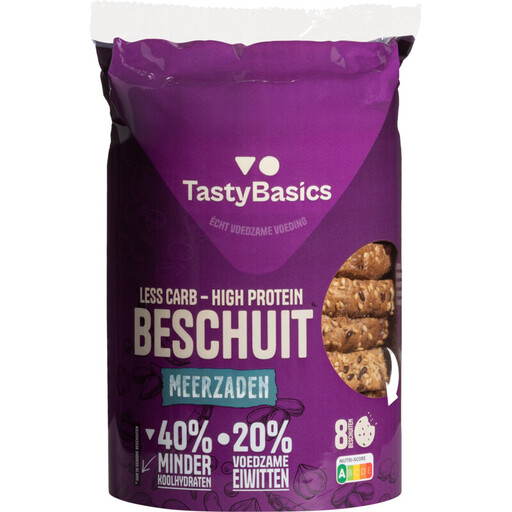 Image unavailable
TastyBasics multiseed rusks, 184 g
An option if you’re looking for multiseed rusks and want to compare pack weights. Check the nutritional information and allergen declaration for this variety; the pack weight says nothing about how sturdy an individual rusk is.
View on Joybuy
Frequently asked questions
Does ‘thick cut’ mean a rusk is sturdier?
No, the term alone doesn’t prove that a rusk is thicker or less likely to break. If you want generous toppings, look at the stated size and serving size, but don’t assume this tells you how much weight a rusk can support.
Which rusks should I look at for generous toppings?
A variety explicitly described as ‘extra large’ is a sensible starting point if you’re mainly looking for more room for toppings. Albert Heijn uses this description for Bolletje Vezelrijk boeren beschuit volkoren, but it doesn’t guarantee that the rusk won’t break; it’s best to add toppings shortly before eating.
Do Dutch rusks always contain baker’s salt?
No, according to the Netherlands Nutrition Centre, bakers aren’t required to use baker’s salt. If you want to know whether a particular rusk contains it, read the ingredients list or ask the manufacturer.
How should I store rusks after opening?
Store opened rusks according to the instructions on the packaging; the varieties reviewed are described as needing to be stored in a dry, sealed container. Seal the pack or a suitable tin properly after use.
Which allergens should I check in rusks?
Read the allergen declaration for the specific variety before buying or serving it. The products reviewed contain, among other things, wheat, other cereals containing gluten, egg and sesame, but the combination varies by product.


