
Parents looking for wholegrain and fibre
When choosing rusks for tea time, you can compare the grain base and nutritional information for each variety rather than relying on taste or crispness alone.


Choose wholemeal rusks if wholegrain and fibre are your priorities, or try multiseed rusks if seeds and kernels will make tea time special. Traditional egg rusks are another option if you’re looking for a light, crisp variety. If you’re packing rusks for school or an after-school club, always check the exact product packaging for allergens and ask about the arrangements in place.
When choosing rusks for tea time, you can compare the grain base and nutritional information for each variety rather than relying on taste or crispness alone.
Seeds, kernels, organic ingredients or a traditional egg-based recipe may influence your choice. For these varieties, be sure to check the ingredients and allergens too.
Your child’s needs and the arrangements in place will be key. Check the label of your chosen variety for wheat and other gluten-containing cereals, egg and sesame.
First, decide what you want to make tea time special: a wholemeal base, seeds and kernels, or a traditional crisp rusk. Then check that the exact variety is suitable for your child’s dietary needs and, if you’re packing rusks to take with them, complies with the arrangements at their school or after-school club.
| What to consider | What to check when buying | Who it matters to |
|---|---|---|
| Wholegrain and fibre | Check the types of grain in the ingredients list and compare the fibre content per 100 g. | If you want to serve wholemeal rusks, you’ll want to know which grains they’re made from. This is the main factor for around 38% of consumers. |
| Seeds and texture | Check which seeds or kernels the variety contains and look at the serving size. | For a special tea time, you might be looking for seeds and kernels, or perhaps a light, traditional rusk instead. Around 37% of consumers prioritise this choice of flavour and texture. |
| Allergens and school arrangements | Read the current label, including any warnings, and ask about the arrangements at the school or after-school club. | If you’re packing rusks for school, first check that your child can eat the ingredients and find out what’s allowed there. This is the deciding factor for around 25% of consumers. |
Seeds and kernels may be combined with sesame, egg and gluten-containing cereals. PLUS Wholemeal Rusks with Seeds is one example of a variety that contains several ingredients to check.
Read the ingredients and allergen information on the packaging for the exact variety, even if you already know the brand.
Organic describes how a product is made; it doesn’t tell you how much fibre or salt a rusk contains. The ingredients may also vary between varieties.
Compare the nutritional information per 100 g and the ingredients of the products you’re considering.
The product ranges mentioned include both traditional egg rusks and dark wholemeal rusks.
The product ranges mentioned include standard wholemeal rusks and organic wholemeal multiseed rusks.
The product range mentioned includes organic wholemeal rusks.
The wholemeal rusks with seeds mentioned are suited to anyone choosing based on seeds and kernels.
The product range mentioned includes wholemeal rusks as a supermarket own-brand product.
The product range includes Goud Gebakken plain and wholemeal rusks.
These products offer a choice of dark wholemeal rusks, standard wholemeal rusks and multiseed varieties for tea time with children. The packaging is still the best guide to the ingredients and whether a product is suitable for school or an after-school club.
 Image unavailable
A choice for anyone looking for dark wholemeal rusks for tea time.
 Image unavailable
A choice for anyone looking for a standard wholemeal variety for tea time.
 Image unavailable
A choice for anyone looking for seed-covered rusks for a special tea time.
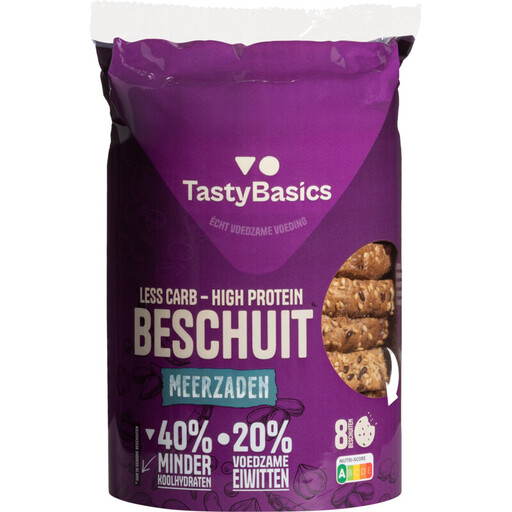 Image unavailable
A choice for anyone who’d also like to consider this TastyBasics product among the multiseed varieties.
No. First check the arrangements at the school or after-school club and the label on your chosen rusks. Varieties may contain wheat or other gluten-containing cereals, egg or sesame. The Netherlands Food and Consumer Product Safety Authority explains how allergens are listed on labels.
No. Organic refers to how a product is made, while multiseed describes its ingredients; neither tells you on its own whether a variety is suitable. Compare the ingredients, allergens and nutritional information for each product, especially if you’re packing rusks for school or an after-school club.