
Households with different tastes
One person prefers light, familiar rusks; another would rather have wholegrain. Two small packs let you cater for both without stocking up on a large quantity of just one type.


Choose wholegrain rusks if the type of grain and fibre content are your main priorities. If someone at home prefers light, crisp rusks, go for a familiar plain variety instead. When tastes differ, two small packs may be more practical than one variety that not everyone enjoys. Check the ingredients, nutritional information and quantity you’ll actually use on the exact pack.
One person prefers light, familiar rusks; another would rather have wholegrain. Two small packs let you cater for both without stocking up on a large quantity of just one type.
If rusks are a regular part of breakfast or lunch, you’ll want to compare the grain type and nutritional information for the exact product. The Voedingscentrum describes wholegrain cereal products as being made from the entire grain kernel.
You’re looking for a suitable pack size at a shop where you’re already doing your food shopping. Albert Heijn, Jumbo, PLUS, ALDI and Lidl list wholegrain rusks in their ranges; check which variety you can order or pick up at your local shop.
First decide whether wholegrain and fibre, a familiar taste or a suitable pack size matters most to you. Then check the packaging of the variety you’ve chosen: a brand name or dark colour won’t tell you which ingredients or nutritional values are in that particular pack.
| What to consider | What to check when buying | Who is this most important to? |
|---|---|---|
| Wholegrain and fibre | Check that the product is labelled wholegrain and compare the fibre per 100 g on the label. | If rusks are a regular part of my breakfast or lunch, I want to know which grain type and fibre content I’m buying. This is the main purchase priority for around 42% of consumers. |
| Taste and texture | Choose between plain and wholegrain based on what people at home prefer; if you have specific dietary requirements, check the ingredients too. | Not everyone at home likes the same rusks, so a familiar light variety may be the deciding factor for me. Around 33% of consumers give this taste preference priority. |
| Pack size and availability | Compare the number of pieces or the weight, and check whether your preferred variety is available at your shop. | For a small top-up, I don’t want to buy a larger pack than I’ll use, and the right type needs to fit in with my food shop. This practical need comes first for around 25% of consumers. |
The colour and visible seeds don’t, on their own, tell you whether a rusk is wholegrain or how much fibre it contains.
If wholegrain is your main priority, read the product name and ingredients list, and compare the fibre content on the label.
The Voedingscentrum’s example portions weigh 20 g for regular rusks and 10 g for wholegrain rusks. This means the figures per rusk aren’t based on the same weight.
Compare the nutritional information per 100 g first, then consider how many rusks you actually eat.
According to the Voedingscentrum, bakers aren’t required to use baker’s salt. The product category alone therefore won’t tell you what’s in the pack you choose.
If it matters to your purchase, check the ingredients list for baker’s salt or iodised salt.
Basic wholegrain rusks and rusks with seeds can be sold in packs of different weights. For example, PLUS lists its basic wholegrain pack as 125 g and its seeded wholegrain variety as 230 g.
Think about how many rusks you need and choose a pack size to suit.
Bolletje offers both regular and wholegrain rusks. Compare the specific packs if both taste and grain type matter to people at home.
Albert Heijn lists both AH Beschuit naturel and AH Beschuit volkoren in its rusk range.
Jumbo’s rusk range includes plain, wholegrain and varieties with grains or seeds.
PLUS lists a basic wholegrain pack and a separate wholegrain variety with seeds.
ALDI lists Goud Gebakken wholegrain rusks as an option for a simple top-up shop.
Lidl lists wholegrain rusks in its range.
For a small top-up shop, here are two wholegrain varieties from Bolletje and a plain variety from g'woon. First choose the taste and grain type that suit your household, then use the pack size and label to tell the packs apart.
 Image unavailable
An option if you’re looking for a dark wholegrain variety to top up your supply. The pack contains 10 rusks; check the ingredients and nutritional information on the exact pack if these will influence your choice.
 Image unavailable
Another wholegrain option if you want to add a pack to your regular shop. This pack contains 13 rusks; compare the ingredients and fibre on the packaging before treating it as equivalent to another variety.
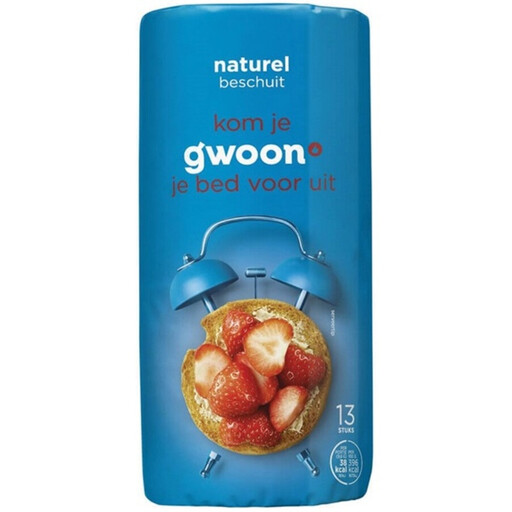 Image unavailable
For anyone who prefers plain rusks when topping up their supplies. The pack weighs 125 g; check the ingredients and nutritional information if you’re comparing it with wholegrain rusks.
No, base your choice on what people at home eat and which product features matter to you. If tastes differ, a small pack of plain rusks and a small pack of wholegrain rusks may be a better fit than one larger pack of a single variety.
No, you shouldn’t assume that. The Voedingscentrum says bakers aren’t required to use baker’s salt, so if it matters to your choice, check the ingredients list on the rusks you’re buying.
Check the ingredients and allergen information on the packaging of the exact variety. Bolletje says it uses egg in Bakkers Beschuit Origineel, while PLUS describes a specific dark wholegrain variety from Bolletje as vegan. Neither description applies to every rusk from the brand.