
A small household that wants to try rusks first
You want a useful supply for breakfast or lunch without buying several rolls straight away. Compare the total weight and the size of each rusk, not just the number in the pack.


If you live in a small household and want to see how often you eat rusks before buying more, one standard roll of 125 g containing 13 rusks is a sensible place to start, such as Jumbo Plain Rusks. If you prefer wholemeal or larger rusks, compare the total weight too: ten larger rusks may not be a smaller purchase overall. Before buying, check the ingredients, allergens and storage instructions for the variant you choose.
You want a useful supply for breakfast or lunch without buying several rolls straight away. Compare the total weight and the size of each rusk, not just the number in the pack.
You’re looking for a variant whose wholemeal labelling or nutritional information suits your preferences. Bear in mind that a wholemeal roll may contain a different total quantity from a plain one.
Wheat, egg and other ingredients or allergens vary between rusk variants. Check the exact packaging, even if you’re switching to a different variant from the same brand.
First decide what matters most to you. If you’re buying a small amount to try, the total weight tells you more than the number of rusks alone.
| What to consider | What should you check? | Who is this most important for? |
|---|---|---|
| Quantity | Compare the total weight and the weight of each rusk; also check how to store the roll once opened. | If I don’t yet know how often I eat rusks, I want to start with one manageable roll. For around 36% of consumers, starting with a limited supply is the priority. |
| Wholemeal and fibre | Look for an explicit wholemeal label and compare fibre on the same basis: per 100 g. | I mainly want to know whether my choice of rusks suits my preference for wholemeal or fibre, even if the roll is heavier. This is a priority for around 29% of consumers. |
| Ingredients and allergens | Read the allergen information for the exact variant, including any precautionary statements about traces; check separately for a vegan label if you want one. | If I need to avoid certain ingredients, I rule out a variant before considering its size or taste. Around 21% of consumers make this check their priority. |
| Size for toppings | Check the weight per piece and the description of the size; ten rusks don’t automatically mean there’s less to eat. | For a breakfast with plenty of toppings, I’m more likely to look for a larger rusk than the smallest roll overall. For around 14% of consumers, size matters most. |
According to Albert Heijn’s product information, a Bolletje Echte Beschuit weighs around 9.6 g per piece, while a Bolletje Bakkers Beschuit weighs around 14 g. So a roll with ten larger rusks isn’t necessarily a smaller purchase than one with thirteen standard rusks.
Compare the total weight and the weight per piece if you want to avoid having leftovers.
Seeds or a multigrain label don’t, on their own, prove that a rusk is fully wholemeal. Fibre content can also vary between variants.
Check the wholemeal labelling and compare the fibre per 100 g in the nutritional information.
Ingredients and allergens can differ between plain, wholemeal and seeded rusks. So having chosen the same brand before doesn’t tell you enough about a new variant.
Before buying, read the ingredients and allergen information on the pack you’re actually choosing.
According to the Netherlands Nutrition Centre, bakers aren’t required to use baker’s salt. Seeing the word ‘salt’ in an ingredients list doesn’t confirm which type of salt was used in those rusks.
If you want to know whether a specific variant contains baker’s salt, check the packaging or ask the manufacturer.
Bolletje’s range includes Echte Beschuit, Volkoren Beschuit and the larger Bakkers Beschuit Origineel.
Albert Heijn lists both its own-brand rusks and Bolletje variants in its range.
Jumbo lists its own-brand rusks in varieties including plain and wholemeal.
PLUS lists plain rusks alongside other varieties, including seeded rusks.
ALDI lists Goud Gebakken rusks in plain and wholemeal varieties, both with 13 rusks per pack.
Lidl lists Ambachtelijk Beschuit Meergranen as a 230 g pack.
These three rolls give you a choice between rusks with 13 pieces and a dark wholemeal variety with 10. If you’re buying a small amount to try, check the pack weight to see whether the size suits the way you’ll use them.
 Image unavailable
An option if you want to start with a roll of 13 and prioritise wholemeal.
This variant is listed as containing 11 g of fibre per 100 g. To compare the total quantity, also check the pack weight and the current allergen information.
 Image unavailable
An option if you’re looking for a dark wholemeal variety with 10 pieces.
Don’t use the number of pieces as a measure of the total quantity; compare the pack weight and the weight of each rusk instead. Also check the ingredients and allergens for this variant.
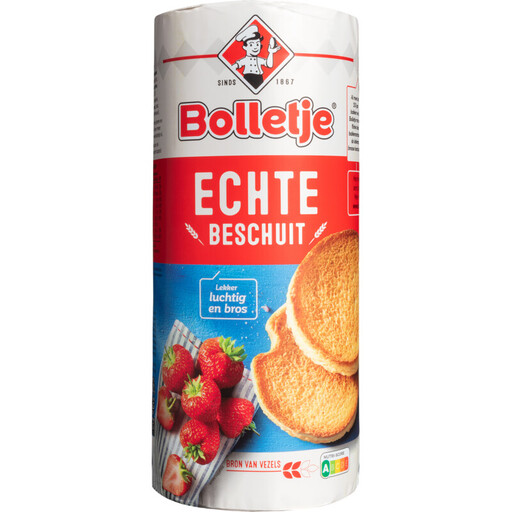 Image unavailable
A good choice if you want a roll of 13 rusks for your first shop.
Compare the total weight with other rolls before deciding which quantity is right for you. Check the packaging for ingredients, allergens and storage instructions.
No, the size of each rusk can make the difference the other way round. According to Albert Heijn, Bolletje Bakkers Beschuit weighs around 14 g per piece and Bolletje Echte Beschuit around 9.6 g, so compare the total weight of the rolls too.
No, when buying rusks, check the number of pieces and the weight of the roll, not a half loaf. Jumbo explains how a rusk loaf is cut in half and the two halves are baked again; this tells you nothing about the pack size.
No, don’t assume they do. According to the Netherlands Nutrition Centre, bakers aren’t required to use baker’s salt. For a specific rusk variant, check the packaging or ask the manufacturer.
No, check each variant separately. Wheat and egg are found in the standard Bolletje variants mentioned here, while other variants may contain ingredients such as sesame or other grains that are relevant to you. Always read the current allergen and precautionary trace information.
Store opened rusks in a cool, dry, dark place in a tightly sealed container. This is the storage advice given for Bolletje Echte Beschuit and Bolletje Bakkers Beschuit; follow the instructions on the packaging for your own roll.