
Planners expecting a small or changing turnout
If the number of people eating during the break could change, the number of rusks per pack and when you open it matter more than an assumed size such as ‘half loaf’.


When choosing rusks for a small or changing conference group, focus on the number of pieces per pack and when you’ll open it, rather than the term ‘half loaf’. Then decide whether to serve plain, wholemeal or seeded rusks. Check the allergens for each product you choose, and make this information available to guests if you serve the rusks unpackaged.
If the number of people eating during the break could change, the number of rusks per pack and when you open it matter more than an assumed size such as ‘half loaf’.
If you serve rusks on a platter or with toppings, you need to be able to share information about the products and toppings you’ve chosen. The Netherlands Food and Consumer Product Safety Authority points out that guests must also receive allergen information when unpackaged food is served at catering events.
Wholemeal or seeded rusks add variety to the menu. Compare the ingredients and nutritional information on each pack, including the allergens.
Start with the expected number of portions and how you’ll serve them. Then choose the type of rusk and note the allergen information for every product you’ll actually serve.
| What to consider | What to check when buying | Who should pay particular attention? |
|---|---|---|
| Portions and leftovers | Compare the number of pieces per pack with the expected demand. Check the net weight and, if necessary, open rolls in stages. | With a changing turnout, I want to have enough rusks ready without opening every roll in advance. For around 42% of consumers, getting portion planning right is a priority. |
| Allergens and serving | Read the current label for each product, including any warnings about possible cross-contamination. Arrange how guests will receive allergen information if you’re serving the rusks unpackaged. | If I serve rusks with toppings, it needs to be clear which allergens are in each bite. Allergen information is the main concern for around 33% of consumers. |
| Wholemeal, fibre and seeds | Check the product name, ingredients and nutritional information per 100 g; compare the allergens in each variety too. | I want to offer a wholemeal option or seeded rusks, but I don’t want to assume the ingredients are the same. This menu choice is a priority for an estimated 25% of consumers. |
Dutch product listings from retailers such as PLUS, Albert Heijn and Jumbo describe rusks by roll, weight and number of pieces. So ‘half loaf’ doesn’t give you a useful quantity to order.
Work out how many rusks you want to serve, then compare the number of pieces and net weight on the packs.
Misjudging the quantity could leave you short during the break or with unopened leftovers.
PLUS lists wheat and egg as ingredients in Bolletje wholemeal rusks; sesame is also listed as an allergen for the multiseed variety. The name of a variety is no substitute for checking the ingredients list.
Make an allergen overview of the products and toppings you choose. Make sure guests can access this information when you serve the rusks unpackaged.
Albert Heijn lists the individually wrapped Bolletje variety, with 40 pieces, as no longer part of its range. Don’t rely on that listing when planning what to serve at an upcoming conference.
Before placing your order, confirm the variety, pack, ingredients and availability with your supplier.
A substitute product means checking the portion count and allergen information all over again.
PLUS product listings show Bolletje rusks in standard, wholemeal and multiseed varieties.
PLUS lists its own-brand plain rusks in a 125 g roll.
Albert Heijn’s category listing includes its own-brand plain and wholemeal rusks, alongside other brands.
Jumbo’s rusk category includes plain, wholemeal, multigrain and spelt varieties from various brands.
These rusk packs contain 10 or 13 pieces, which can help you plan for a conference break. Choose between standard, wholemeal and seeded varieties to suit your menu, and check the label on your chosen pack before serving.
 Image unavailable
An option if you want to buy wholemeal rusks for the break and count the portions in each pack.
The product information states 100% wholemeal and 11 g of fibre per 100 g. Check the pack weight and current label; wheat, gluten and egg are listed as allergens, and sesame may be present.
 Image unavailable
A seeded variety if you want to consider the ingredients as well as the number of pieces.
The product information states 10 g of fibre per 100 g and lists ingredients including sunflower seeds, linseed, sesame seeds and pumpkin seeds. Wheat, gluten and sesame are listed as allergens; also check the pack weight and any warnings on the label.
 Image unavailable
A 10-piece wholemeal option for anyone planning portions and considering seeded rusks too.
The product information states 100% wholemeal and 10 g of fibre per 100 g. Wheat, gluten and sesame are listed as allergens; check the current label and pack weight before comparing quantities.
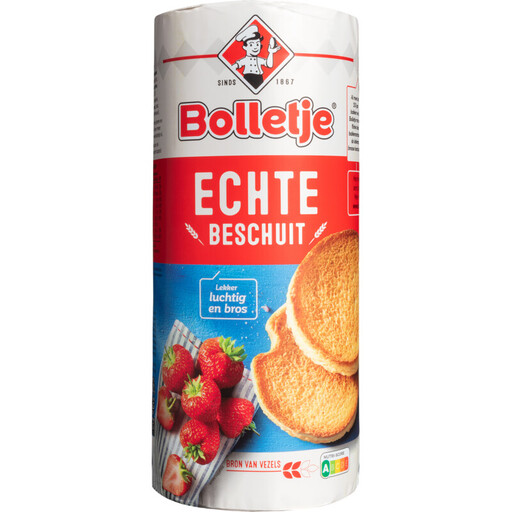 Image unavailable
A standard rusk if you mainly want to match the number of pieces in each pack to the expected turnout for a break.
The product information lists wheat, rye, gluten and egg; sesame may be present. Check the current label and pack weight when comparing this variety with other rolls.
Don’t use ‘half loaf’ as a size when buying Dutch rusks. Product listings from PLUS, Albert Heijn and Jumbo give the number of rolls, net weights and number of pieces; compare these details with the number of guests you expect.
Make sure guests can access allergen information for the rusks and toppings you serve. For unpackaged food at catering events, the Netherlands Food and Consumer Product Safety Authority gives written information, such as a menu, as one example. If you provide the information verbally, guests must be clearly told that they can ask for it.
Not based on the plain and wholemeal varieties mentioned here: wheat and gluten-containing grains are listed for these products. The Netherlands Nutrition Centre also lists rusks as a product that may contain gluten. For a gluten-free option, check a separate product with a suitable label and its accompanying allergen information.
Don’t open more rolls than you need for the next serving, and follow the storage instructions on the pack you choose. PLUS lists Bolletje Real Rusk as needing to be stored in a cool, dry place in a sealed container after opening.