What should you look for?
First, match the quantity of rusks to how you plan to use them. Then compare the nutritional information and allergens. If you’re serving them with toppings, you’ll also need a plan for storing and serving those safely.
| What to consider |
What to check |
Who it matters to |
| Quantity and packaging |
Compare the number of rusks, the weight of each one and whether they’re individually wrapped. |
If I take a while to get through a pack, I don’t want to open more rusks than I expect to use. Around 40% of consumers prioritise quantity and packaging. |
| Wholegrain and fibre |
Read the ingredients and compare the fibre per 100 g as well as the serving size. |
For breakfast, I want to know whether I’m buying a wholegrain option and how much fibre it contains. This is a priority for around 30% of consumers. |
| Allergens |
Check the current ingredients and allergen information for the exact variety you’ve chosen. |
If I need to avoid specific ingredients, I can’t rely on the word ‘wholegrain’ alone. Allergens are the main consideration for around 20% of consumers. |
| Serving at a festival |
Plan to store dry rusks separately from the chilled, hygienic serving of perishable toppings. |
If I’m selling rusks with toppings, I want to make sure they’re stored properly and that customers can get allergen information. Around 10% of consumers prioritise safe serving. |
Rusks on Joybuy
These Bolletje products come in packs of 10 or 13, so you can choose a quantity to suit a small household or a planned serving. If you get through rusks slowly, also compare the storage instructions and check that the pack size suits how you’ll use them.
 No image available
Bolletje Multi-Seed Rusk, 10 stuks
A pack of 10 rusks, so you can match the quantity to the number of occasions when you plan to eat them.
The product description lists 10 g of fibre per 100 g and names wheat and sesame as allergens. Keep the pack tightly closed after opening, and check the weight per rusk if the total quantity matters to you.
View on Joybuy
 No image available
Bolletje Dark Whole Wheat Rusk, 10 stuks
A wholegrain option in a pack of 10, for anyone who wants to plan the number of rusks in advance.
The product description lists 10 g of fibre per 100 g and names wheat, oats, barley and sesame, among other ingredients. Keep the pack tightly closed after opening, and check the weight per rusk if portion size matters to you.
View on Joybuy
 No image available
Bolletje Wholegrain Rusk, 13 stuks
A pack of 13 wholegrain rusks, if that quantity suits the occasions when you plan to eat them.
The product description lists wholemeal wheat flour and 11 g of fibre per 100 g. Wheat and egg are listed as allergens, and sesame may be present. Keep the pack tightly closed after opening.
View on Joybuy
 No image available
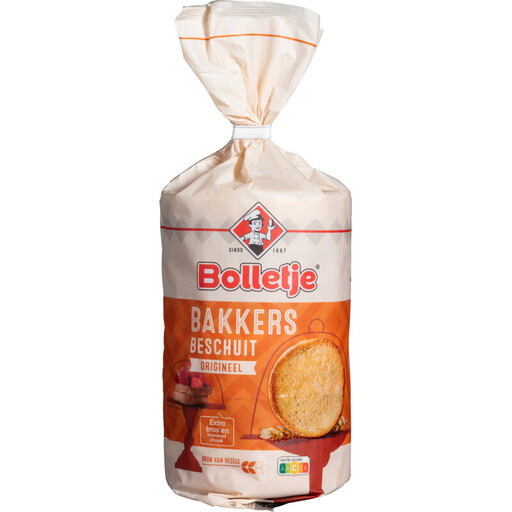
Bolletje Original Rusks, 10 stuks
A regular variety in a pack of 10, for anyone choosing mainly by the quantity they need.
The product description lists 3,6 g of fibre per 100 g and doesn’t mention a wholegrain base. Wheat and egg are listed as allergens, and sesame may be present. Keep the pack tightly closed after opening.
View on Joybuy
Frequently asked questions
Is ‘half loaf’ a standard pack size for rusks?
No. Don’t use this term to work out the pack size. Albert Heijn explains that one rusk loaf makes two rusks. Before buying, compare the number of rusks, the weight of each one and whether they’re individually wrapped.
How should I store an opened pack of rusks?
Follow the instructions on the pack you’ve chosen. The Albert Heijn and Bolletje products described say to store them in a cool, dry place, away from light and in a sealed pack. For its wholegrain rusks, Albert Heijn recommends using a sealed tin after opening.
Are wholegrain or high-fibre rusks automatically allergen-free?
No. The wholegrain varieties from Albert Heijn and Bolletje described here contain wheat and egg, among other ingredients. The high-fibre Bolletje variety described also contains oats, barley and sesame. Read the current allergen information for the exact variety you plan to use.
What should I consider if I’m selling rusks with toppings at a street festival?
Treat the storage and serving of perishable toppings as a separate food safety issue. For sales at markets and events, the Netherlands Food and Consumer Product Safety Authority specifies hygienic practices, allergen information and storage of perishable foods below 7 °C.
Do rusks always contain iodine because they’re made with baker’s salt?
You can’t assume that for every variety. According to the Netherlands Nutrition Centre, using baker’s salt isn’t compulsory. Check the product-specific information rather than assuming which type of salt was used based on the word ‘salt’ alone.


