
Small households that enjoy the occasional late-night snack
If you only eat rusks now and then, the main thing to consider is how many will be left once you’ve opened the pack.


For a late-night snack in a small household, the number of rusks in a pack is a more useful point of comparison than the term ‘half a loaf’. A pack of 10 leaves you with fewer rusks than a pack of 13 if you only eat them occasionally, but it won’t automatically prevent leftovers. If you prioritise wholegrain or fibre, check the description and nutritional information for the exact variety. For plain rusks, consider whether you’re likely to finish the pack.
If you only eat rusks now and then, the main thing to consider is how many will be left once you’ve opened the pack.
As well as the number of rusks, you’ll want to check the product description and fibre per 100 g in the nutritional information.
You want a simple rusk as the basis for a late-night snack, and a pack that suits how often you eat them.
First, consider how many rusks you’re likely to get through. Then check the nutritional information and ingredients for the variety you’re considering.
| What to consider | What to check | Who is it important for? |
|---|---|---|
| Number of rusks | Compare packs of 10 and 13, and check how to store an opened pack. | If I only eat rusks occasionally as a late-night snack, I don’t want lots left over; around 40% of consumers prioritise a smaller quantity. |
| Wholegrain and fibre | Check for the ‘wholegrain’ description and compare fibre per 100 g across the exact varieties. | When I’m looking for wholegrain rusks, I don’t want to judge by their darker colour alone. Wholegrain or fibre is the main priority for around 30% of consumers. |
| Plain rusks | Check the variety and number of rusks; plain and wholegrain are different product choices. | For my late-night snack, I mainly want plain rusks that I’ll actually finish; this straightforward choice matters most to around 20% of consumers. |
| Ingredients and allergens | Read the current ingredients and allergen information for the variety you’ve chosen. | If an ingredient or allergen is a deciding factor for me, I check the label before considering the pack size. This check takes priority for around 10% of consumers. |
A smaller pack leaves you with fewer rusks than a pack of 13, but it still needs to suit how often you eat them.
Choose a quantity you’re likely to finish and follow the storage instructions on the packaging once opened.
Colour, seeds and the ‘wholegrain’ description don’t mean the same thing. Ingredients and allergens also vary between varieties.
Check the exact product description, ingredients list and allergen information before making your choice.
The product name ‘rusk’ doesn’t tell you which type of salt was used in that variety.
If the type of salt matters to your choice, check the ingredients list or ask the manufacturer which type they use.
Bolletje varieties in packs of 10 or 13 are listed by retailers including PLUS and Jumbo.
PLUS lists a 125 g pack of plain rusks.
ALDI lists Goud Gebakken plain rusks in a pack of 13.
Albert Heijn lists a range of own-brand rusks, including plain and wholegrain varieties.
These Bolletje packs give you a choice of 10 or 13 rusks. There’s an option if you’d rather open a smaller pack, as well as choices for anyone looking for plain or wholegrain rusks. Compare the exact variety before you choose.
 Image unavailable
A pack of 10 for anyone who only eats rusks occasionally and is looking for a seeded variety.
Check the latest allergen information, particularly for wheat and sesame.
 Image unavailable
A pack of 10 in an explicitly wholegrain variety.
Check the latest ingredients and allergen information, including for wheat, oats, barley and sesame.
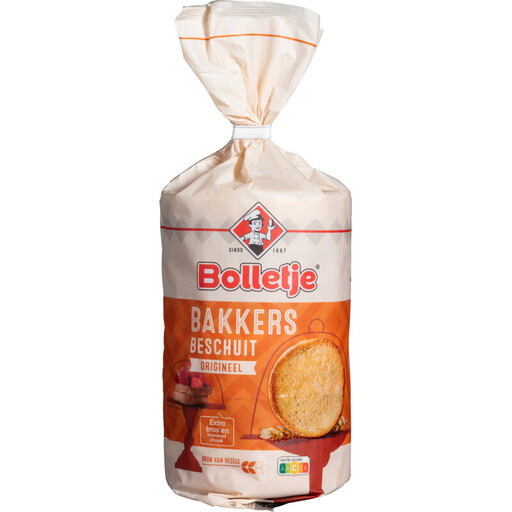 Image unavailable
Plain rusks in a pack of 10 for occasional use.
If wheat, egg or sesame is relevant to your choice, check the allergen information on the packaging.
 Image unavailable
A wholegrain variety for anyone who can finish a pack of 13.
That’s three more rusks than in the packs of 10 shown; check the latest allergen information too.
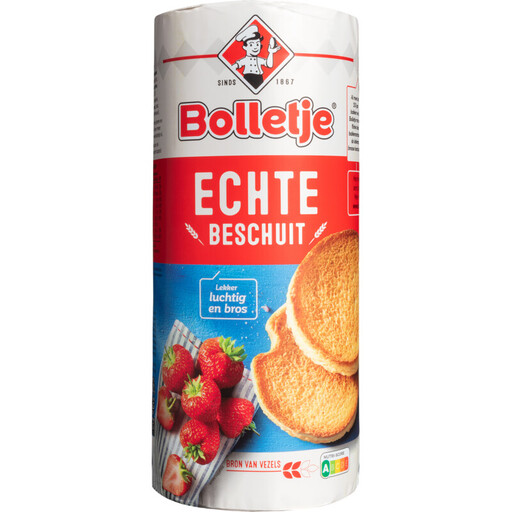 Image unavailable
Plain rusks for anyone who prefers a pack of 13.
Check the ingredients and allergens for this variety before choosing the pack.
For rusks, it’s better to compare the number in each pack: the varieties discussed here contain 10 or 13. This gives you an idea of which quantity will suit your needs.
Once opened, a pack of 10 leaves you with three fewer rusks than a pack of 13, but it will only prevent leftovers if you finish them. Store an opened pack according to the instructions on the packaging.
No, don’t judge by colour alone. Check whether the exact variety is labelled ‘wholegrain’; according to the Voedingscentrum, this is a specific product description. Also read the ingredients and nutritional information.
Compare the salt content per 100 g on the packaging of the varieties you’re considering. Also take into account how many rusks you eat and what you put on them.