If you’re stocking a shop for older and fussy eaters, it makes sense to offer both wholemeal and plain rusks. That way, shoppers can choose between a wholemeal option and a familiar, lighter rusk. Check the nutritional information and allergens for each product. If someone has difficulty chewing or swallowing, their individual dietary advice should take priority over general choices about what to stock.
Who is this choice important for?
Shoppers keeping an eye on fibre
If you’re buying rusks for older people, compare the wholemeal claim and nutritional values per 100 g. The Netherlands Nutrition Centre highlights fibre and getting enough fluids as points to consider when planning food for older people.
Fussy eaters who prefer plain rusks
Offering a plain variety alongside wholemeal gives people who prefer a familiar, light and crisp rusk another choice. Bolletje describes its Bakkers Beschuit Origineel as extra crisp and light, though whether someone enjoys that texture is a personal preference.
Shoppers buying for someone with individual dietary advice
If someone has an allergy or difficulty chewing or swallowing, the product category alone isn’t enough to guide your choice. Check the allergen information on the exact pack and, if they have difficulty swallowing, follow their personal dietary or speech and language therapy advice. Zorg voor Beter emphasises that any adjustments for swallowing difficulties should be considered on an individual basis.
What should you look for when stocking up?
First, decide which wholemeal and plain rusks you want to offer side by side. Then compare the nutritional information and check that your choices suit the people who’ll be eating them and your restocking needs.
| What to consider | What to check when buying | Who is this important for? |
|---|
| Wholemeal and fibre |
Look for the wholemeal claim and compare the fibre and salt content per 100 g for the exact products. |
If I’m looking for a wholemeal option for everyday eating, I want to compare fibre content on a like-for-like basis, without mixing up different serving sizes. This is the top priority for around 36% of shoppers. |
| Familiar texture |
Compare a plain rusk with your chosen wholemeal variety; don’t rely on words such as ‘crisp’ alone. |
If someone tends to avoid strongly flavoured wholemeal varieties or seeds, I also want to be able to offer plain rusks. Around 29% of shoppers are expected to prioritise this preference. |
| Restocking |
Check current availability and decide which similar variety you could stock if your usual choice is unavailable. |
For a small shop shelf, I want to be able to keep replenishing a chosen rusk without having to change the range each time. This is the most important consideration for around 21% of shoppers. |
| Individual dietary requirements |
Check the latest allergen information; if someone has difficulty chewing or swallowing, follow their personal dietary advice. |
If I’m buying for someone with an allergy or swallowing difficulty, the rusks need to meet their individual requirements. This is the first consideration for around 14% of shoppers. |
Common mistakes
-
Assuming a dark rusk is wholemeal
A dark colour or a coating of seeds doesn’t tell you how much wholemeal flour the product contains.
Look for the wholemeal claim on the pack, then compare the nutritional information for the exact variety.
-
Stocking a seeded variety for everyone
The Bolletje variety with oats and seeds described by Albert Heijn is different from a simple wholemeal rusk. Its ingredients and allergens may therefore differ too.
Check the allergen information on each pack and offer a seeded variety as an additional option only if it’s suitable for the people who’ll be eating it.
-
Replacing individual dietary advice with a general product choice
If someone has difficulty chewing or swallowing, choosing between plain and wholemeal rusks doesn’t, by itself, tell you whether they can eat them. Zorg voor Beter recommends checking what adjustments are needed on an individual basis.
Before offering rusks, ask about the person’s existing dietary or speech and language therapy advice.
-
Assuming every rusk contains iodised salt
You can’t tell from the product category or colour of a rusk which salt was used in the recipe.
Check the ingredients list on the pack you’ve chosen for baker’s salt or iodised table salt.
Brands to consider
Bolletje
The range reviewed includes plain and wholemeal rusks, as well as a variety with oats and seeds.
- Albert Heijn lists 11 g of fibre per 100 g for Bolletje Wholemeal Rusks.
- Ingredients and allergens vary by variety, so check the details carefully for seeded options.
Albert Heijn
Its own-brand range includes a 140 g wholemeal rusk that you can compare as a separate wholemeal option.
- The product name makes it clear which own-brand variety you’re comparing with other wholemeal rusks.
- For your final choice, use the nutritional and allergen information on the current pack.
Jumbo
Its rusk range includes plain and wholemeal options, as well as varieties with grains and seeds.
- These varieties give you options for choosing a plain product to stock alongside wholemeal rusks.
- Check the availability of the exact variety when restocking your shop.
PLUS
Its range includes its own wholemeal rusks and Bolletje Wholemeal Rusks.
- You can assess the two wholemeal options separately by checking their packaging and nutritional information.
- Don’t assume the ingredients or allergens are the same just because both products are labelled wholemeal.
Lidl
Lists a 140 g wholemeal rusk as an in-store product.
- An option to look for in a physical shop.
- Check the pack before comparing its nutritional values or ingredients with another variety.
Rusks for a mixed shelf on Joybuy
These two rusks represent a choice between a wholemeal variety and a plain, lighter option. Check the current packaging before deciding which ones are suitable for the people who’ll be eating them.
 No image available
Bolletje Wholemeal Rusks, 13 pieces
A wholemeal option for a shelf that also stocks plain rusks.
Compare fibre on a like-for-like basis, for example per 100 g, and check the latest allergen information if wheat, egg or sesame is relevant.
View on Joybuy
 No image available
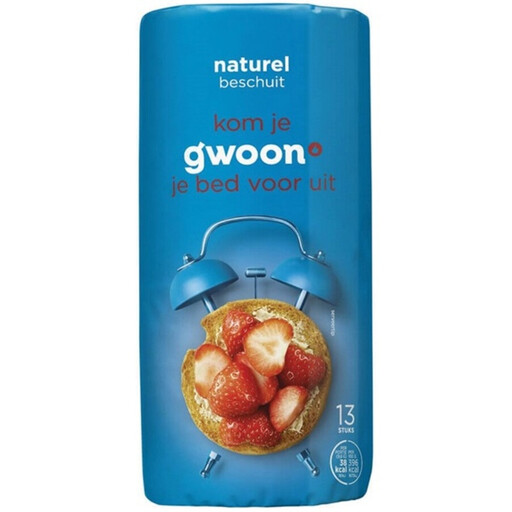
g'woon Plain Rusks, 125 g
A plain rusk for people looking for a lighter, crumbly texture.
Check the latest allergen information if milk, egg or wheat is relevant. Assess its nutritional value separately from that of the wholemeal variety.
View on Joybuy
Frequently asked questions
Is a dark rusk automatically wholemeal?
No. Don’t judge by the colour. Look for the wholemeal claim on the pack, then compare the fibre per 100 g in the products you’re considering.
Can someone with swallowing difficulties eat plain rusks?
This needs to be assessed individually; the type of rusk alone isn’t enough to make that decision. Follow the person’s dietary or speech and language therapy advice before offering dry, crisp rusks. Zorg voor Beter recommends checking with the person concerned to find out what adjustments are suitable for their swallowing difficulties.
How can I tell whether rusks contain iodised salt?
Check the ingredients list on the exact pack for baker’s salt or iodised table salt. The word ‘rusk’ alone doesn’t tell you which salt was used.
How should I store an opened pack of rusks?
Seal the pack tightly and store it in a kitchen cupboard. The Netherlands Nutrition Centre recommends keeping opened rusks in a kitchen cupboard for up to one month.


