
Buyers who care about presentation
You’re looking for rusks whose size or visible seeds make them a good fit for a more substantial lunch spread. Check how many pieces are in each pack, too.


For an office lunch where presentation is a priority, consider larger rusks or a variety with seeds. If a wholemeal base and fibre matter more, compare the nutritional information for the exact varieties. When ordering for several colleagues, also check the allergens, pack size and availability.
You’re looking for rusks whose size or visible seeds make them a good fit for a more substantial lunch spread. Check how many pieces are in each pack, too.
You want to assess a wholemeal variety as part of the lunch selection, comparing the fibre per 100 g and per piece for the exact variety each time.
You’re ordering for colleagues with different dietary requirements, so you check the ingredients and allergen information before buying. The varieties reviewed differ in their declarations of wheat, egg and sesame, among other things.
First, decide what matters most for this office lunch: presentation, a wholemeal base, suitability for colleagues with specific dietary requirements or the practicalities of ordering. Then compare the exact packs.
| What to consider | What to check when buying | Who it matters to |
|---|---|---|
| Wholemeal and fibre | Compare fibre per 100 g and per piece; check which grains are listed in the ingredients. | If fibre is my priority for the lunch selection, I want to compare wholemeal varieties using the same nutritional basis. An estimated 31% of consumers give this need priority. |
| Presentation and toppings | Check the size, seeds, number of pieces and storage instructions. | For a shared lunch spread, I’m looking for a type of rusk that suits the presentation I have in mind. An estimated 31% of consumers prioritise this. |
| Allergens and dietary requirements | Read the current ingredients and allergen information for each variety you choose. | When I order for colleagues with different dietary requirements, I want to know which pack is suitable for whom. Around 23% of consumers make this their main consideration. |
| Stock and delivery | Check the pack size and availability for the office address; follow the storage instructions after opening. | If a pack needs to last for several lunches, I want to plan the quantity I need and arrange delivery. This is the main consideration for an estimated 15% of consumers. |
For rusks at an office lunch, the focus might be on size, seeds, a wholemeal base or a different nutritional profile. None of these features automatically makes a variety suitable for every colleague.
Decide in advance which feature matters for your lunch, then compare the relevant information for the exact products.
A name containing ‘wholemeal’, ‘spelt’ or ‘seeds’ doesn’t tell you which allergens are in the full recipe. The varieties reviewed include cereals containing gluten, egg and sesame, among other things.
Read the current information on each pack separately and bear in mind that some colleagues may need a different option.
The rusk range includes plain, wholemeal and seeded varieties.
The own-brand range includes seeded rusks, including a wholemeal variety.
Jumbo has its own-brand rusks, including an organic wholemeal product.
The range includes own-brand rusks and branded products, including Bolletje.
ALDI lists plain and wholemeal rusks under this name.
Lidl lists plain rusks as a supermarket product.
The list below compares three specific types of rusk solely by their stated fibre content per 100 g. It isn’t a ranking of taste, suitability for all colleagues or overall product quality; the nutritional information comes from Joybuy and PLUS.
| Rank | Product | Specifications | Details | Retailer |
|---|---|---|---|---|
| 1 | TastyBasics Rusks with Sunflower Seeds, 8 pieces | 11 g fibre per 100 g | Joybuy lists 11 g fibre per 100 g for this variety. Its position is based solely on this fibre content. | Joybuy |
| 2 | PLUS Wholemeal Rusks with Seeds, 230 g roll | 10,6 g fibre per 100 g; 49% wholemeal wheat flour | PLUS also lists over 25% seeds. These features alone don’t indicate whether the product is suitable for people with allergies. | PLUS |
| 3 | Bolletje Protein Rusks, 13 pieces | 6,7 g fibre per 100 g | The fibre value listed by PLUS determines this position; compare other nutritional values separately if they matter for your lunch. | PLUS |
These products offer different options for an office lunch: wholemeal rusks and a variety with sunflower seeds. Choose based on the pack you want, the nutritional information and the allergens listed for the exact product.
 Image unavailable
An option if wholemeal rusks are a priority for your lunch selection.
Joybuy’s product information lists 10 g fibre per 100 g. If you’re buying for colleagues with allergies, check the current pack, including for cereals containing gluten and sesame.
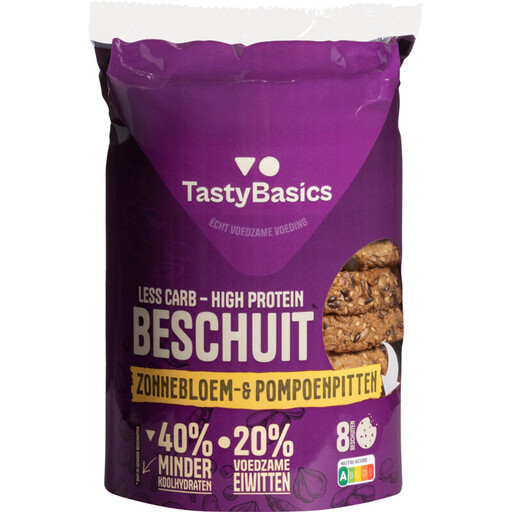 Image unavailable
A type of rusk with sunflower seeds for anyone who also wants to compare the nutritional information for a specific addition to their lunch.
Joybuy lists 11 g fibre per 100 g. Before placing an order for a group, check the current label for cereals containing gluten, egg and sesame, among other things.
 Image unavailable
A wholemeal option if you want to plan a pack for several lunches.
Joybuy lists 11 g fibre per 100 g. Check the current allergen information: the product details list wheat and egg and warn that traces of sesame may be present.
Check the allergen information on the exact, current pack. The varieties discussed here include cereals containing gluten, egg and sesame, among other things; don’t rely on words such as ‘wholemeal’ or ‘seeds’ in the product name alone.
No. A wholemeal base is one possible consideration alongside presentation, allergens and practical packaging. The Netherlands Nutrition Centre lists 0,8 g fibre for one 10 g piece of wholemeal rusk; when choosing a product, compare the values for the exact varieties on the same basis.
Follow the instructions on the pack and seal any opened rusks securely. For one Bolletje variety, Albert Heijn advises storing it in a dark, dry place after opening. This is particularly useful if a pack will be used over several lunches.
No. Check availability and delivery options for the office address before planning your lunch. A listed variety may no longer be available online or may only be available in store.