For a small office with lunch breaks at different times, individually wrapped portions are worth considering if an opened pack would be left sitting around for too long. Bolletje wraps its Mono rusks individually, but says they are not sold in supermarkets. If a pack better suits your needs, compare the number of rusks and check the ingredients, allergens and storage instructions on the packaging for your colleagues.
Who might this choice be relevant to?
People managing a small office food cupboard
When lunch breaks are irregular, you don’t want to open a whole pack for just a few rusks. Bolletje offers individually wrapped Mono rusks; the plain packs listed by Albert Heijn and Jumbo each contain 13 portions.
Lunch planners comparing wholegrain options or fibre
If the type of grain matters, look beyond the number of rusks. PLUS lists Bolletje Wholegrain rusks as 100% wholegrain, with 11 g of fibre per 100 g. Always compare nutritional information on the same basis, such as per 100 g.
Buyers taking allergens into account
For a shared lunch, it should be clear which rusks are suitable for each colleague. Product information from Albert Heijn, Jumbo and PLUS, among others, lists wheat, egg or sesame in the varieties checked; always check the label on the pack you choose.
What should you look for when choosing?
Individually wrapped rusks
Choose these if: colleagues have one or a few portions at different times.
Bear in mind: Bolletje says its individually wrapped Mono variety is not available in supermarkets.
A standard pack
Choose this if: the number of rusks in the pack suits your planned lunch breaks.
Bear in mind: an opened pack needs to be kept somewhere dry and sealed; Albert Heijn recommends storing it in a closed tin.
| What to consider |
What to check when buying |
Who should pay particular attention? |
| Portions and storage |
Compare the number of rusks with how many you expect to use, and check how the pack should be stored once opened. |
If rusks are only eaten occasionally in the office, I don’t want an opened pack left sitting around. Portion control is the top priority for around 40% of consumers. |
| Grain type and nutritional value |
Check the ingredients and compare fibre or protein per 100 g; portion sizes can vary by product. |
When wholegrain, fibre or protein determines what I choose for my lunch, I want to compare varieties on the same basis. Around 30% of consumers prioritise this nutritional information. |
| Allergens |
Check the ingredients and allergen information on the current packaging, including for wholegrain and multiseed varieties. |
If I’m buying rusks for colleagues with different food allergies, I need to know what each product contains. Checking the label is the top priority for around 30% of consumers. |
Common mistakes
-
Looking for a ‘half loaf’ of rusks
That term won’t help you distinguish between the rusk packs we looked at. Albert Heijn and Jumbo list their plain varieties in 125 g packs containing 13 portions; Bolletje also offers individually wrapped Mono rusks.
Work out how many rusks you use at each lunch break, then compare the number of rusks, the weight and the packaging.
-
Assuming wholegrain or multiseed means allergen-free
The varieties we looked at may contain wheat, egg or sesame, among other ingredients. Choosing a product for its fibre or protein content says nothing about whether it is suitable for someone with an allergy.
Before a shared lunch, read the ingredients and allergen information on every pack you choose.
-
Leaving an opened pack unsealed
Moisture can make rusks lose their crunch. Albert Heijn recommends storing them in a closed tin once opened; Jumbo suggests keeping them somewhere cool, dry and dark.
Seal an opened pack securely and choose a quantity that matches how many you’ll actually use.
-
Assuming every rusk contains iodine
The Netherlands Food and Consumer Product Safety Authority sets out the conditions under which iodine may be present in bakery products through baker’s salt. That doesn’t mean iodine is a standard feature of every rusk.
Check the information for the specific product if iodine is important to your choice.
Brands to consider
Bolletje
Bolletje offers standard and wholegrain rusks, multiseed and protein varieties, as well as individually wrapped Mono rusks.
- Bolletje says Mono rusks are individually wrapped, which may be useful when lunch breaks are spread throughout the day.
- Bolletje says Mono is not sold in supermarkets. Ingredients and allergens also vary by variety.
Albert Heijn
The own-brand range includes AH Plain Rusks in a standard pack.
- For this variety, Albert Heijn lists 125 g and 13 portions, along with ingredients, allergens and storage instructions.
- Check the current packaging: product and allergen information can change.
Jumbo
Jumbo’s own-brand rusks include plain, wholegrain and multigrain varieties.
- The product page for Jumbo Plain Rusks lists 13 portions and storage instructions.
- Check the ingredients and allergens for each variety; the plain variety lists wheat and egg.
Lidl
Lidl Netherlands lists 125 g plain rusks as an in-store product.
- The listed weight gives you a useful basis for comparing pack sizes.
- Check the label in store for the full ingredients, allergens and nutritional information.
ALDI
ALDI lists Goud Gebakken rusks in plain and wholegrain varieties.
- ALDI lists 13 rusks per pack for the wholegrain variety.
- Check the packaging for the ingredients and allergens in the variety you choose.
PLUS
PLUS lists its own-brand plain rusks, as well as product information for several Bolletje varieties.
- For the listed Bolletje Wholegrain rusks, the grain type and fibre content per 100 g are provided, making these features easy to compare.
- Availability and product information can vary by store or over time; check the packaging you choose, too.
Rusks for the office lunch at Joybuy
These products are packs of rusks containing 10 or 13 pieces. Compare the number of rusks with how many you’ll use for lunch; if you’re looking for individually wrapped portions, check for a different type of packaging.
 Image unavailable
Bolletje dark wholegrain rusks, 10 pieces
An option if 10 pieces suit your planned lunch breaks and you’re looking for wholegrain rusks.
Also compare the weight and check the ingredients and allergens on the packaging.
View at Joybuy
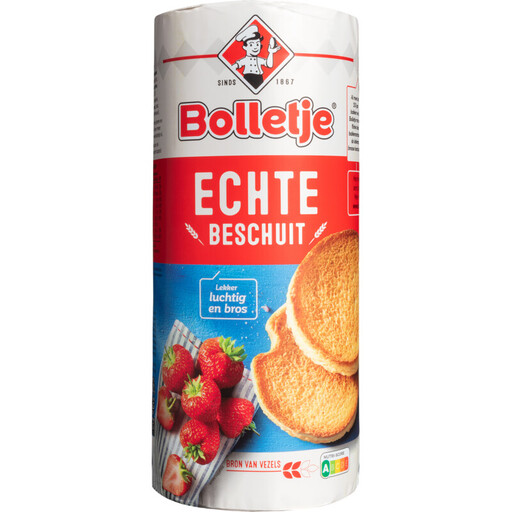 Image unavailable
Bolletje traditional rusks, 13 pieces
A standard pack of rusks for lunch breaks when 13 pieces suit your needs.
After opening, store the pack according to the instructions on the packaging and check the label for allergens.
View at Joybuy
 Image unavailable
Bolletje wholegrain rusks, 13 pieces
A wholegrain option if a pack of 13 suits your planned lunches.
Use the nutritional information on the current packaging to compare fibre per 100 g, and check the allergens.
View at Joybuy
Frequently asked questions
Is a ‘half loaf’ a common small pack size for rusks?
When comparing rusks, it’s better to look at the number of pieces, the weight and the packaging than to use that term. Albert Heijn and Jumbo list plain packs of 125 g containing 13 portions; Bolletje also offers individually wrapped Mono rusks, which the manufacturer says are not available in supermarkets.
How should I store an opened pack of rusks at the office?
Keep the rusks dry and seal the pack securely. For its plain rusks, Albert Heijn recommends storing them in a closed tin once opened; Jumbo recommends keeping its plain variety somewhere cool, dry and dark.
Are standard rusks automatically suitable for someone with a food allergy?
No. Check the current label for each product. The rusk varieties we looked at list ingredients including wheat and egg; PLUS also lists sesame in one multiseed variety.
Do Dutch rusks always contain iodine from baker’s salt?
No. You can’t assume that every rusk contains iodine without checking product-specific information. The Netherlands Food and Consumer Product Safety Authority explains the permitted use of baker’s salt; check the current ingredients information for the rusks you choose.


