
The portion-conscious evening snacker
You’re looking for a small base for a late-night snack and want to choose how many rusks to have and what to top them with.


Choose plain rusks if you want a simple base and would rather control the amount by choosing how many you eat and what you put on them. If fibre is your priority, compare wholemeal varieties using the nutritional information per 100 g. If you’re mainly drawn to a baker’s-style rusk, check the serving size, ingredients and allergens too.
You’re looking for a small base for a late-night snack and want to choose how many rusks to have and what to top them with.
You compare wholemeal and other rusk varieties by their fibre content, ideally per 100 g, so differences in the weight of each rusk don’t skew the comparison.
You focus mainly on the type of rusk, such as a multiseed or baker’s-style variety, and also check the ingredients and allergens on the label.
First, decide what matters most for your late-night snack: the type of grain, the portion size, the kind of rusk or any ingredients you need to avoid.
| What to consider | What to check before buying | Who is this most important for? |
|---|---|---|
| Fibre and wholemeal | Check that it’s labelled wholemeal and compare fibre per 100 g. | If I have rusks as an evening snack regularly, I mainly want to know which type of grain I’m choosing. Around 40% of consumers say fibre and wholemeal are their top priorities. |
| Portion size | Check the weight per rusk and the nutritional information per rusk; remember to include the topping too. | For a small snack, I want to decide for myself how many rusks to have and what to put on them. For around 30% of consumers, choosing the portion comes first. |
| Flavour and texture | Compare the variety name with the ingredients list; don’t mistake a description of crispness for nutritional information. | I’d rather choose a type of rusk that appeals to me for its flavour or texture, even if I still need to compare the label afterwards. For around 20% of consumers, this is the main consideration. |
| Allergens | Check the current ingredients and allergen information for the exact variety you’ve chosen. | If I need to avoid certain ingredients, the packaging determines whether these rusks are suitable for me. For around 10% of consumers, checking the label is the top priority. |
The Netherlands Nutrition Centre lists a 20 g serving of plain rusks and wholemeal rusks per 10 g rusk. This means the values per serving aren’t directly comparable.
Compare the values per 100 g first, then check the weight and how many rusks you plan to eat.
A name that refers to a style or added seeds doesn’t, by itself, tell you how much fibre the product contains.
If the type of grain or fibre content is what matters to you, check the ingredients and nutritional information per 100 g.
Recipes vary between products. For example, Albert Heijn lists egg, wheat and rye in AH Plain Rusks; for Bolletje Baker’s Original Rusks, Jumbo lists egg and wheat and says they may contain sesame.
Before buying and eating them, check the current information on the packaging of the specific rusks.
Rusks can lose their crunch if they get damp. Albert Heijn’s product information recommends storing them in a dark, dry place.
Seal the pack tightly after use or store the rusks in a dry, airtight container.
If rusks lose their crunch, they may end up being wasted.
The product ranges shown by Jumbo include plain, wholemeal, multiseed and baker’s-style rusks from Bolletje.
The range includes AH Plain Rusks and varieties containing ingredients such as wholemeal grains or seeds.
Albert Heijn lists TastyBasics Multiseed Rusks as another type of rusk in its range.
These rusks let you compare wholemeal and multiseed varieties with an original variety. For your late-night snack, also check the weight per rusk and the latest nutritional information on the packaging.
 Image unavailable
An option to consider if you want to compare seeded rusks for your late-night snack. The product name says the pack contains 10 pieces; check the label for the weight per rusk, fibre and allergens.
 Image unavailable
A wholemeal variety to consider if the type of grain is what matters to you. The product name says the pack contains 10 pieces; compare the weight per rusk and the nutritional information on the packaging.
 Image unavailable
Another wholemeal option to compare with other types of rusks. The product name says the pack contains 13 pieces; for a portion comparison, check the weight and nutritional information per rusk.
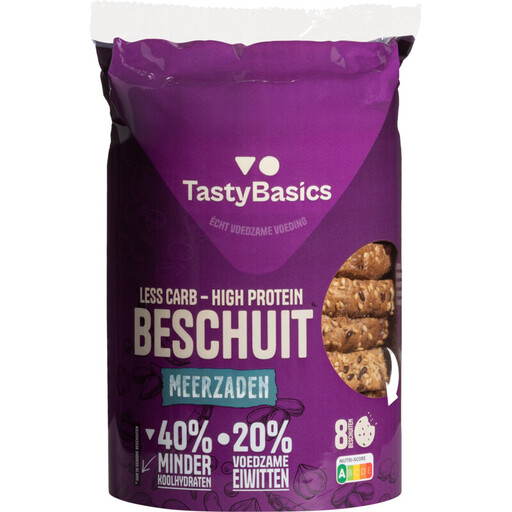 Image unavailable
A multiseed variety to consider if you want to compare different types of rusks. The product name lists 184 g per pack; check the label for the number of pieces, the weight per rusk and the allergens.
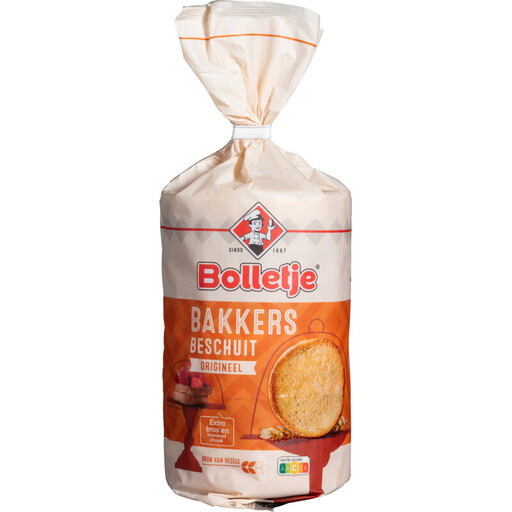 Image unavailable
An original variety to compare with wholemeal and multiseed rusks. The product name says the pack contains 10 pieces; check the ingredients, nutritional information and serving size on the packaging before choosing.
Choose wholemeal rusks if you’re mainly looking at the type of grain and fibre; plain rusks make a simple base for toppings of your choice. Compare the nutritional values per 100 g, as the Netherlands Nutrition Centre lists plain rusks per 20 g and wholemeal rusks per 10 g rusk.
You can’t tell from the product category alone. The Netherlands Food and Consumer Product Safety Authority explains that iodine compounds are added to bakery products through baker’s salt. If this matters to you, check the ingredients for the rusks you’ve chosen.
Read the allergen information and ingredients on the current packaging of the variety you’re buying. The Netherlands Food and Consumer Product Safety Authority says allergens must be clearly listed on the label; don’t rely on the product name or an older product image alone.
Keep the rusks dry and seal the pack tightly after opening. For its plain rusks, Albert Heijn recommends storing them in a dark, dry place and keeping them in a sealed container once opened; check the storage instructions on your own pack too.