
Families with fussy rusk eaters
If some members of your family prefer plain, light rusks, you can take that into account alongside the desire to keep wholegrain rusks at home too.


If not everyone in your family likes the same rusks, you don’t have to choose just one variety: you can combine a familiar plain option with a wholegrain one. If wholegrain is your main priority, check the product name and compare the fibre per 100 g. For seeded varieties, the ingredients, allergens and pack size also matter.
If some members of your family prefer plain, light rusks, you can take that into account alongside the desire to keep wholegrain rusks at home too.
If you buy rusks regularly, you can compare the wholegrain description and the stated fibre per 100 g. These two details don’t tell you exactly the same thing.
If you’re looking for seeds or need to avoid certain ingredients, the ingredients and allergen information for your chosen variety matter more than the general description on the front of the pack.
Start with what your family members will actually eat. Then compare the wholegrain description, nutritional information, pack size and ingredients of the varieties you’re considering.
| What to consider | What to check when buying | Who it matters to |
|---|---|---|
| Taste and whether your family will enjoy them | Choose between plain and wholegrain rusks based on your family’s preferences; try a variety before buying several packs. | If a new type of rusk goes uneaten, I’d rather have a familiar variety at home too. Around 36% of consumers put acceptance first. |
| Pack size | Check the number of rusks and the pack weight; packs of different weights can’t be compared directly by number alone. | I want to estimate how many packs we’ll need when several family members eat rusks. For around 29% of consumers, planning how much to stock is the main concern. |
| Wholegrain and fibre | Check whether the product is described as wholegrain and compare the fibre content on the same basis, preferably per 100 g. | When I mainly want to buy wholegrain rusks, a dark colour shouldn’t be my only clue. Around 21% of consumers focus on wholegrain and fibre. |
| Ingredients and allergens | Read the current ingredients list and allergen information for each variety separately. | If someone at home needs to avoid an ingredient, I want to know what’s in each pack. Ingredients are the main consideration for around 14% of consumers. |
Colour and visible seeds don’t, by themselves, mean that a rusk is wholegrain. The Dutch Nutrition Centre distinguishes between the term ‘wholegrain’ and other descriptions for grain products.
Look for the wholegrain description on the pack, and also check the fibre per 100 g if you’re comparing varieties.
Packs can differ in the number of rusks they contain and their weight. So two packs won’t necessarily top up your family’s supply in the same way.
Compare the number of rusks and the pack weight before choosing a larger stock-up.
The wholegrain and seeded varieties described may contain ingredients including wheat, egg or sesame. The term ‘wholegrain’ doesn’t indicate whether a product is suitable for someone with a relevant allergy.
Check the allergen information on the current pack every time you buy.
A general rule about baker’s salt doesn’t tell you which ingredients are in a specific rusk.
If iodine is relevant to your choice, check the product’s own ingredient information.
A brand whose plain, wholegrain and dark wholegrain rusks you can compare side by side.
A supermarket own-brand option if you’re looking for a basic wholegrain rusk.
An own-brand range that includes plain and wholegrain rusks, as well as varieties with grains or seeds.
An option to consider if seeds or a specific nutritional profile matter to you.
These products include a wholegrain variety, a dark wholegrain variety and a product with several seeds. If some members of your family prefer plain rusks, that remains a separate choice.
 No image available
For family members who want wholegrain rusks; the pack contains 13.
Albert Heijn lists 11 g of fibre per 100 g for this variety. Check the current pack, including the allergen information.
 No image available
For anyone looking for a dark wholegrain variety with oats and seeds; the pack contains 10.
Check the allergens on the current pack. Only compare the fibre content with other rusks once you know what quantity it refers to.
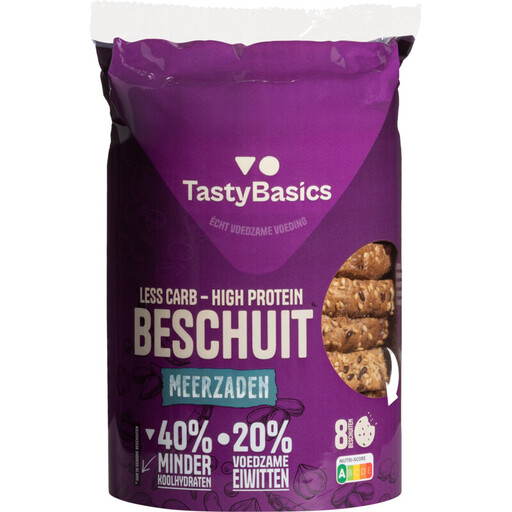 No image available
A seeded product to consider if you’re looking at an alternative to plain or wholegrain rusks; the pack weighs 184 g.
Check that the product type matches the rusks you’re looking for: the product description also uses the term crispbreads. Read the current ingredients and allergen information.
No. According to the Dutch Nutrition Centre, the term ‘wholegrain’ is linked to the use of wholemeal flour; colour or visible grains are no substitute. Check the product name and compare the nutritional information if fibre matters to your choice.
Store rusks in a dry, airtight container. For AH Wholegrain Rusks, Albert Heijn recommends using a closed tin after opening; for other products, follow the storage instructions on the pack.
Yes, if anyone in your household has a relevant allergy or intolerance. The varieties described may contain ingredients including wheat, egg or sesame; the current pack will list the allergens for the product you choose.
You can’t assume that of every product. A general rule about baker’s salt doesn’t confirm what a specific rusk contains; check the ingredients on the pack if iodine is relevant to your choice.