
Families who want to keep mealtimes relaxed
If a child rejects dark, coarse or seedy rusks, a small portion of a familiar variety can be a practical first step. The Netherlands Nutrition Centre advises against pressuring children to eat.


Don’t automatically start with the wholemeal option if a fussy eater finds the colour, taste or texture off-putting: a familiar, light-coloured rusk can be a useful starting point. Choose wholemeal if they’re happy with the texture, or try the switch in small portions without putting them under pressure. According to the Netherlands Nutrition Centre, wholegrain products contain more fibre and other nutrients than white grain products, but it advises against forcing a child to eat.
If a child rejects dark, coarse or seedy rusks, a small portion of a familiar variety can be a practical first step. The Netherlands Nutrition Centre advises against pressuring children to eat.
For anyone looking to switch from light-coloured to wholemeal rusks, while bearing in mind that the colour, taste or texture may be different. According to the Netherlands Nutrition Centre, wholegrain products contain more fibre and other nutrients than white varieties.
If you need to avoid certain ingredients or allergens, you’ll need to check the packaging for the exact variety. Wheat, egg and ingredients such as sesame aren’t present in the same way in every variety.
Start by choosing a texture the eater is willing to try. Then compare the wholemeal ingredients, nutritional values per 100 g and the ingredients in the exact variety.
| What to consider | What to check when buying | Who it matters to |
|---|---|---|
| Taste and texture | Look for a light or dark colour and a fine or coarse texture; try a small portion. | If a child rejects new flavours or coarse rusks, I want to offer something they’ll try without pressure first. For around 24% of consumers, immediate acceptance comes first. |
| Switching to wholemeal | If you like, start with wholemeal rusks without visible seeds and see how the colour and texture go down. | I want to offer wholemeal more often, but not switch all at once to a variety with a very different texture. For around 29% of consumers, making the change gradually is the main concern. |
| Wholemeal ingredients and fibre | Read the ingredients and compare the stated amount of fibre per 100 g. | When wholemeal is already accepted, I mainly want to know which variety best suits my preference for wholemeal and fibre. This is the top consideration for around 29% of consumers. |
| Ingredients and allergens | Check the current packaging for the exact variety, especially if you have questions about wheat, egg or sesame. | If an ingredient needs to be avoided, I don’t want to rely on packaging that looks similar. For around 18% of consumers, checking the ingredients is the top priority. |
The colour or texture of wholemeal rusks can be a stumbling block for a fussy eater. The Netherlands Nutrition Centre advises against forcing a child to eat.
Offer a small portion without pressure and, if you like, try wholemeal again another time.
PLUS product information lists 7,7 g of fibre and 0,72 g of salt per 100 g for its standard wholemeal rusks; its wholemeal variety with seeds contains 10,6 g of fibre and 0,8 g of salt per 100 g.
Compare nutritional information on the same basis, such as per 100 g, and check whether the eater likes the texture of rusks with seeds.
Ingredients vary between varieties. According to PLUS product information, its wholemeal rusks with seeds include sesame, oats, barley and egg.
Every time you buy, read the ingredients and allergen information on the current packaging for the product you’ve chosen.
You can’t tell whether a product contains iodine just from the fact that it’s a rusk. Brood.net describes the use of iodine-containing baker’s salt in the baking sector as part of an agreement.
If iodine is relevant to your choice, check the ingredients list or ask the manufacturer about the exact variety.
Offers both Echte Beschuit and wholemeal rusks, so you can compare light and wholemeal varieties within the same brand.
Offers its own-brand wholemeal rusks, alongside plain, wholemeal and multiseed varieties in its rusk range.
Offers its own-brand wholemeal rusks alongside other rusk varieties.
Offers standard wholemeal rusks as well as a wholemeal variety with seeds and kernels.
ALDI’s own-brand wholemeal rusks come in a pack of 13.
These Joybuy products suit three choices for the same mealtime: wholemeal rusks, light plain rusks and a coarser wholemeal variety. The right texture depends on what the eater is willing to try; if there are any allergies, always check the current packaging.
 No image available
An option to consider if the eater already enjoys crunchy rusks and you’d like to try wholemeal. The pack contains 13 pieces; if there are any allergies, check the current ingredients and allergen information.
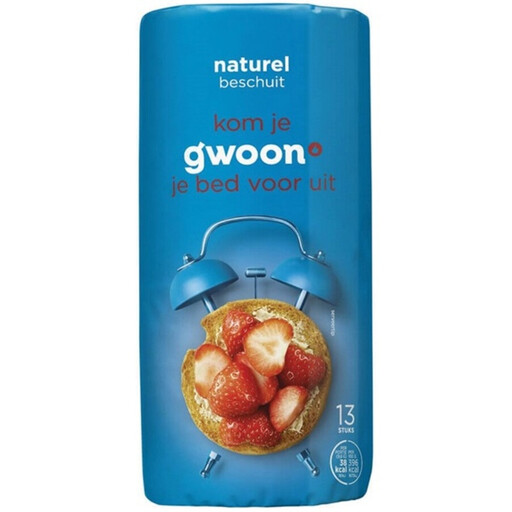 No image available
Worth considering if a light, crumbly texture is a better fit than switching to wholemeal. If you have a milk allergy, it’s especially important to check the current packaging before buying: the available ingredient and allergen information gives conflicting details about milk.
 No image available
Worth considering if the eater already enjoys a coarser wholemeal variety with oat flakes and seeds. The pack contains 10 pieces; check the current allergen information before choosing this variety.
No, not if the different colour or texture puts them off trying it. According to the Netherlands Nutrition Centre, wholegrain products contain more fibre and other nutrients than white varieties, but it also advises against forcing a child to eat. You could try a small portion of wholemeal later on.
According to the Netherlands Nutrition Centre, this means that all the flour in the product is wholemeal. If you want to compare the fibre content of different rusk varieties, also check the nutritional information per 100 g.
They’re best suited to eaters who already enjoy seeds and a coarser texture. Check the allergens for the exact variety too: PLUS lists sesame, oats, barley and egg among the ingredients in its wholemeal rusks with seeds.
You can’t tell from the word ‘rusk’ alone. Brood.net describes the use of iodine-containing baker’s salt in the Dutch baking sector as part of an agreement. If iodine is relevant to your choice, check the ingredients list or ask the manufacturer about the exact variety.
Follow the instructions on the pack and seal the rusks well after opening. Albert Heijn advises storing Bolletje Volkoren in a cool, dry, dark place in a sealed container after opening; PLUS advises keeping its wholemeal rusks away from moisture and heat.