
Host with guests who like to choose
You want guests to choose their own toppings, without serving everyone a strongly flavoured seeded or wholemeal variety. Offering a light and a wholemeal rusk side by side leaves that choice open.


For Friday afternoon drinks with guests who have different preferences, serve a light rusk alongside a clearly labelled wholemeal option, with the toppings on the side. A seeded variety is another choice: check that its ingredients and allergens are suitable for your guests, rather than treating it as a substitute for either of the two basic options.
You want guests to choose their own toppings, without serving everyone a strongly flavoured seeded or wholemeal variety. Offering a light and a wholemeal rusk side by side leaves that choice open.
You’re looking for a rusk labelled as wholemeal and comparing the ingredients and fibre per 100 g. A dark colour alone isn’t a reliable guide.
You check each pack to see which grains and other allergens it contains. For the varieties described, wheat, egg and, depending on the product, sesame are among the ingredients to look out for.
For a mixed group, first decide which light and wholemeal rusks you’d like to serve side by side. Then check the labels on the exact packs, especially if you’re also considering a seeded variety.
| What to consider | What to check when buying | Who is this important for? |
|---|---|---|
| Choice of base | Check the product name and ingredients to distinguish a light option from a wholemeal one. | If my guests prefer different kinds of toppings and rusks, I want to let them choose. For around 33% of consumers, having that choice is the top priority. |
| Wholemeal and fibre | Look for the wholemeal label and compare the fibre per 100 g on the pack. | I want to serve a clearly identifiable wholemeal option, so I also check the nutritional information. Around 42% of consumers say this is their priority. |
| Ingredients and allergens | Read the allergen information on each pack; for the varieties described, look out for wheat, egg and sesame, among other things. | If I need to consider what my guests can eat, I don’t want to choose a variety based on appearance. This check is the top priority for around 25% of consumers. |
According to the Netherlands Food and Consumer Product Safety Authority, the term ‘wholemeal’ refers to the grain ingredient, not the colour or the seeds on the outside.
If you want to serve wholemeal rusks, choose a product labelled as wholemeal and read the ingredients list on the pack.
The seeded and dark wholemeal varieties mentioned don’t all have the same ingredients. The products described include wheat, egg, sesame, oats and barley, among other things.
Check the allergen information for each variety separately. Keep products and serving utensils separate if you want to minimise cross-contact.
The fact that iodine may be present through baker’s salt in certain bakery products doesn’t tell you anything about a specific rusk. The Netherlands Nutrition Centre does not list rusks as a source of iodine.
So don’t base a choice about iodine on the general rules for baker’s salt.
A shop’s range can change. On the product page consulted, Jumbo listed its Wholemeal Rusks as temporarily unavailable.
Check that your chosen light and wholemeal varieties are available before you prepare for your get-together.
Bolletje offers a light Echte Beschuit, a wholemeal variety and a dark wholemeal variety with seeds.
AH Wholemeal Rusks are a wholemeal option without a seed mix in the ingredients described.
PLUS offers plain wholemeal rusks as well as a separate wholemeal variety with seeds.
Jumbo’s range includes plain, wholemeal and seeded rusks.
This ALDI own-label brand offers wholemeal rusks alongside a plain variety.
These rusks suit a choice between a light base and a wholemeal option for your get-together. The dark wholemeal variety with seeds is a separate, more distinctive option.
 Image unavailable
A wholemeal option to serve alongside light rusks with a choice of toppings.
Joybuy’s product information lists 11 g of fibre per 100 g. Check the pack for allergens, including wheat and egg.
 Image unavailable
An option for guests who want dark wholemeal rusks with a seed and grain mix, served alongside a lighter base.
Joybuy’s product information lists 10 g of fibre per 100 g. For this variety, check the pack for ingredients including wheat, oats, barley and sesame.
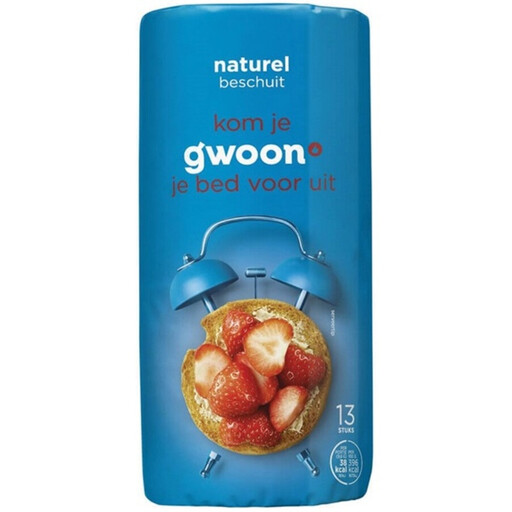 Image unavailable
A plain option for guests who want a light base alongside the wholemeal rusks.
Compare the nutritional values per 100 g on the pack and read the current allergen information before serving.
No. According to the Netherlands Food and Consumer Product Safety Authority, ‘wholemeal’ refers to the grain ingredient; a dark colour doesn’t prove that a product is wholemeal. Look for the wholemeal label and read the ingredients list.
No, don’t choose rusks for that purpose. The Netherlands Nutrition Centre does not list rusks as a source of iodine. The fact that iodine may be present through baker’s salt in certain bakery products doesn’t confirm that it’s in a specific rusk.
Read the allergen information on the exact pack. The varieties described include wheat and other cereals containing gluten, egg and sesame, among other things, but the combination varies by product.
Follow the storage instructions on the pack and keep the rusks dry. PLUS recommends storing its plain wholemeal variety in a cool, dry place; Bolletje says to store Dark Wholemeal in its packaging, in a dark, dry place, and to reseal it after opening.